

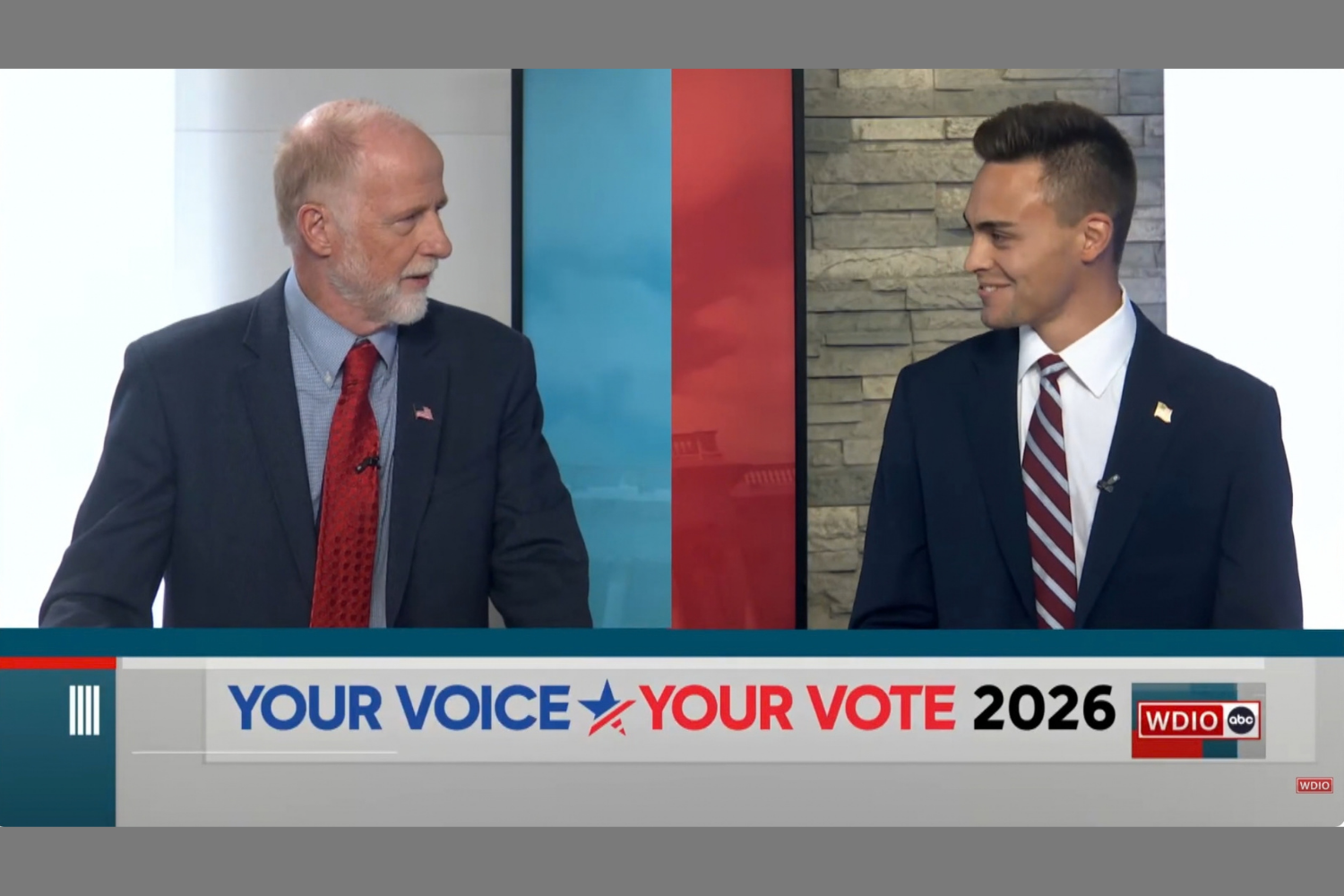
7th CD Dem Fred Clark pitched his candidacy as a chance to place a check on the president, while GOP rival Michael Alfonso defended Donald Trump’s administration.
The Trump presidency hung over last night’s debate hosted by Duluth-based WDIO, with Clark attacking Trump’s tariffs and prosecution of the Iran war while the Trump-endorsed Alfonso reiterated many of the president’s talking points.
That includes in response to a question from moderator Dillon Morello about rising healthcare costs.
Alfonso, the 26-year-old former podcast producer from Hayward, defended the new work requirements and nearly $1 trillion in Medicaid cuts passed by Congress last year, saying the idea that Republicans cut benefits for deserving Americans was “one of the biggest lies being perpetuated by Democrats.”
“We want to help the people that truly need help, but I will not allow anyone to be taken advantage of by this fraud and waste,” Alfonso said.
He also touted the administration’s $50 billion rural health fund, which bankrolls state grants to improve rural healthcare access.
Clark, the 67-year-old former state lawmaker who represented a southcentral Wisconsin district but now lives in Bayfield, said Medicaid cuts would lead to worse health outcomes, shorten people’s lives, and increase the strain on rural healthcare providers.
“It’s astonishing to anyone paying attention to think that cutting a trillion dollars out of the Medicaid budget is just waste and abuse,” he said.
Clark returned to the costly financial impact of tariffs and the Iran war on 7th CD residents throughout the debate, saying he would work to see Congress reclaim its power of the purse and authority to decide when the country goes to war.
Alfonso said tariffs were necessary to create a “fair playing field” for American businesses and defended the war as necessary to stop Iran from gaining a nuclear weapon.
Clark at times pressed Alfonso to answer for presidential actions controversial in the rural, agriculture-heavy 7th CD, asking Alfonso if he would push back on Trump’s staunch support for data centers and how Alfonso felt about Trump’s decision to approve the import of 300,000 metric tons of tariff-free beef from Argentina.
Alfonso deflected on the data center issue, saying the president had said municipalities were not expected to accept data center developments. He did not address the beef question, instead noting that he backed repealing the federal estate tax “that shut down so many small farms.”
The two candidates also split on education issues, with Alfonso backing school choice and dismantling the U.S. Department of Education, while Clark said school vouchers would draw more money away from public schools and saying the federal agency could funnel more resources to rural school districts.
Alfonso then asked Clark for his position on the New Richmond School District’s policy of allowing students to use restrooms corresponding with their gender identity.
The Education Department has launched a Title IX investigation into the school for “allowing biological males to use female restrooms” after uproar from groups like the far-right Moms for Liberty.
“I don’t think the federal government should be in the business of deciding who uses what bathrooms,” Clark said.
Alfonso throughout the debate prescribed cutting red tape to address the region’s economic issues, saying it would encourage housing development and boost local businesses, while Clark called for targeted federal investment and using antitrust laws to rein in corporate power.
Alfonso sought to paint Clark as too liberal for the district, charging that his Dem contender wanted to stop Enbridge’s Line 5 pipeline and opposed delisting the gray wolf; Clark denied both charges.
Clark, in turn, took swipes at Alfonso for skipping out on grassroots debates during the GOP primary and a healthcare forum earlier this week and for accepting campaign cash from the transportation lobby. Alfonso’s father-in-law is U.S. Transportation Secretary Sean Duffy, the former 7th CD congressman.