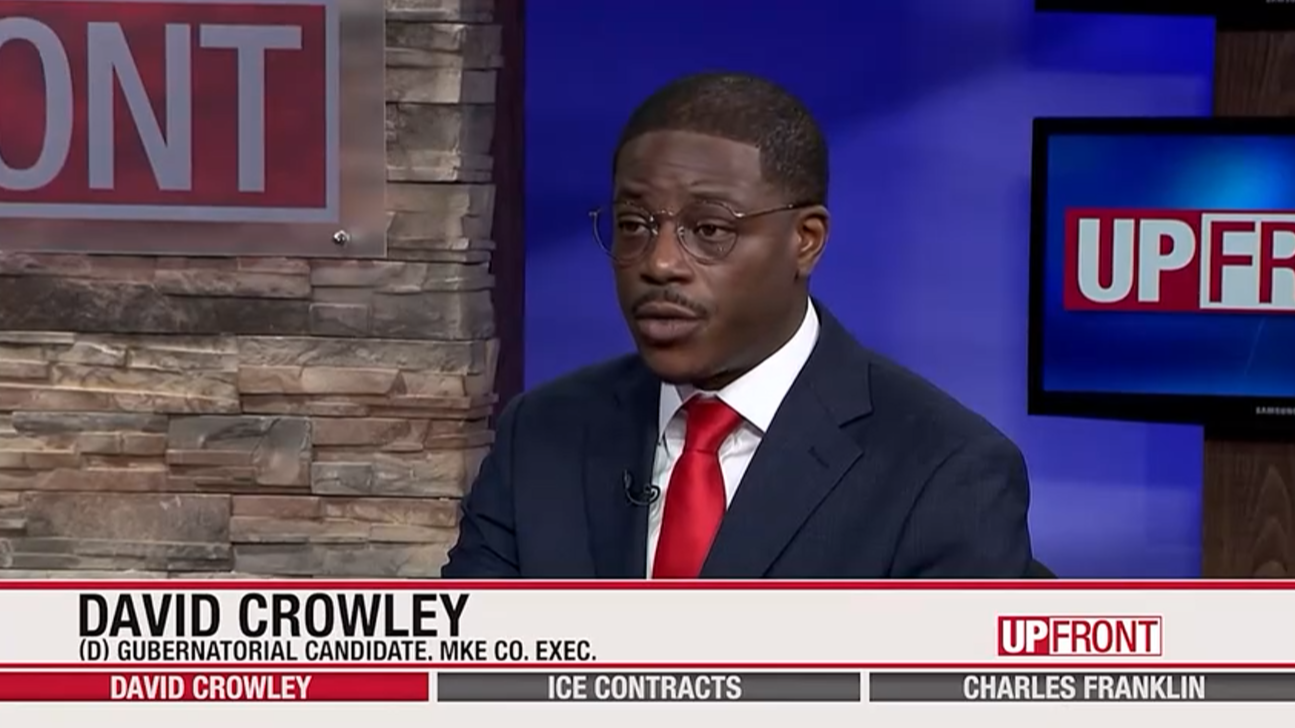
Milwaukee County Executive David Crowley, a Democratic candidate for governor, says he doesn’t see “any scenario where we would want to partner with ICE” as more Wisconsin counties are set to enter new partnerships with immigration officials.

“The expectations for our local law enforcement should be to focus on protecting local communities that they were employed to do,” Crowley said on WISN 12’s “UpFront,” which is produced in partnership with WisPolitics-State Affairs. “We didn’t bring these local law enforcement officers to become federal agents.”

Since 2018, the Milwaukee County Sheriff’s Office has followed a policy where it will not honor ICE detainers or assist federal immigration officials in the Milwaukee County Jail.

“No,” Crowley said when asked if he would like to see that changed. “I think that the sheriff’s office have been operating under their policy for many, many years.”

Border czar Tom Homan has recently praised new partnerships with counties in Minnesota, citing them as a reason for a reduction in federal troops.

“I think anyone who has stood up to President Trump, and particularly the way that he has employed his ICE officials to go into different communities, is going to put a target on your back,” Crowley said. “But it is our job to make sure that we’re protecting the public, making sure that we’re putting safeguards in place to protect our most vulnerable populations, and making sure that our local law enforcement officers are there to help our neighbors when they need it most.”

Crowley also pushed back at criticism for Milwaukee County failing to renew its health care contract for thousands of employees and retirees. The county board raced to approve a five-year extension late last week, and Crowley fired the county’s benefits director following the fallout.

Lt. Gov. Sara Rodriguez said, “There’s been a breakdown in leadership.”

Crowley responded: “Look, I think that it is easy for anyone to say what they would or would not do when they’ve never had the responsibility of actually governing. Lt. Gov. Rodriguez, just like any other candidate, they’ve never held the responsibility of governing or been accountable with having to actually implement policies.”

“I’m ready to run the state of Wisconsin,” Crowley added. “I can look Wisconsin voters in the face and say, look, this is exactly what legislative leadership and executive leadership looks like. When we see the problem, we fix the problem. We addressed it in a transparent way in public, and we made sure to resolve it and put those safeguards in place, and that’s exactly how we’d govern.”

Pollster Charles Franklin says there’s a big political divide when it comes to views on immigration, ICE and deportations revealed in a new Marquette University Law School national survey.

“Eighty percent of Republicans approve of the job ICE is doing; only 5% of Democrats do,” Franklin told “UpFront.” “But I think it’s fairly important that only 23% of independents approve of the job ICE is doing. We are looking ahead to the midterms, and neither party has a majority just from their base. Either party, to win in the midterms, needs to win a significant share of the independent vote, and on immigration issues, independents are fairly negative.”

Franklin said immigration-related issues are “fairly high” but not the highest for voters ahead of the midterms.

“Inflation remains easily the most important issue, followed by the economy,” Franklin said. “Immigration comes in third place with about 14% saying it’s the most important issue for them. We don’t distinguish between that, whether that 14% thinks immigration should be enforced more strongly or whether they’re pushing back against the way it’s enforced, but just the issue itself, that’s down considerably from where it was in 2024.”

Kurt Bauer, president and CEO of Wisconsin Manufacturers and Commerce, says the group’s new report is a “warning” to state lawmakers and the gubernatorial candidates ahead of the midterms.

“Wisconsinites are competitive,” Bauer told “UpFront.” “We expect to be leaders, not only in our sports teams, but on economic measures, and while we typically have been, we’re falling behind. And this is kind of a warning that we need to work together, the business community, public policymakers, to make sure that we’re competitive.”

The Wisconsin Competitiveness Report says the state “faces a shrinking population, a labor market that’s failing to grow, burdensome regulations, lagging educational performance, soaring health care costs, and a tax climate that weighs heavily on families and employers alike.

“This is no surprise, particularly on the workforce side of things, that they have been struggling to find workers for quite some time,” Bauer said. “That’s been evident in our economic studies.”

Bauer said health care costs and taxes are the most pressing issues lawmakers should address.

“The whole point of this is to make this a conversation piece in the midterm elections,” Bauer said. “We want the gubernatorial candidates talking about it. We want the legislative candidates talking about it. We want our members to read this.”

The report proposes a number of solutions, including growing the workforce, affordability, new manufacturing, reforming education and fixing health care.

“I would start on the health care side of things with transparency for pricing,” Bauer said. “Right now we’ve got a bill in the Legislature that they’re taking a look at that would have price transparency so that we can be consumers, we can make decisions based on the cost of services at hospitals right now.”

See more from the show.