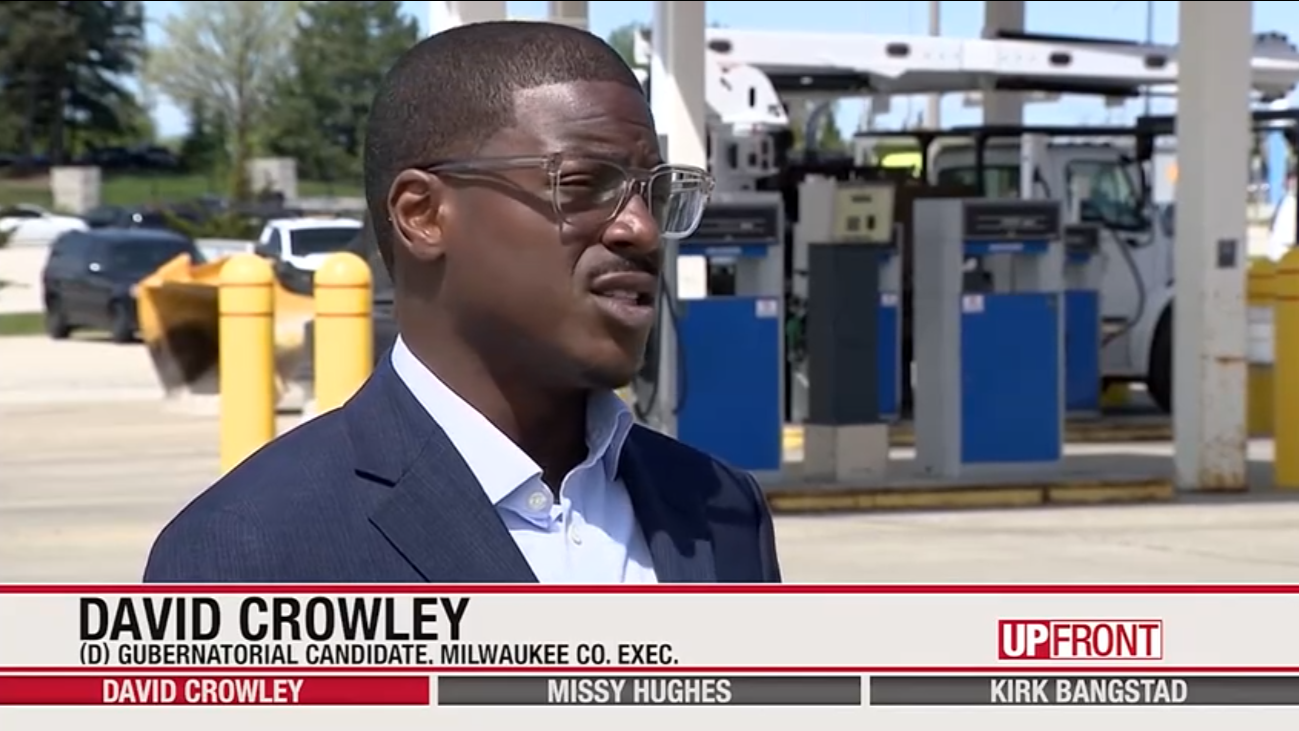
Milwaukee County Executive David Crowley, a Dem candidate for governor, says the county could face a $1 million deficit because of the rising fuel prices, blaming President Donald Trump and the Iran war.

“We have to take a look at our non-essential services and how we’re going to have to cut back,” Crowley told WISN 12’s “UpFront,” produced in partnership with WisPolitics. “No one budgeted for a 30% rise in gas prices, right? And this is because of a particular decision that was made. We know that gas prices will rise and they will fluctuate, and yes, we are prepared to do what needs to be done, but it’s hard to prepare for a 30% increase based off a war that this president decided to go into.”

Crowley dismissed the idea of a gas tax holiday, which has been proposed by fellow Dem candidate Joel Brennan.

“I’m not sure what exactly that would do for us to move forward,” Crowley said. “You know that’s the only dollars that help to actually rebuild our infrastructure here locally.”

Crowley polled at 3% in the most recent Marquette University Law School poll on the Dem primary field.

“I think a lot of people have been, quite frankly, exhausted by politics,” Crowley said. “There’s a lot of frustrations right now, not just frustrated with Republicans, folks are frustrated with Democrats, and especially what is happening at the federal level. I think politics has really been in people’s face right now, but there are a lot of folks who are paying attention.”

Also on the program, Dem gubernatorial candidate Missy Hughes says she would work with the Legislature to ban local sheriffs from assisting with new ICE detainers in county jails.

“We’re seeing some sheriffs around the state holding immigrants in their facilities for longer than we allow under Wisconsin law in order to assist ICE. And so I would bring those sheriffs and bring all the sheriffs in and say ‘How are we going to do this together?’ because I think it’s really important that law enforcement continues to have strong relationships in their communities,” Hughes told “UpFront.”

Last week, Hughes released a plan centered around “standing up” to Trump.

“I worked a lot with the federal government as secretary of WEDC, working to make sure that resources are coming to Wisconsinites, and that conversation has to continue,” Hughes said. “But what I’m hearing from Wisconsinites is that they are so frustrated with the corruption that they’re seeing with the threats to our democracy, to free and fair elections, that we need to take proactive steps to stand up to him.”

Hughes, who polled at 1% in the most recent Marquette poll, said she has no intention to drop out before the August primary. She said “undecided” was the “leading candidate” in that survey.

“I’m committed to this,” she said. “As we were saying, I’ve run marathons. This is a marathon, and I strongly believe in Wisconsin’s ability to choose the right governor, and I want to make sure that they have me as one of those choices.”

New Dem gubernatorial candidate Kirk Bangstad, who’s been condemned by the party and fellow candidates for a Facebook post about the attempted assassination of the president, says he’ll win the primary if he’s barred from speaking at the state Dem convention.

“I’d speak anyways. I’d speak outside the front door,” Bangstad told “UpFront” about the June 13-14 convention. “And if they try to not let me speak, they’re going to put me in office. Let’s be honest, if they restrict my speech as a fellow Democrat, they are going to do so much harm to their appearance, and they’re going to do so much harm to the other candidates. I will win the primary if they don’t let me speak. I guarantee you that.”

After the White House correspondents’ dinner shooting, where a man is now charged with attempting to assassinate Trump, Bangstad wrote on Facebook, “Either a brother or sister in the resistance needs to work on their marksmanship.”

Bangstad, who owns Minocqua Brewing Co., explained: “Now remember, there was another half of that post that said, ‘Or Donald Trump is trying to fake an assassination attempt to get a better news cycle.’ You’ve got to read the whole thing, don’t you?

“The first part was satire that was trying to set off the second part,” Bangstad added, after he was interviewed by the FBI last week.

Bangstad said he thought the assassination attempt was staged.

Bangstad, who entered the race last week, wouldn’t reveal how much he raised in his first week.

“I’ve raised a ton of money so far, but we’re three days into this thing,” Bangstad said. “I’ve got oodles of money in Facebook followers and Substack, or the equivalent of that in my being able to reach people and give them my message.”

in another segment, Ryan VanGrack, the vice president of legal and head of litigation for Coinbase, says the U.S. Supreme Court will likely decide the ongoing feuds between states like Wisconsin and prediction markets.

“Ultimately, they’re suing based on a fundamental misunderstanding,” VanGrack told “UpFront.” “They are presenting these issues as being whether these markets are regulated by a state regulator or no regulator, but that actually has it backwards. These are already being regulated by a federal regulator. The key question is, should these markets be overseen by a federal national regulator, or should they be overseen by a patchwork of state-by-state rules and regulations?”

Attorney General Josh Kaul recently sued prediction markets like Coinbase and Kalshi, accusing the platforms of “flouting Wisconsin law” and facilitating illegal sports betting in the state.

“He’s wrong because Congress already answered this question long ago when it assigned authority in this space to the Commodity Futures Trading Commission, a federal regulator,” VanGrack said. “And we continue to advance that point because we believe customers are best protected when you have clear and uniform rules regardless of where you live.”

Meanwhile, Kaul says he’s “certainly aware” of the position of Wisconsin’s tribes when asked if he was pressured to sue prediction markets after Gov. Tony Evers legalized online sports betting through the tribes.

“We received a letter at one point, and there’s a suit going on involving Ho-Chunk Nation, I believe, but we make our decisions in cases like this based on the facts and the law,” Kaul said. “That’s what we did here, and this case will move forward in the courts, and ultimately that’s where the resolution will be.”

He also said there was nothing unusual about the timing of the lawsuit he filed.

“I think it’s not an accident that when there has been this proliferation of online, what we allege is online sports betting, that has led to both legal action and also to debate in the Legislature,” Kaul added. “But I think that’s why you’re seeing both of these unfolding around the same time.”

The Commodity Futures Trading Commission is now suing the state after Wisconsin’s initial lawsuit. The CFTC argues the federal government has sole authority over prediction markets.

“Frankly, it’s a pretty novel theory of the law,” Kaul said. “It’s really interesting to note what’s been going on here. So states have been regulating gambling throughout the history of our country, and the position that some of these companies are taking, and now the federal government is taking too, is that this federal agency can come in and basically override state’s gambling laws, even though the law they’re saying that’s based on, which passed in response to the Great Recession, was designed to address the things that caused the Great Recession. Somehow, they want people to believe that there was no debate at the time over this massive change in what the federal government’s authority is. We’re arguing that that’s not correct.”

See more from the show.