

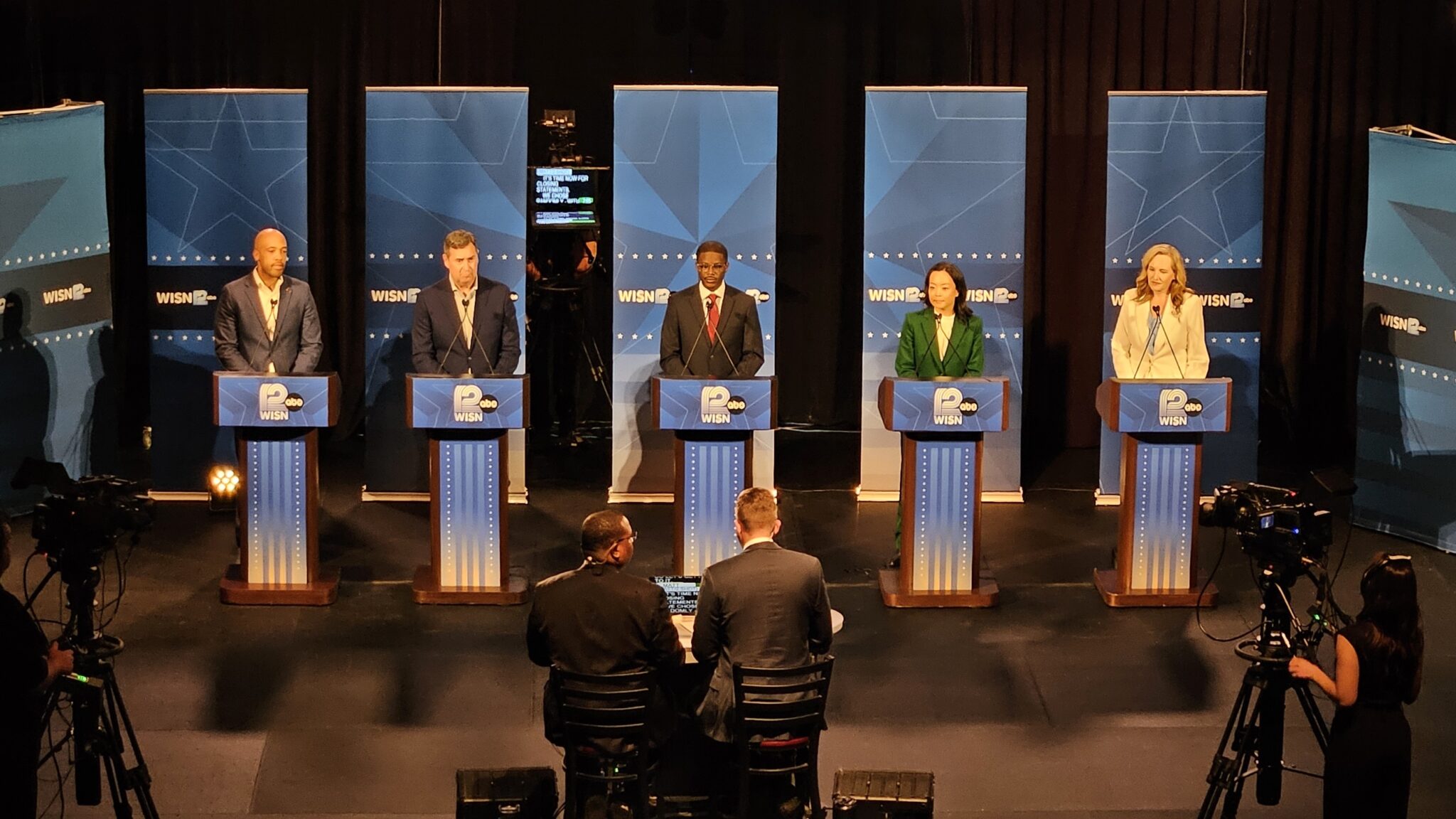
The five Democratic candidates for governor tonight vowed they wouldn’t sign a state budget that cut money to law enforcement, even as state Rep. Francesca Hong and former Lt. Gov. Mandela Barnes explained past comments critical of the police.
Following a police shooting of a Black man in Madison, Hong called it an “execution.” The Madison lawmaker said during the debate she likely wouldn’t make such a comment before an investigation was completed if elected because the governor “has the largest microphone in the state.”
Asked about her past comments calling to defund the police, Hong said she wouldn’t cut money for law enforcement and would instead seek to also invest in programs that prevent crime. That includes investing in education, preventing opioid addiction
“The governor cannot defund police, and I am not here to govern by slogan,” Hong said. “I am here to make sure I am the governor that’s most serious about public safety.”
Barnes was knocked during his failed 2022 bid for the U.S. Senate over his comments on reducing funding to law enforcement and abolishing ICE. He didn’t address the question about his past comments during the debate, instead saying the images of a police officer shooting Corey Ruiz were disturbing. Madison Police don’t use body cameras, and Barnes argued those should be the norm for departments across the state.
“I wouldn’t sign a budget that would reduce funding because that police department needs the funding to buy body cameras,” Barnes said.
The only televised debate in the race was hosted by WISN-TV in conjunction with WisPolitics. It came two weeks before the Aug. 11 primary, which will determine which Dem will face expected GOP nominee Tom Tiffany, a congressman from Minocqua.
Though Hong has regularly led in polling, none of her rivals criticized the democratic socialist or her proposals. The only swipe any of the candidates took at a rival came when Barnes referenced Milwaukee County Executive David Crowley dropping out of the race and then getting back in.
“It’s been mentioned that the county executive had his campaign resurrected by special interests in a dark room with people with their thumb on the scale,” Barnes said. “This means things will always be the same with that sort of leadership. We should be asking for more. We should be demanding more.”
Crowley didn’t respond to the remark. But after the debate, he quipped to reporters, “If I was handpicked, it could have happened a long time ago, right?”
Moderators Matt Smith and Gerron Jordan, co-hosts of WISN-TV’s “UpFront,” opened the debate by asking each candidate to defend their credentials.
Crowley left the race July 8 and got back into the campaign July 18 with the endorsement of Gov. Tony Evers. But he insisted he wasn’t a tool of the establishment while touting the endorsements of the governor, organized labor and other leaders.
“I was never born into the establishment; I was born into the struggle,” Crowley said.
Hong, who has been leading public and private polling, said she doesn’t support the national Democratic Socialists of America platform that calls for things like abolishing the presidency and the Supreme Court. Hong has said she aspires to a world without prisons, which is part of the national party’s platform. But Hong said she’s not a member of the national organization and isn’t supported by the party.
“The policies that we have been working on, permanent affordability, has broad bipartisan support in every corner of the state,” Hong said.
Barnes defended his 2022 loss to GOP U.S. Sen. Ron Johnson, of Oshkosh, saying he saw $50 million spent against him while national Dems didn’t see the race as winnable. He said that race taught him the impact of big money, adding he currently has the resources and support “to get it done.”
“I have zero interest in upholding the status quo. I have zero interest in being the establishment candidate,” Barnes said.
Former DOA Secretary Joel Brennan and state Sen. Kelda Roys, of Madison, defended their electability as polling has found them regularly in the single digits.
Brennan said his challenge has been that people don’t know him well. But the “upheaval” in the race has sparked interest. Along with Crowley dropping out and then getting back in, Lt. Gov. Sara Rodriguez earlier this month ended her campaign after announcing her campaign manager had failed to properly report contributions and expenses.
“Day by day, I am feeling that momentum, and I’m feeling people who want somebody who can beat Tom Tiffany in the fall and who can hit the ground running on day one,” Brennan said.
Roys argued she has more experience than any of her rivals, citing her 10 years in the state Legislature as well as work in the nonprofit and private sectors. Roys said she’s the candidate who’s turned progressive ideas into law.
“That kind of experience is absolutely essential, and voters need to think about not just who can beat Tom Tiffany, although that is important, not just who can deliver a Democratic Legislature, although that is vitally important, but who can actually do the job on day one,” Roys said.
The five candidates offered a few differences on policy.
Crowley, for example, was the only candidate who raised his hand when the moderators asked the five if they would’ve signed a $1.8 billion surplus package that Evers negotiated with GOP legislative leaders. It failed with three Senate Republicans and all 15 Dems in the chamber — including Roys — voted against it. Hong also opposed the bill when the Assembly voted on it.
All five said they would seek to add an additional tax bracket for those making more than $1 million. The state’s top income tax rate is 7.65%, which kicks in for income above $431,000 for married joint filers.
Barnes said he’d add about 0.8% to 0.9% to that rate for the new bracket, though the final figure would be negotiated. Hong said she’d add a percentage point to the top rate, though she proposed legislation that would impose a top income tax rate of more than 17% on married couples with income above $1 million with the revenue generated going to schools.
The others didn’t commit to a figure.
Crowley and Brennan said they wouldn’t seek to phase out or eliminate the state’s school choice program, though they also wouldn’t allow an expansion of vouchers. The others favored steps to reduce vouchers or eliminate the program, arguing state tax dollars should remain in public schools.
Following the debate, Tiffany said it’s become increasingly clear Hong will be the nominee, adding she supports abolishing the police, prisons and the U.S. Senate.
“While Democrats offer chaos, I’m offering common sense: lower taxes, safer communities, stronger schools, and a government that lets the people of Wisconsin keep more of their hard-earned money,” Tiffany said.