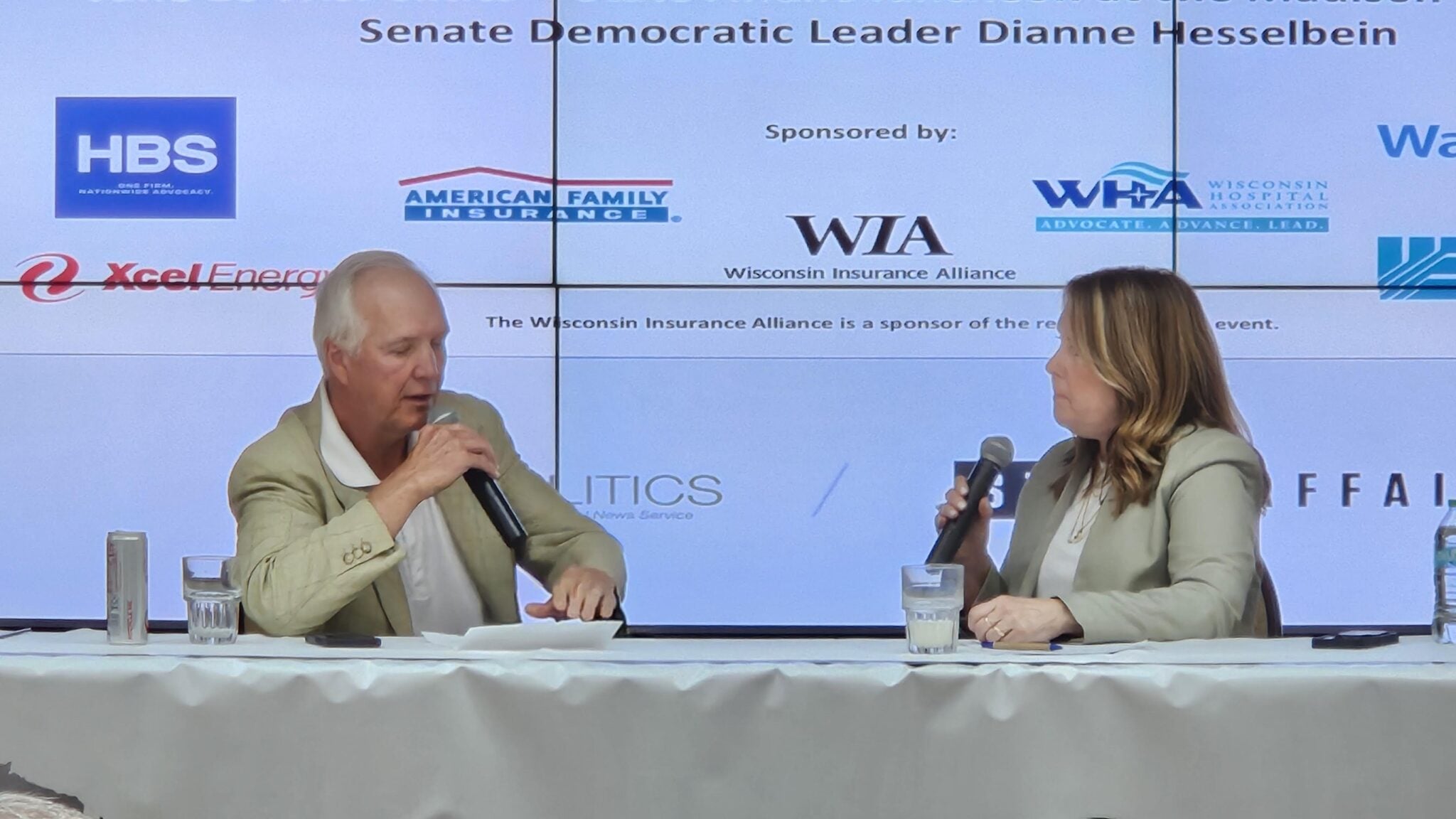
Senate Minority Leader Dianne Hesselbein said Democrats will take up legislation to restore the Knowles-Nelson stewardship program and increase school funding if they return with a trifecta next year. 

Free school meals, a right of first refusal bill for new transmission construction and new data center regulations could also be on the table, the Middleton Democrat told attendees at a WisPolitics-State Affairs luncheon Tuesday.

She was also unconcerned about the seven-way Dem primary for the governor’s office, saying that primaries were a good thing and that Republicans would have been better served with a primary than Republicans “putting their thumb on the scale” with Donald Trump’s endorsement of U.S. Rep. Tom Tiffany, R-Minocqua. 

Increasing distaste for the president favored Democrats as well, she noted.

“I think there are a lot of people in the state of Wisconsin that want something normal in the state of Wisconsin and are just sick of what’s happening at the national level,” Hesselbein said. 

Hesselbein expressed confidence Democrats could retake control after the “stranglehold” GOP Assembly Speaker Robin Vos has held on the state for years. 

If they succeed, Hesselbein said Democrats would pass legislation to restore funding for Knowles-Nelson to “at least where it was, probably a little bit bigger.”

Lawmakers introduced several bills last session to continue the stewardship program but were unable to reach a compromise. Funding for the program will lapse on June 30. 

She said Dem lawmakers were also “very excited about” passing funding for free school meals, but said she was “not sure we’re going to be able to get all the way” to universal free meals, citing the high cost incurred by Minnesota when it implemented its program. 

Education funding is one of the predominant issues Dems are hearing about in campaign season, Hesselbein said. 

She said a Dem majority would pass a budget that would eliminate school districts’ dependence on referenda to address budget gaps. She also said Dems are taking a close look at the state’s K-12 funding formula and are considering having a study committee look into changing it. She said Dems could take up legislation giving in-state utilities the right of first refusal on building contracts for new high-voltage transmission lines after such legislation failed to progress last session.

“We absolutely should have gotten ROFR done,” Hesselbein said. “It was going to let Wisconsin companies do the work. It was good for Wisconsin jobs. It was good for Wisconsin unions.” 

Hesselbein said lawmakers would also have to “look into” new data center regulations, saying it was important for local municipalities to have a say in the facilities’ development while noting that data centers and their water and cooling needs were changing in real time. 

On the failed $1.8 billion surplus funding deal, Hesselbein told attendees that she had pitched Republicans on passing just the special education funding portion of the package, to no avail.

Hesselbein has said she’d oppose any package that would leave the state in a structural deficit, like the nearly $3 billion hole the nonpartisan Legislative Fiscal Bureau projected the surplus deal would have created to start the 2027-29 state budget. 

“My door’s always open if there’s a different proposal they want to talk to me about,” she said, though she noted “no one’s contacted me about that.” 

Hesselbein also: 

*said she doesn’t know if she will endorse one of the Democrats on the primary ballot for governor. She said she “really like(s) all seven of them,” noting she had served with several in the Legislature. She was not concerned about candidates being seen as too far to the left.

*said her relationship with Gov. Tony Evers was “absolutely” on good terms after the guv slammed Hesselbein and Senate Democrats for rejecting the surplus deal. Evers suggested to reporters that Hesselbein had the Senate Dem caucus “wrapped around her finger” and was using the promise of appointments next session as a way to hold members in line in opposition to the stimulus bill.

*named legislation expanding postpartum Medicaid and access to breast cancer screenings and Senate Dems’ role negotiating this biennium’s budget as three of the caucus’s most substantial accomplishments.

*included a dig at Act 10, saying she could guarantee a Dem majority would not “put something out there that’s going to bring tens of thousands of protestors to our state Capitol.”  

Watch the luncheon on WisconsinEye.