

By Audrey Lopez-Stane for WisPolitics-State Affairs
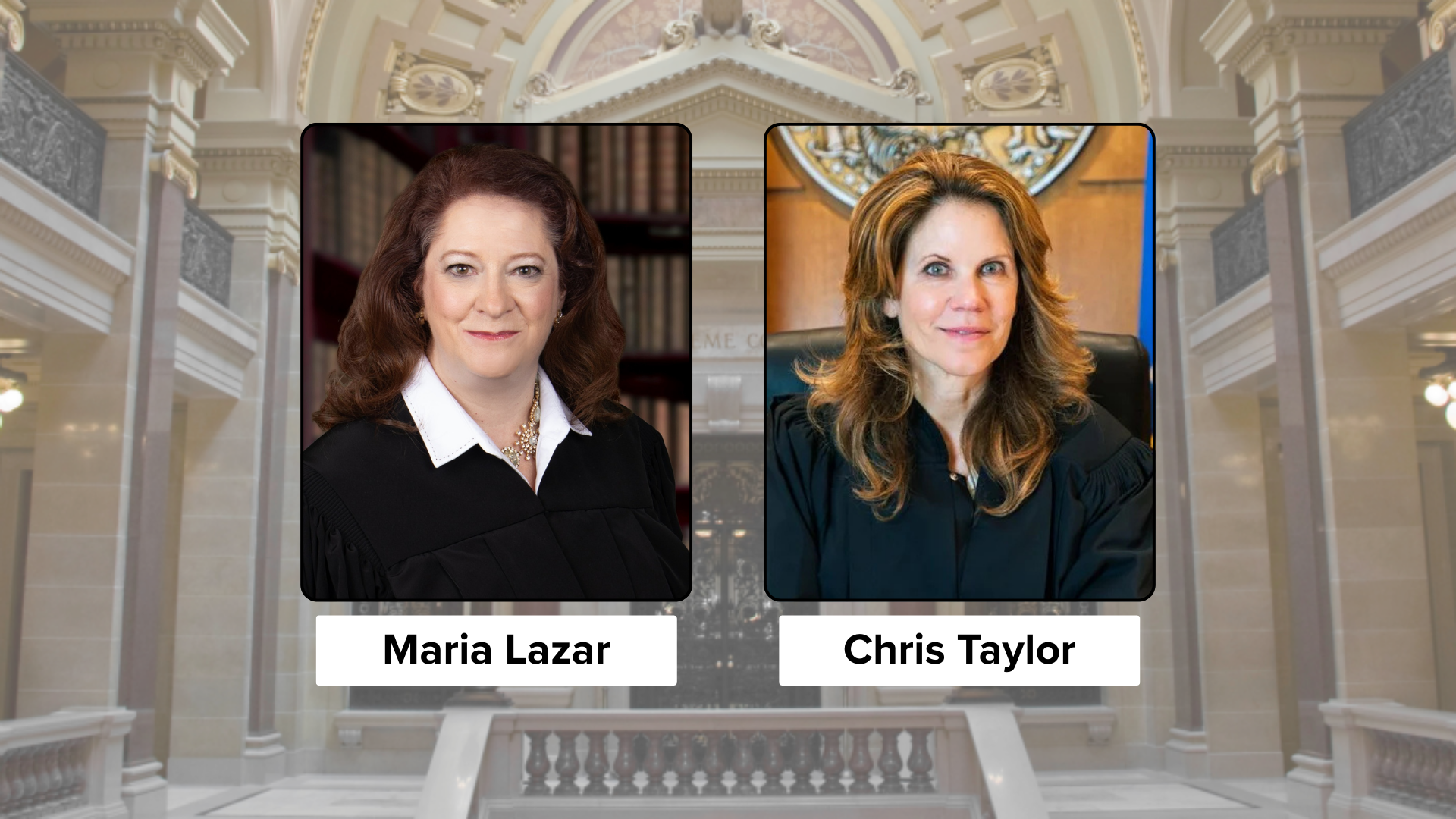
Conservative Supreme Court candidate Maria Lazar has authored twice as many appeals court rulings as liberal rival Chris Taylor.
Since joining the appeals court in 2022, Lazar has also had three rulings overturned by the Supreme Court in cases on the attorney general’s powers, access to voters’ personal information and discipline handed out by the WIAA.
Taylor has seen two of her appeals court rulings appealed to the Supreme Court since her 2023 election. In one, the court upheld the decision for a malpractice lawsuit to continue against a doctor for violating informed consent laws.
>> WisPolitics is now on the State Affairs network. Get custom keyword notifications, bill tracking and all WisPolitics content. Get the app or access via desktop.
Their rulings provide insight into their judicial philosophies as they seek to succeed retiring conservative Justice Rebecca Bradley. They also played a role in the April 2 “UpFront” debate on WISN-TV.
In the one and only debate between the two appeals court judges, Taylor accused her rival of “repeatedly” being overturned and refusing to follow precedent. Lazar countered the reversals were a sign of her judicial independence.
In perhaps Lazar’s most notable overturned ruling, she upheld a 2018 lame duck law that required Dem AG Josh Kaul to get sign off from the GOP-controlled Joint Finance Committee before settling environmental and consumer protection cases as well as lawsuits involving the governor’s office and executive branch. But the high court ruled 7-0 last year that the GOP-authored law violated the separation of powers.
In that case, then-Dane County Judge Susan Crawford first ruled in 2022 that the statute was unconstitutional. Then Lazar reversed the ruling, claiming the Legislature’s Joint Finance Committee has a legitimate interest in these cases.
In the unanimous decision authored by conservative Justice Brian Hagedorn, the Supreme Court ruled “the Legislature has not identified any constitutional role for itself in these two categories of cases” and overturned the appeals court ruling.
Lazar authored a second opinion dealing with Kaul’s powers that is now before the state Supreme Court.
The same 2018 extraordinary session laws that sought oversight of settlements directed the attorney general to deposit all settlement money into the general fund. But Kaul deposited the money into a fund under DOJ control, arguing it met the law as it was written.
Lazar ruled against Kaul, and the Supreme Court recently heard oral arguments in that case.
The Supreme Court also overturned Lazar after she ruled in favor of a high school wrestler who sued the Wisconsin Interscholastic Athletic Association after his state championship title was revoked in 2019 for competing despite a previous unsportsmanlike conduct disqualification.
Hayden Halter cursed at an official during a match and flexed at the opposing crowd after winning, prompting the disqualification. WIAA rules require athletes to serve a suspension at the next event following an ejection.
For Halter, that was the regional tournament, a necessary first step to qualify for the state championship. Halter, a varsity wrestler at Waterford Union High School and previous state champion, tried to sign up for a junior varsity tournament to serve his suspension there.
The WIAA ruled that wasn’t sufficient and tried barring him from the regional tournament. Halter sued and still competed, winning the state championship, but the WIAA revoked his title.
Lazar wrote the decision reversing a circuit court judge who ruled against Hatler’s claim that the WIAA is a state actor and “arbitrarily” applied its rules to disqualify him based on unsportsmanlike conduct.
Hagedorn joined the court’s liberals last year in a 5-2 decision overturning Lazar’s ruling.
Though the Supreme Court didn’t rule whether the WIAA is a state actor, the court decided the WIAA acted reasonably in applying its rules for disqualification.
In the third case, the high court overturned a Lazar ruling that would’ve allowed a conservative activist group to obtain the guardianship records of those deemed incompetent to vote. In that 5-2 ruling, the Supreme Court found the 2nd District Court of Appeals should’ve followed an earlier ruling by the 4th District Court of Appeals that denied the effort to obtain the records.
The Wisconsin Voter Alliance filed multiple requests with local officials for the documents. That includes Walworth and Juneau counties, where circuit courts denied the request.
The Wisconsin Voter Alliance appealed, and the 4th District Court of Appeals affirmed the Walworth County ruling.
It also appealed the Juneau County denial to the 2nd District Court of Appeals, where Lazar wrote the alliance was entitled to the forms under public records laws.
In its ruling, the state Supreme Court found the 2nd District was bound by the earlier ruling and Lazar’s attempts to differentiate the two cases were insufficient.
Taylor highlighted that case in Thursday’s debate, accusing Lazar of failing to follow precedent, saying it shows her opponent “refuses to follow the law.”
Lazar countered that the reversals show she is independent.
“I guess when my opponent has a few more years of judicial experience, she’ll understand that being reversed is a part of being an independent judiciary,” she said.
Taylor touts her record of never being overturned. But court observers note the Supreme Court has had a liberal majority the entire time she’s been on the appeals court.
“I am scrupulous in applying the law, and I have a spine of steel when it comes to making sure people’s rights and freedoms are protected,” Taylor said.
In the 66 cases where Lazar authored the opinion, the appeals court affirmed 12 driving under the influence convictions. It also affirmed 12 extended or ordered involuntary medication or commitment and reversed two.
In the 28 cases where Taylor wrote the opinion, the appeals court affirmed three driving under the influence convictions and reversed one due to a double-jeopardy violation. The appeals court also affirmed three cases ordering involuntary medication or commitment. It reversed two eviction orders and affirmed one.
Taylor’s most high-profile appeals court ruling was a unanimous decision that absentee ballots still count even if voters don’t provide their street number, name and municipality. In that ruling, the court found voters still had to provide enough information for a clerk to reasonably identify where they live. That ruling hasn’t been appealed.
Taylor’s decisions that went to the Supreme Court include a medical malpractice suit filed against a doctor who suggested a woman have her left ovary removed due to severe endometriosis. But Melissa Hubbard did not agree to this and said she wanted to think about the procedure more.
Dr. Carol Neuman referred Hubbard to a surgeon for a related colon procedure. Neuman also met with the surgeon to discuss removing Hubbard’s ovaries in the same surgery, and the procedure was done without her consent.
While Neuman claimed she wasn’t the “treating physician” because she didn’t perform the procedure, Taylor ruled in favor of Hubbard because Neuman planned and recommended the ovary removal. The Supreme Court upheld the decision 5-2 with conservative Justices Rebecca Bradley and Annette Ziegler dissenting.
The Supreme Court hasn’t yet ruled in the second case where Taylor authored the opinion. It involves a minor who applied for an extension of child in need of protection or services beyond her 18th birthday.