

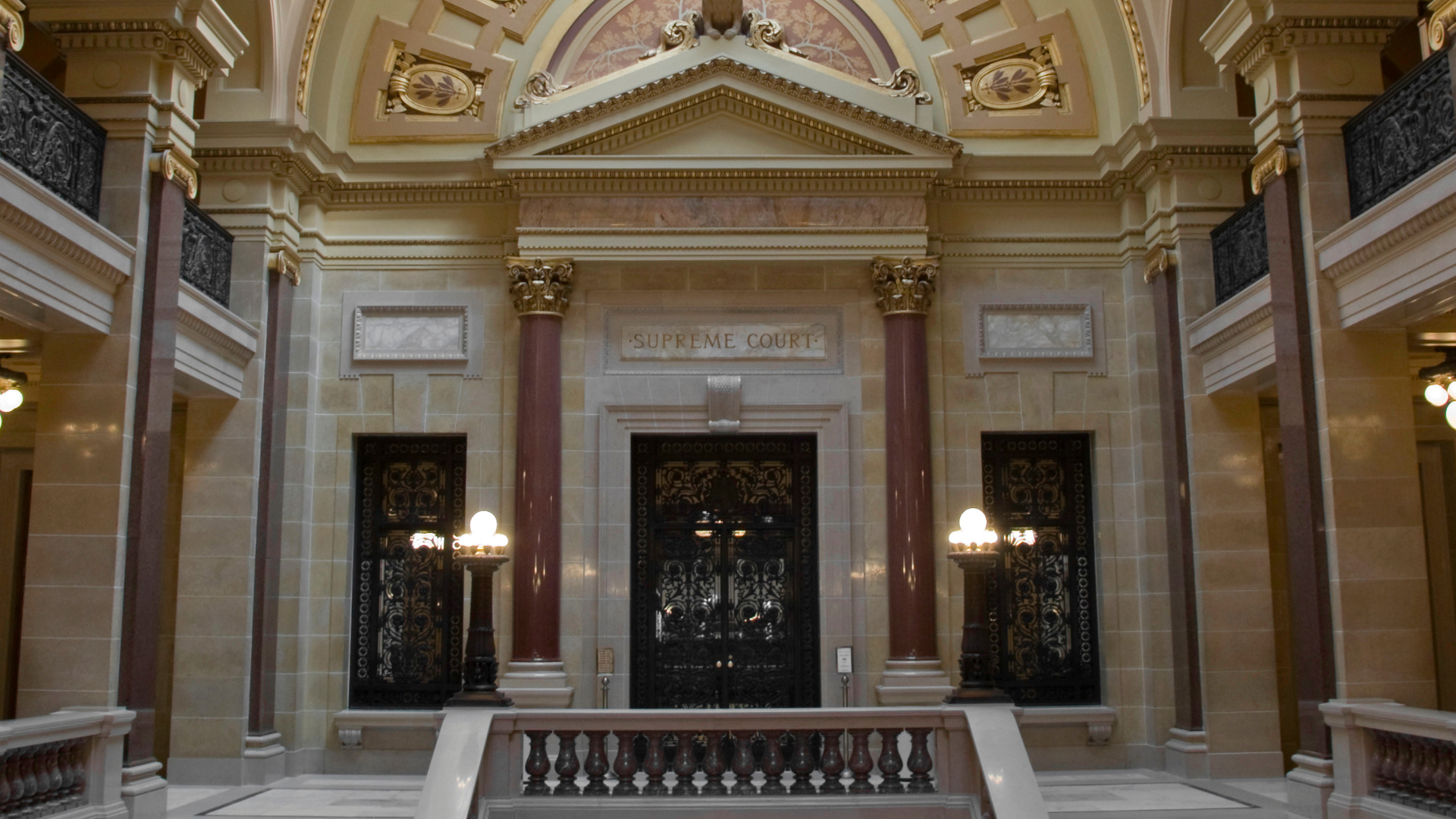
An attorney for Wisconsin’s GOP House members acknowledged some justices on the state Supreme Court want to allow judges to find a map is a partisan gerrymander.
But Misha Tseytlin during Wednesday’s oral arguments argued a case before the justices wasn’t the vehicle to do that because the plaintiffs seeking to overturn the districts failed to provide an adequate standard to decide when mapmakers have gone too far.
Meanwhile, the attorney for those challenging the map urged the justices to plow ahead with the case, arguing Republicans are simply throwing up a series of excuses in the hopes of keeping the lines in place for the rest of this decade.
“They are trying to tie this court’s hands from applying your law to your map,” attorney Abha Khanna argued.
The court on Wednesday heard oral arguments in two challenges to the map, including one that claims the lines amount to an unconstitutional partisan gerrymander. The other argues the map — which has helped produce a 6-2 GOP supermajority — is an anti-competitive gerrymander because the lines are drawn in a way to protect most incumbents from a true challenge.
The court began oral arguments a little after 9 a.m. and was scheduled to start the second case at 10:30 a.m. Instead, the court wrapped up the first case after lunch and was still hearing arguments in the second suit shortly before 5 p.m. Both cases seek new maps in time for the 2028 election.
In both cases, the court appointed three-judge panels to hear the challenges as laid out in a 2011 law written by Republicans. But the panels dismissed both challenges, saying they were bound by a ruling from the former conservative majority on the state Supreme Court. In that case that led to the current maps, the majority ruled partisan gerrymandering claims can’t be heard by Wisconsin courts.
The plaintiffs want that standard reversed and the cases sent back to the three-judge panels to consider the merits of their arguments.
Justices at times pressed attorneys for both sides on what test they should use to determine if a map constituted a gerrymander.
Tseytlin, representing the GOP House members, argued the partisan gerrymandering case wasn’t a suitable vehicle to establish such a standard. The map, approved by the state Supreme Court in 2022, was based on lines Republicans drew in 2011 when they had full control of the state Legislature. The former conservative majority directed the parties to submit maps that took a “least change” approach to those 2011 lines and ultimately selected the map drawn by Dem Gov. Tony Evers.
Testylin said establishing a partisan gerrymander would require discovery on the intent behind the lines that were drawn both in 2011 by Republicans and in 2022 by Evers. Beyond the expense — and time — involved in such an endeavor, there would need to be a standard that would show when a map crossed over from a partisan advantage to an “extreme partisan gerrymander” that was unconstitutional.
If the plaintiffs wanted to accomplish that, they would’ve included detailed standards in their briefs to review maps, but failed to provide them.
“This is just not serious work,” Tseytlin said.
Khanna argued numerous standards are used in other cases at both the state and federal level that could be used to judge a map. No matter what test would be used, the standard would be the same, that the “way the map is drawn stacks the deck in favor of one party or another to an extent that essentially the decision is made before a single ballot has been cast.”
Taylor Meehan, representing GOP legislators, also argued there was no clear standard for the court to use. She also said it wasn’t for the court to find a standard for a partisan gerrymander that goes too far. That should be left to Congress or to voters, who could amend the Wisconsin Constitution to include such a ban.
But liberal Justice Susan Crawford countered the issue has been repeatedly raised in courts and voters don’t think it’s appropriate for legislators to be able to draw a map that locks one party or the other into power.
“Doesn’t it show us there is some underlying problem there?” she said.
Meanwhile, conservative Justice Brian Hagedorn regularly asked attorneys for those seeking to overturn the lines how the courts are supposed to know when a map goes too far. He said it seemed that a map with some partisan advantage is OK, but one that’s “extreme” is not, wondering how that line would be drawn.
“You want to appeal to us, to our personal sense of fairness, and that seems to me like lawlessness,” Hagedorn told Khanna. “You’re asking us to invent a new right that’s never been recognized.”
Khann countered that standard is grounded in the Wisconsin Constitution.
While partisan gerrymandering claims have been raised in Wisconsin in the past, those who filed the anti-competitive challenge have acknowledged it’s a novel concept in the state.
Chief Justice Jill Karofsky said she was struggling with the concept and whether the suit was looking at the entire state or just some districts. She also asked if the court found one district was anti-competitive, would it “poison the whole lot.”
“I’m just not sure how this all works,” she said.
At one point in oral arguments, attorney Doug Poland said the plaintiffs weren’t challenging the 3rd CD on the western side of the state or the 1st CD in southeastern Wisconsin.
GOP U.S. Rep. Derrick Van Orden, R-Prairie du Chien, won reelection in 2024 to the 3rd CD by less than 3 percentage points. In the 1st, U.S. Rep. Bryan Steil, R-Janesville, won by more than 10 points. But in the 2022 gubernatorial election, Evers lost the 1CD by 472 votes out of 302,703 cast as he beat GOP challenger Tim Michels statewide by 3.4 percentage points.