

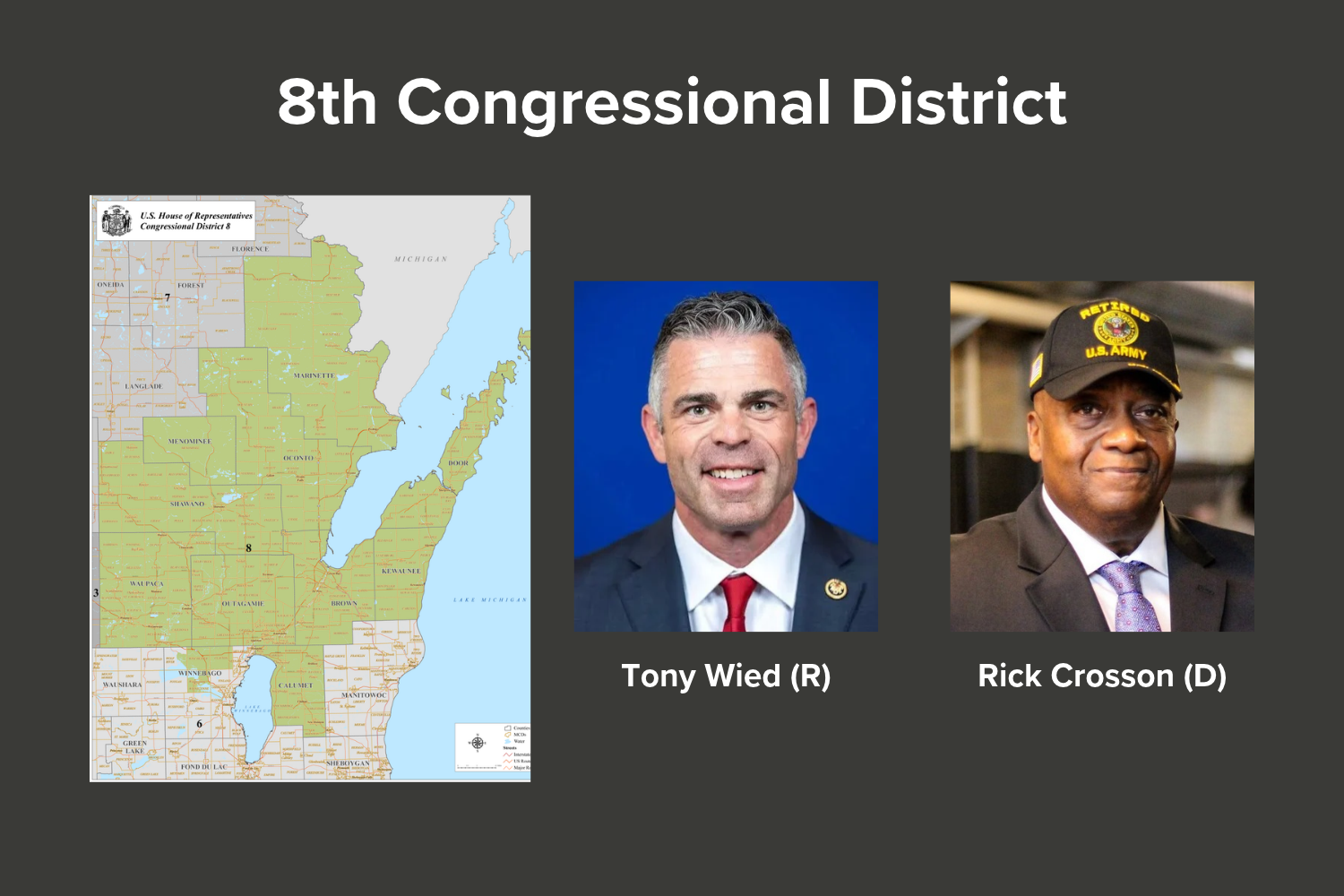
In a televised debate, U.S. Rep. Tony Wied touted the Republican-led Congress’ achievements while Democratic opponent Rick Crosson questioned Wied’s fitness for the job.
Wied, R-De Pere, who is serving his first full House term after being elected in a 2024 special election, highlighted and defended Congressional action – and at times inaction – on issues like healthcare, border security and putting full-fat milk back in school cafeterias.
“Our country faces many challenges, and I am continuing to fight to solve those challenges and those problems for each and every one of you,” Wied said.
Crosson, on the other hand, took Wied to task for failing to place checks on the administration’s trade wars and military action.
“At what point do you assert yourself as a congressman is supposed to assert themselves in this process?” Crosson, an Army veteran, said to Wied. “I don’t see it happening. You’ve had opportunities to do that, which tells me that this role, you’re just not suited to take on this particular challenge.”
That played out early on in Thursday’s WFRV-hosted debate in sparring over the Iran War.
Wied acknowledged the impact of the conflict on fuel prices but defended President Donald Trump’s decision to attack Iran and brought up elevated fuel prices under the Biden administration, which he blamed on the Green New Deal.
“We have policies that caused the prices in the past and now, once we take away this threat, and take away the instability, I think things will improve,” Wied said.
Crosson said Wied and Congress had acquiesced to the president’s “erratic whims” and criticized the incumbent for voting repeatedly against a House resolution to end military action in Iran.
“This is one where you can’t blame Sleepy Joe Biden for this situation,” Crosson said.
Wied dismissed the House resolution as a “symbolic gesture.”
Crosson also took Wied to task for his lack of in-person town halls since taking office.
Wied said he had met with “over 300 groups of people” as a congressman and held multiple tele-town halls.
He also said he did not want to engage with the “left-wing mob” at in-person town halls and invoked an alleged threat made against Wied by a volunteer with the Brown County Democratic Party.
Given the opportunity to question his opponent, Wied asked Crosson why he’d campaigned with “known communist” Francesca Hong and asked if he supported calls to abolish the police, as Hong had in the past.
Crosson said he was not a communist and noted he has a criminal justice degree and had worked as a military liaison providing support to U.S. and Mexican law enforcement.
“Of course I’m for law and order. Who isn’t? But what I don’t want to see happen are people taking advantage of their power and authority and imposing that on our population. That’s not law and order. That’s terrorism,” Crosson said.
In his return question, Crosson pressed Wied on his prolific stock trading portfolio.
Wied has repeatedly bought and sold stocks while serving on committees that oversee those industries; he maintains his investments are managed through an independent financial advisor and he has no role in those decisions.
Wied said the problem lay with “career politicians,” naming Democratic elected officials Joe Biden, Nancy Pelosi and Ilhan Omar, and called for term limits and the passage of a bill he authored that would bar members of Congress from serving as lobbyists for at least 10 years after leaving office.
“The real money comes after your service, when you become a lobbyist, or you get a big job at a war contractor or a federal contractor,” he said.
On healthcare, Crosson criticized cuts to Medicaid and Congress declining to renew Affordable Care Act subsidies and said healthcare “should be an unequivocal human right.”
Wied touted what he called the “transformational” changes to Medicaid in the GOP-authored budget reconciliation bill and claimed credit for a change to Wisconsin’s Medicaid reimbursement formula expected to increase federal healthcare funds by $1 billion per year.
Wied also reiterated his support for the SAVE America Act, which would impose new voting restrictions and expand the executive branch’s control over elections, while Crosson said the new requirements were unnecessary and meant to intimidate voters.
Both candidates indicated their support for greater federal and state regulation of data centers and communities having the freedom to decide whether to host the energy-guzzling facilities.