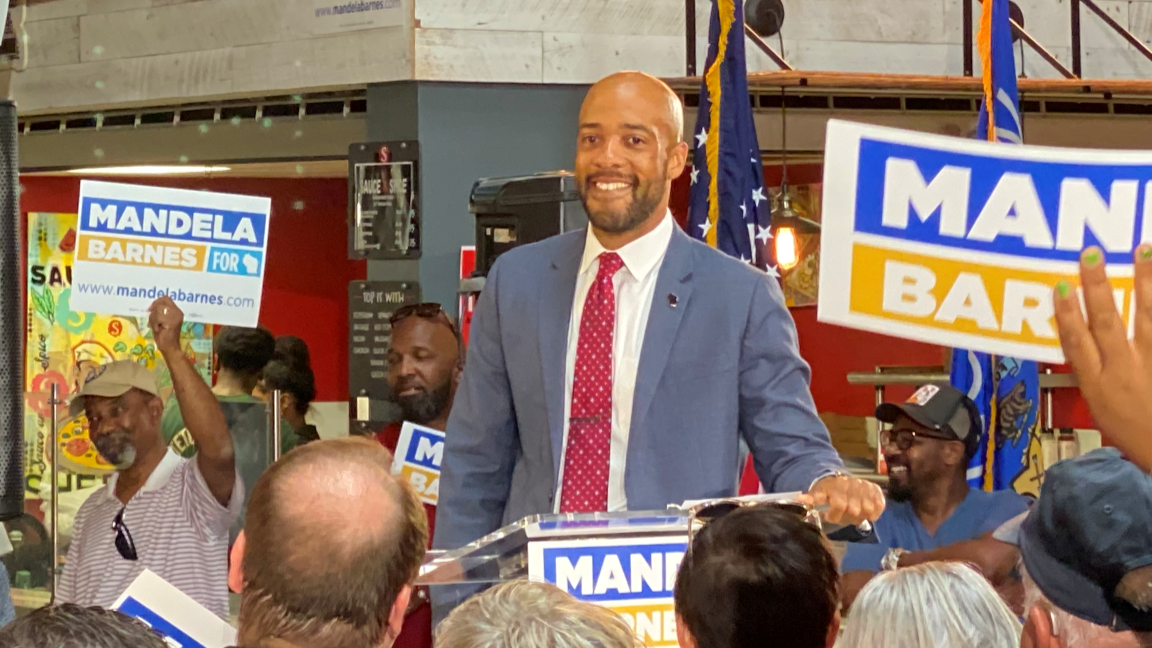
Democratic gubernatorial candidate Mandela Barnes says he’s shooting to raise “closer to $50 million” for his campaign cycle, which would be a significant uptick from his 2022 bid for U.S. Senate.
Barnes didn’t share how much he’s raised since formally announcing his campaign last week, but told reporters at Black Saddle Bicycle Shop in Madison Monday he’d had a “strong haul” that would “make (his) mom proud.”
Despite that, Barnes called his fundraising goal “not a good sign” for Wisconsin and said state officials should be taking more steps to reduce the impact of money in politics.
“The goal is to get big money out of politics. The goal is for campaign and ethics reform,” Barnes said.
>> WisPolitics is now on the State Affairs network. Get custom keyword notifications, bill tracking and all WisPolitics content. Get the app or access via desktop.
The first campaign finance filings in the governor’s race are due Jan. 15.
Three years ago, Barnes raised $42 million in his unsuccessful challenge to U.S. Sen. Ron Johnson, R-Oshkosh.
According to OpenSecrets, that topped the nearly $36 million that Johnson raised for the cycle.
Still, outside groups poured a combined $78 million into efforts backing Johnson, compared to $50 million from those backing Barnes, according to OpenSecrets. Barnes ultimately lost by 26,718 votes, a margin of 1 percentage point.
The fundraising targets for Barnes and GOP guv candidate Tom Tiffany, of Minocqua, suggest another expensive guv’s race in Wisconsin. Tiffany told WisPolitics in May he expected a guv candidate would have to raise $30 million to $40 million to be successful in 2026.
According to the Wisconsin Democracy Campaign, candidates and groups spent $164.8 million on the 2022 guv’s race, topping the $93.1 million spent on the 2018 campaign.
Barnes fielded questions from reporters during his first stop in Madison following his announcement last week. He declined to say whether Dem Gov. Tony Evers should comply with a Trump administration request to provide food stamp recipients’ personal data to the federal government to root out fraud.
The Trump administration has threatened to withhold funding from states that don’t comply, and the demand for the personal information of recipients is currently the subject of a multi-state federal lawsuit.
Barnes said the demand was an attempt to bully state and local leaders, and the state has its own protocols to address fraud.
“It’s not about holding to the law because there are mechanisms in place in state government, and if there were instances where the federal government saw the state government was out of compliance, then we’d handle that,” said Barnes, who served as lieutenant governor under Evers in his first term. “But we’re not there yet because that hasn’t been happening.”
USDA Secretary Brooke Rollins said last week that the administration needs states to provide data like names and immigration status to the department to combat fraud and it would withhold funds from the Democratic-controlled states that have refused to do so.
“We asked for all the states for the first time to turn over their data to the federal government to let the USDA partner with them to root out this fraud, to make sure that those who really need food stamps are getting them, but also to ensure that the American taxpayer is protected,” Rollins said last week.