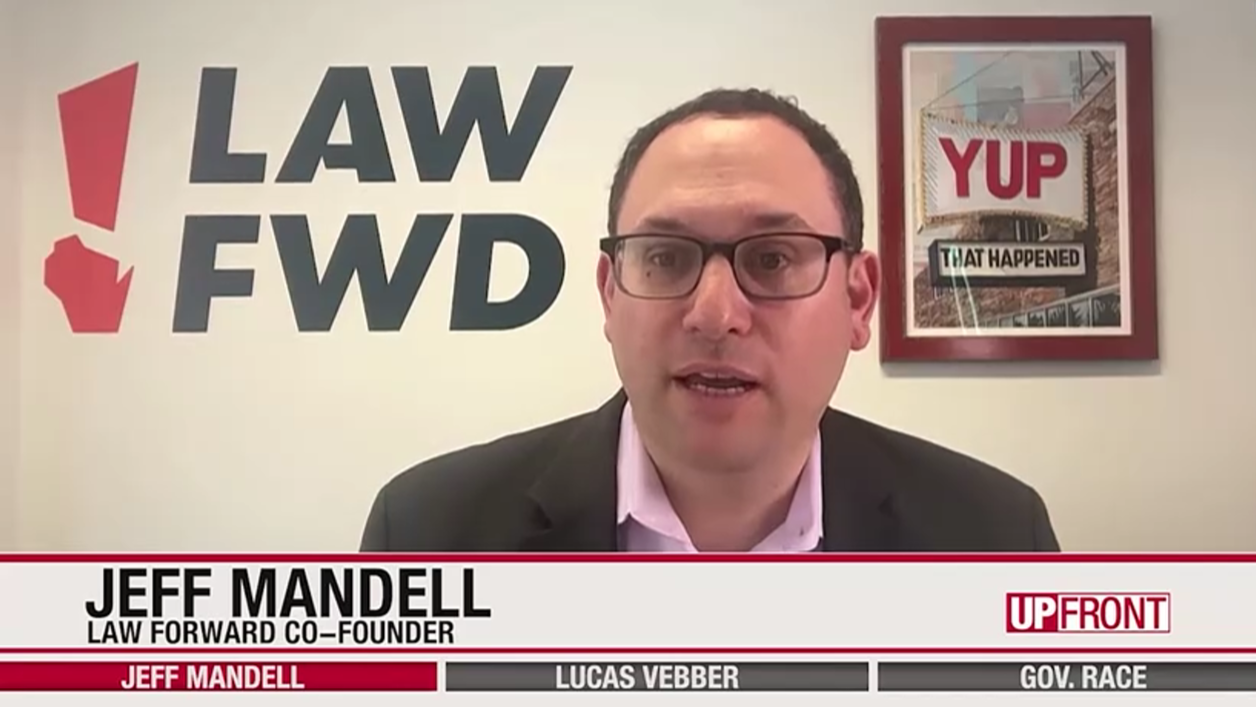
Jeff Mandell, co-founder of Law Forward which is suing to redraw Wisconsin’s congressional maps, says he’s looking to 2028 and not the 2026 midterms for a resolution.
“The ultimate goal is to have fair maps here in Wisconsin,” Mandell said on WISN 12’s “UpFront,” which is produced in partnership with WisPolitics. “We do believe that voters are disenfranchised every time that we go to the polls without those fair maps, but I don’t know that it’s really realistic at this point to have those for the 2026 elections.”
The Wisconsin Supreme Court assigned two separate three-judge panels to hear two separate lawsuits. Scheduling hearings were held Friday.
The case brought by Law Forward on behalf of Wisconsin Business Leaders for Democracy isn’t expected to go to trial until April 2027. A specific trial date for the other case has not been decided.
>> WisPolitics is now on the State Affairs network. Get custom keyword notifications, bill tracking and all WisPolitics content. Get the app or access via desktop.
“It is true that in the past there have been rulings on the congressional maps,” Mandell said. “But no one has considered the anti-competitive gerrymandering case that we are bringing, and we do believe the courts can consider that and that the court can rule.”
Multiple states have undergone districting efforts as Republicans and Democrats push to control Congress after the midterms.
“I think it’s radically different than what we’ve seen across the country from both Democrats and Republicans in an effort to change the maps purely for partisan gain and to game the system,” Mandell said. “That is different from what our lawsuit here in Wisconsin is doing, which is a nonpartisan lawsuit, right, about an anti-competitive gerrymander that has been entered and is just trying to make sure that the Wisconsin constitution and the rights of voters are vindicated.”
— Meanwhile, Lucas Vebber, deputy counsel for the conservative Wisconsin Institute for Law and Liberty, has asked to intervene in the cases. He says Mandell’s argument is moot.
“I think they’re trying to frame it as a new argument,” Vebber told “UpFront.” “But I think what they’ve done is essentially just repackage a partisan gerrymander argument, which has been explicitly rejected by our Supreme Court and the United States Supreme Court.
“The maps in Wisconsin were adopted by the Wisconsin Supreme Court,” Vebber added. “Those are maps that were drawn by Gov. Tony Evers. The maps are what they are, and elections matter. Candidates matter. Issues matter. I think what these cases, that are being brought, seek to do is assign every person in Wisconsin either one political party or the other and assume that they’re always going to vote that way going forward in perpetuity. We know that’s simply not how it is.”
Vebber agreed Wisconsin’s cases are different from redistricting efforts sweeping other states, both controlled by Democrats and Republicans.
“In the other states that are doing this, whether you like it or not, those are legislatively-driven efforts,” Vebber said. “Elected officials in the state legislatures are choosing to do what they want to do. That’s what the U.S. Constitution says. Here in Wisconsin, they’re just going to the courts. They’re trying to evade the Legislature. In one of the cases, they’re actually opposing the legislature’s intervention in the lawsuit. So it’s an entirely different situation.”
— Joel Brennan, the latest candidate in the Democratic primary for governor and former Department of Administration secretary, says he would sign legislation repealing Scott Walker’s Act 10.
“We decided to put a target on the backs of public employees and on teachers, and I think now we’re having challenges in finding people to fill some of those roles that now have for the better part of 10 years, some real challenges that they’ve had to do in retaining and attracting people in those jobs,” Brennan told “UpFront.” “Yes, I would do that. But I also think that as we do that, we need to look at the relationship between state government and local governments.”
When asked whether a repeal would result in higher property taxes and more school referendums, Brennan said, “Well, I think it all depends on how you end up doing this. You can’t just settle all the responsibility of what’s happening at the local level. There needs to be this level of partnership.”
Brennan called his eventual tax plan “an opportunity to look at everything” when asked whether he’d propose raising taxes on wealthy Wisconsinites and corporations, like other Democratic candidates have suggested.
“I’d like to make sure that we continue to do what we’ve done under the Evers administration, is to find ways to lower the tax burden for middle-class families,” Brennan said. “And I think that’s been one of the hallmarks of what Tony Evers has been able to do. I think one of the things we have to do is find rational, reasonable ways to raise revenue in the state, but also direct that revenue and invest in things that we consider to be our Wisconsin values.”
Brennan said his campaign is one that will “stand up to the cruelty, the challenges that Donald Trump provides, and what I think is chaos at the federal level.”
“But I think every campaign is a campaign about Wisconsin,” Brennan added. “Is it about Donald Trump? Yes. Is it about standing up for Wisconsin? Absolutely.”
— Opening statements begin this morning in the trial of Milwaukee County Judge Hannah Dugan, accused of helping an undocumented immigrant evade ICE agents after appearing in her courtroom.
“The government has to prove beyond a reasonable doubt that what she did obstructed,” retired U.S. District Judge Nancy Gertner, who helped lead an effort among retired judges nationwide condemning the arrest when it happened, told “UpFront.” “And they have to prove her state of mind.”
Interim U.S. Attorney Brad Schimel recently said federal prosecutors had offered Dugan a plea deal, which she didn’t accept.
“I’m not remotely surprised,” Gertner said. “I mean, the issue at stake here, candidly, it’s nothing more than sort of the independence of the judiciary and conceding that she ran her courtroom in a way that the federal government doesn’t like is inconsistent with the independence of the judiciary, so I’m not surprised.”
FBI Director Kash Patel touted the arrest in a social media post shortly after plus Attorney General Pam Bondi and President Trump weighed in — all comments that will not be allowed at trial.
“It’s not a surprising decision,” Gertner said. “And it’s not a big loss, except it shows to some degree, shows a bad faith of the prosecution that they did a perp walk with a sitting state judge, which is astonishing and troubling. So on one hand, admitting this evidence shows their animus was more than just prosecuting Judge Dugan; their animus was to make an example of her.”
See more from the show.