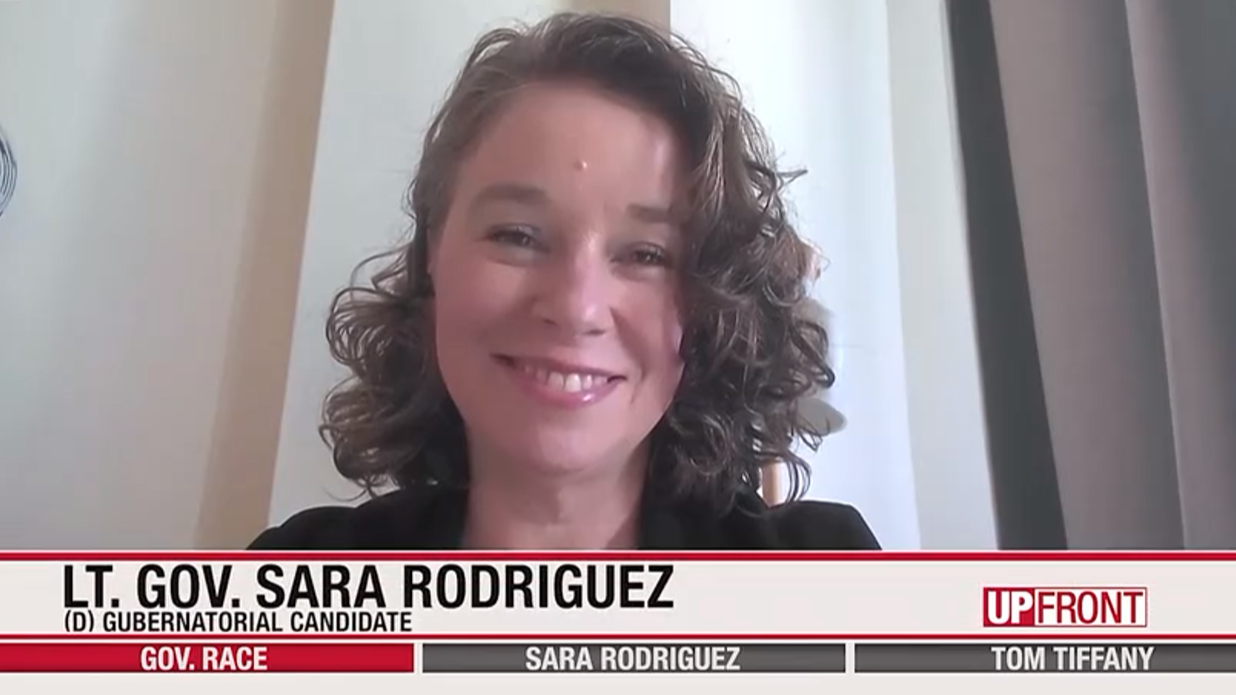
Lt. Gov. Sara Rodriguez, a Democratic candidate for governor, says she wouldn’t instruct Wisconsinites to obstruct ICE agents as she calls for statewide bans on where federal immigration arrests could be made.
“I would never urge Wisconsinites to obstruct federal agents, and in fact, that is something I absolutely would discourage people to do,” Rodriguez said on WISN 12’s “UpFront,” which is produced in partnership with WisPolitics. “I would encourage them to do what they have been doing, which is peacefully protest as well as making sure that you are using your video camera on your phone and taping them to make sure that we can hold these agents accountable if they do violate people’s civil rights.”
Last week, Rodriguez proposed banning “civil immigration enforcement actions” in and around courthouses, hospitals, daycares, schools, domestic violence shelters, and places of worship. Two exceptions, she said, would be a judicial warrant and imminent threat to public safety.
Gov. Tony Evers didn’t immediately back the proposal and questioned whether the approach was legal, telling reporters, “I think banning things will absolutely ramp up the actions of our folks in Washington D.C.”
>> WisPolitics is now on the State Affairs network. Get custom keyword notifications, bill tracking and all WisPolitics content. Get the app or access via desktop.
“So this is one area that I respectfully disagree,” Rodriguez said. “I believe that we do have the ability to be able to create transparency and standards in the state of Wisconsin. We have seen other states that are doing that as they are working quickly to protect their residents. It’s something I would like to see Wisconsin do as well. I have so much respect for Gov. Evers, and I 100% understand where he’s coming from, but this is something that I think we need to be leaders on, and we need to be protecting the folks here in Wisconsin.”
Meanwhile, U.S. Rep. Tom Tiffany, a Republican candidate for governor, criticized Rodriguez’s proposal and said he would work with federal immigration officials as governor.
“Under the law, the federal law enforcement they have the duty to remove people who are here illegally in the United States, and they need to be able to do their job,” Tiffany told “UpFront.” “It’s no different than your county sheriff doing his job. Federal law enforcement is charged with moving people or removing people who are here that are illegal immigrants, and for the life of me, I don’t understand where the lieutenant governor is coming from.”
When asked what ICE’s presence would look like in Wisconsin if Tiffany was governor, he said, “It would be similar to what we saw in just this past week where they were people interdicted here in Wisconsin that are here illegally, and they were removed from the state of Wisconsin because they had committed crimes either in their home country or here in the state of Wisconsin.”
Lawmakers, including Evers and U.S. Sen. Ron Johnson, R-Oshkosh, have voiced concerns about the potential impact of widespread immigration raids on Wisconsin’s dairy and farm industry.
“When I talk to farmers a lot, and I come from a farm family and still have brothers and sisters that are in agriculture, and you know they certainly want to know what is happening,” Tiffany said. “But they do want to have illegal aliens on their farms that are violent criminals, and most are not, but there are a few that are, and they don’t want to have them there. I think one of the most important things we can do is implement work requirements. We have so many Americans, the estimate is as high as 10 million people across America that are choosing not to work. There’s a lot of people that can do those jobs. If we would implement work requirements, if the federal government doesn’t do it as governor, I will implement work requirements so they can fill some of those jobs that are available here in our state.”
GOP U.S. Rep. Bryan Steil is pushing back on criticism his congressional stock-trading bill doesn’t go far enough. It advanced in a key House committee last week.
“Don’t let the partisanship get in the way of understanding a very common-sense bill,” Steil told “UpFront.” “This bill moves us forward dramatically on improving the current ethics laws before us. It’s always easy for people to complain that they wish they had the idea in the first place, but at the end of the day, this law is very clear. It’s very straightforward.”
The bill would ban lawmakers from buying individual stocks. Lawmakers would be allowed to keep their existing stocks, but require a seven- to 14-day notice before making a sale.
“This is all about making sure we’re doing two key things,” Steil said. “Individuals who’ve had successful private-sector careers, we want them to be able to come to Washington and work on behalf of the American people. But, two, we also need to put in place reasonable restrictions so that the American people know that their elected representative is working for them, not working to pocket, to pocket their own money.”
Also on the show, Peter Barca, the former Democratic state lawmaker and revenue secretary, is leading the new Wisconsin chapter of the Natural Allies for a Clean Energy Future. Barca says he’ll push candidates ahead of the midterms to adopt clean energy policies.
“I wouldn’t call it a liberal agenda, maybe somewhat of a progressive agenda, but it is sort of a center-left alliance that’s been put together to try and build support for a clean energy future,” Barca told “UpFront.” “But we’re clearly reaching out to Republicans and anybody, for that matter of fact, as our polling result showed, people, whether you’re Democrat, Republican, Independent, they all support a clean energy future.”
The group recently commissioned a poll asking Wisconsinites’ views on energy, including data centers. It found 41% of those polled said they believe the state should block data centers because they’re driving up costs, 34% said the state should partner with tech companies, and 25% said they were unsure.
“Whether data centers continue to advance at a rapid pace as they have been, or whether it’s just the industrial sector, which is a big part of our demand for energy, in Wisconsin, being the former revenue secretary, I can tell you we’ve had huge growth in every sector of the economy,” Barca said. “Our industrial base, especially manufacturing, we’re the second-largest proportion of manufacturing jobs in the country, and that’s growing. But there’s no question data centers are demanding more energy than ever before, so it’s a part of the mix.”
See more from the show.