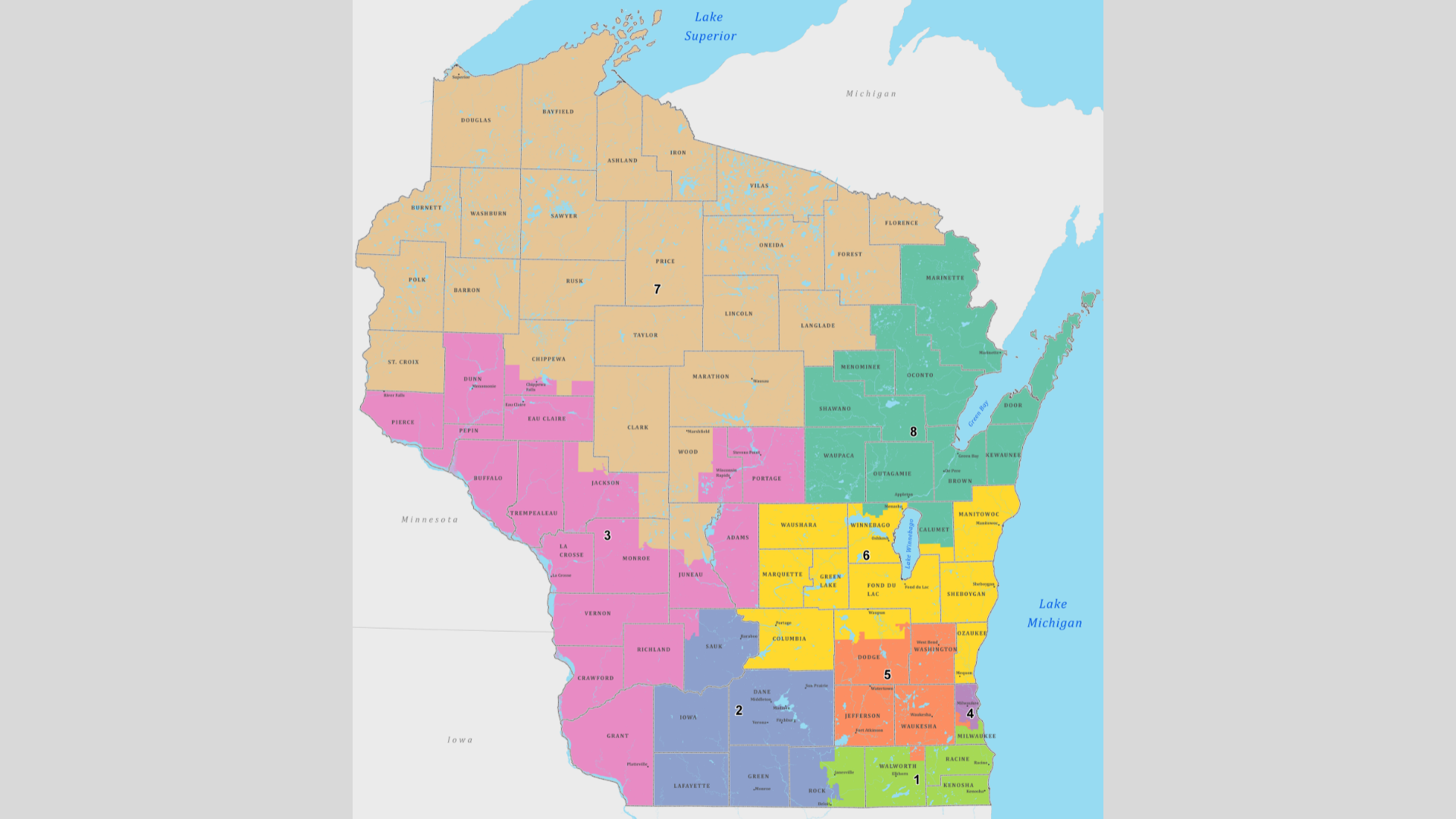
The business leaders who challenged Wisconsin’s congressional map as an “anti-competitive gerrymander” filed a notice of appeal with the state Supreme Court after a three-judge panel on Tuesday dismissed the suit.

Law Forward attorney Doug Poland, part of the team that represented the Wisconsin Business Leaders for Democracy, said it was the first such case ever filed in state court and “deserves to be heard.”

Meanwhile, state GOP Chair Brian Schimming hailed the ruling as another defeat for Dems seeking a new map.

Last month, a separate panel of circuit court judges dismissed a lawsuit challenging the map — which has helped produce a 6-2 GOP supermajority — as an unconstitutional partisan gerrymander.

While the rulings can be appealed to the state Supreme Court, candidates have already begun circulating nomination papers for the fall elections.

The deadline to turn in signatures is June 1.

“National Democrats know their ideas are out of step with Wisconsin voters, and their only path to win is to rig the maps in their favor,” Schimming said.

The panel ruled Tuesday the anti-competitive gerrymandering challenge was barred by a previous state Supreme Court decision that found lines can’t be challenged over their partisan composition.

The separate panel cited the same precedent in March when it rejected the partisan gerrymandering challenge. In that ruling, the panel noted the state Supreme Court in 2022 found partisan gerrymandering claims are barred under the Wisconsin Constitution and it didn’t have the power to overrule that holding.

The Wisconsin Business Leaders for Democracy sought to separate their anti-competitive gerrymander challenge from the claim that the map is an unconstitutional partisan gerrymander.

But the three-judge panel that issued Tuesday’s decision found the claims are “functionally equivalent,” and the anti-competitive gerrymandering claim is also barred by the 2022 state Supreme Court ruling.

The panel found the competitiveness of a map was a “subjective question with no governing standards,” similar to questions over the fairness of lines. Thus, the Supreme Court’s prior rulings barring a challenge based on partisan gerrymandering claims also apply to a lawsuit claiming a map isn’t competitive.

The judges wrote as “an inferior court,” they were obligated to follow that ruling.

“In a two-party system, partisan fairness and competitiveness are correlated: a more competitive map is typically a fairer map, whereas less competition usually means less partisan fairness,” the court ruled, finding the objective of both is to change the partisan makeup of districts.

Poland argued the panel was wrong to conclude the two challenges were “functionally equivalent.”

“They are different claims, based on different evidence, that target different ways of manipulating representation to the detriment of voters,” he said.

The suit had been scheduled for a 2027 trial before Tuesday’s ruling.

The state Supreme Court appointed the separate three-judge panels after the challenges to the congressional lines were filed. It was the first time a 2011 law authored by Republicans had been used to review such a lawsuit. In last month’s ruling, that panel noted in its decision that the court didn’t provide guidance to the three judges on their authority in handling the suit.

They also noted the 2011 law lacked guidance as well.

Meanwhile, Dem gubernatorial candidate Mandela Barnes responded to the ruling by pledging if elected to use “every option available to me to protect our democracy.”

Barnes posted on X in response to the ruling that “As Trump rigs maps across the country, we can’t fight with one arm tied behind our back. A 50-50 state with a 6-2 delegation isn’t a fair map, and as governor, I’ll use every option available to me to protect our democracy.”

A spokesperson said that would include proposing a new “fair” map if Dems have control of both houses of the Legislature after this fall’s election.