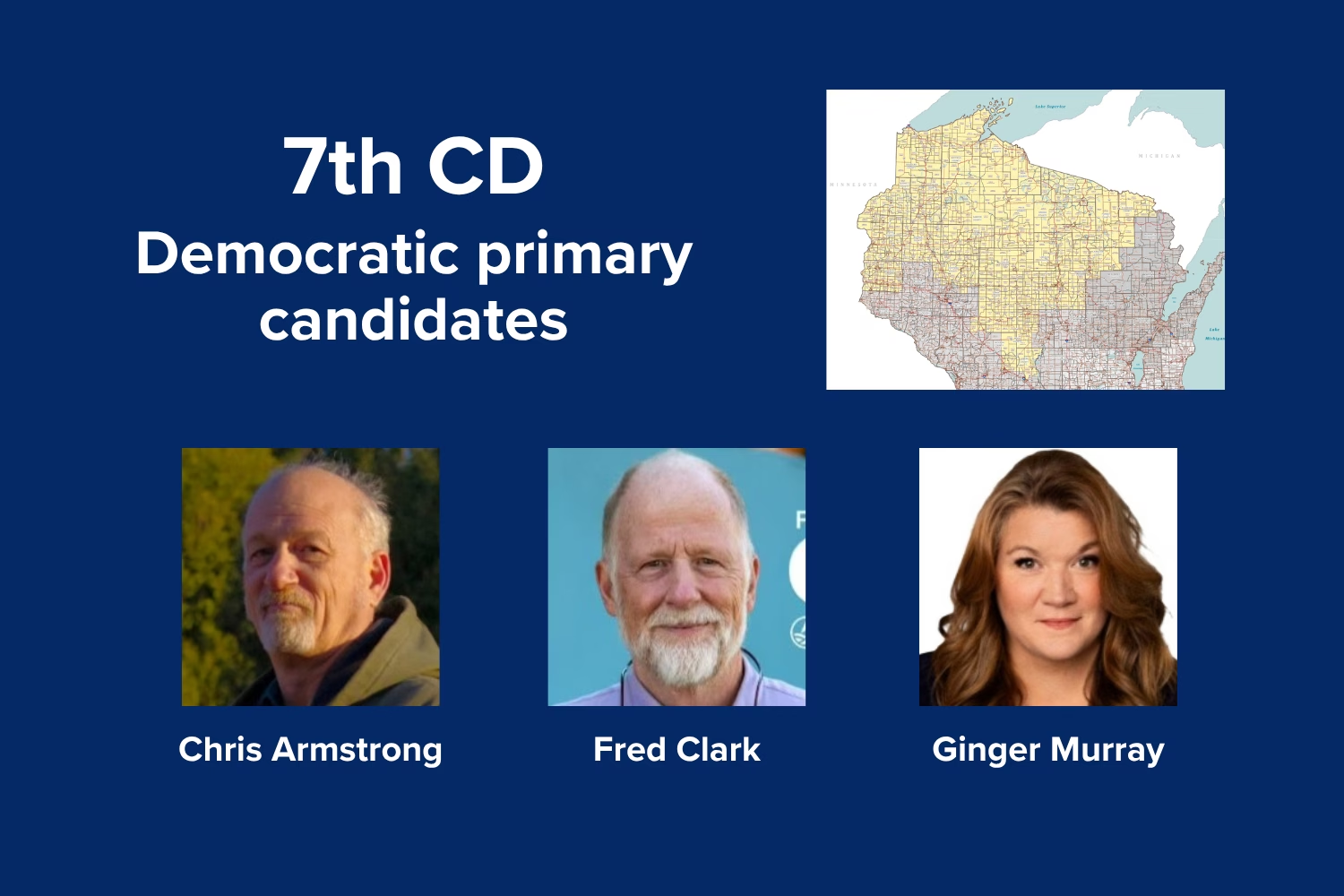
In their only televised debate of the race, all three Democratic candidates in the 7th CD said they supported greater federal regulation of data centers but stopped short of endorsing a moratorium. 

IT business owner Chris Armstrong and family law attorney Ginger Murray both endorsed mandating environmental impact reviews and requiring data centers to draw power from renewable sources.

Meanwhile, former state Rep. Fred Clark said the federal government should monitor data center projects to ensure developers were financially solvent and that communities could demand sufficient payment from those companies to benefit local communities and insulate them from risk. 

“We need to understand that none of this sector is profitable today, there’s a huge bubble going on in the AI, tech sector, today, and that means these developments are at risk,” Clark said yesterday evening during the debate hosted by WJFW-TV. “We don’t know the long-term viability of this entire sector, we don’t know how many of these data centers are going to be sitting empty a year from now.” 

Murray also said she wanted to keep data centers from being built on “nutrient-rich soil,” a standard she also said should apply to wind and solar developments. 

All three candidates said they endorsed expanding public healthcare programs. Armstrong called Medicare for All “viable,” Clark said he’d support a public option, lowering the enrollment age for Medicare and expanding Medicaid, while Murray said she would support any expansion “as long as we’re making progress.” 

Meeting four weeks ahead of the Aug. 11 primary, all three Dems spoke out against the Trump administration’s deportation operation. Murray and Clark called for reform to the U.S. immigration system and Armstrong saying that immigration agents “need to be held accountable for their crimes against the American people” for the fatal shooting of U.S. citizens and migrants alike in places like Minneapolis, Texas and Maine. 

The three Dems declined to say whether the growing number of democratic socialist candidates was good or bad for the party; Clark said labels “are not going to do us any good.”

Armstrong, of New Richmond, characterized himself as a “normal guy” drawn into politics by the abuses of the Trump administration and the president’s allies.

Armstrong pushed back when moderator and WJFW-TV anchor Dan Hagen noted his lack of political experience, saying he had consulted with state and federal agencies and knew how to “govern your business strategy.”

But he said he was “not a healthcare expert” answering a question about healthcare and at one point said he did not know why the Northwoods’ pulp mills were closing.

“I think it has something to do with supply chains, with economics,” he said. 

Clark, who represented the Baraboo area in southcentral Wisconsin for three terms in the Assembly, said the November election “is more about character than party.”

Asked about a 2011 incident where he left a voicemail to a voter saying he felt like “smacking her around,” he said he’s learned that “our words matter.” 

Murray, a New Lisbon family law attorney, said she was a “lady-lawyer leader” in the lineage of Wisconsin Supreme Court Justices Susan Crawford and Chris Taylor and invoked female political leaders throughout the debate. 

She also said she would advocate for the release of federal case files on sex trafficker Jeffrey Epstein, adding it was the “fastest way” to take down the Trump administration. 

“I’m ready to join the ladies who are going to unveil the Epstein files,” she said.