

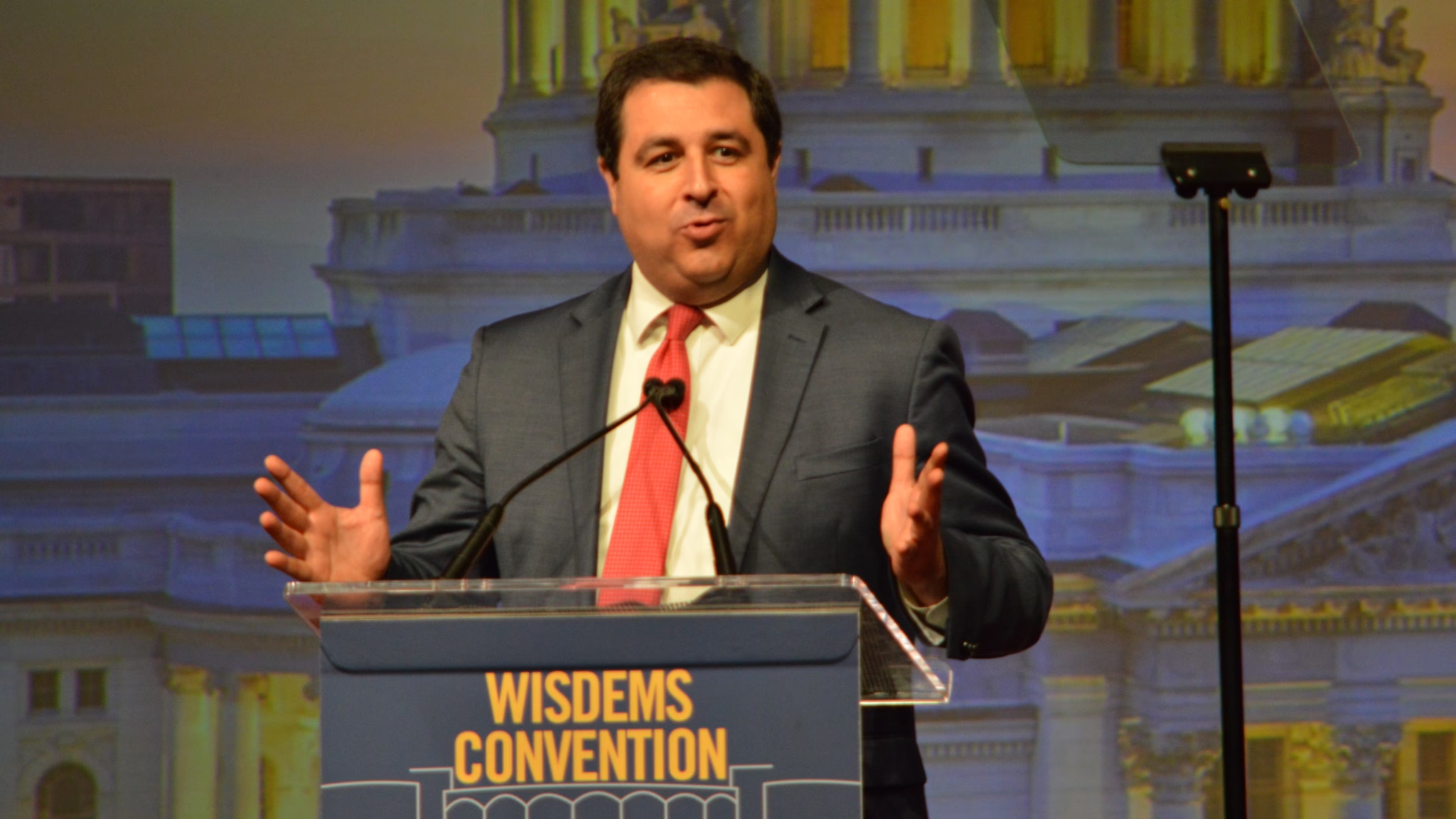
AG Josh Kaul called for state lawmakers to pass guardrails on law enforcement agencies’ use of Flock cameras.
Speaking at a Milwaukee Press Club-WisPolitics-Milwaukee Rotary luncheon Tuesday, Kaul said standards for how police can use the automated license plate readers would set clear expectations for the public on their use and keep them from being used for “dragnet general surveillance.”
“There hasn’t been the kind of robust discussion or debate in the public forum where it should be happening, which is in our Legislature,” Kaul said.
He suggested that include regular audits of the system’s usage and limiting the number of officials that can access the system and types of cases for which the cameras could be used.
>> WisPolitics is now on the State Affairs network. Get custom keyword notifications, bill tracking and all WisPolitics content. Get the app or access via desktop.
DOJ spokesperson Riley Vetterkind said that a “restricted subset” of Division of Criminal Investigation agents can access data from Flock and other automated license plate readers, that queries must be associated with a case, and that the division audits its use of license plate readers.
Kaul also said he doesn’t “see any reason offhand why private contractors should have access to that information,” except for police subcontractors, after the Racine County sheriff cancelled its Flock contract when it learned Flock was generating a separate data set that it was marketing as a “traffic analytics” tool.
Kaul dismissed GOP gubernatorial nominee Tom Tiffany’s proposal to bar municipalities from using state funds to purchase the artificial intelligence-powered cameras while a state task force reviews the issue.
Kaul said Tiffany, a congressman from Minocqua, “has been all over the map on these kinds of issues,” citing his support for a version of the One Big Beautiful Bill Act that would have barred state-level AI regulation.
The Tiffany campaign called Kaul’s remarks “another lie from Democrats,” arguing the removed provision dealt with regulating AI systems and models, not government use of Flock technology.
Kaul’s GOP opponent, Fond du Lac District Attorney Eric Toney, has also called for legislative action on automated license plate readers “to protect the confidentiality of investigations and the privacy of victims and community members,” per a Friday statement.
Kaul said he’d like to see several current restrictions on abortion access loosened, saying a required 24-hour waiting period after first seeing a physician and requiring patients to go back to the same doctor make abortion access more difficult.
He also called the current 20-week ban on elective abortion “problematic,” saying that there were cases where doctors could not accurately gauge how far along a pregnancy is and that there should be exceptions.
Asked about another gestational limit, he said there was “reasonable debate to be had” but that Wisconsin was “not in a place where the laws on the books were passed with concern about the health of the woman or about the health of children following births, but are designed to inhibit access to abortion.”
Kaul also:
*defended the state’s refusal to turn over unredacted voter data to the federal government. He said doing so would be illegal under state law and called President Donald Trump “openly hostile to free and fair elections.”
*said he believed body cameras should be worn by all police officers in a “tactical situation” and “would not oppose” a state mandate requiring officers to wear body cameras. Kaul added it was “critical” that such a mandate come with additional funding.
*said it was up to jail administrators and the Department of Corrections to decide what technology inmates should have access to after a Milwaukee man used a county jail-provided tablet to intimidate witnesses in his case.
*said he “wasn’t going to second-guess” the jury that convicted former Milwaukee County Judge Hannah Dugan of felony obstruction for impeding the arrest of a migrant targeted by federal immigration agents, but said federal prosecutors were targeting people “not based in the interest of justice but in the interest of serving an ideological or political agenda.”
*said Toney was “trying to pledge fealty to Donald Trump” when the DA cited the new administration among the reasons overdose deaths had decreased.
Toney’s campaign didn’t immediately respond to a request for comment.