
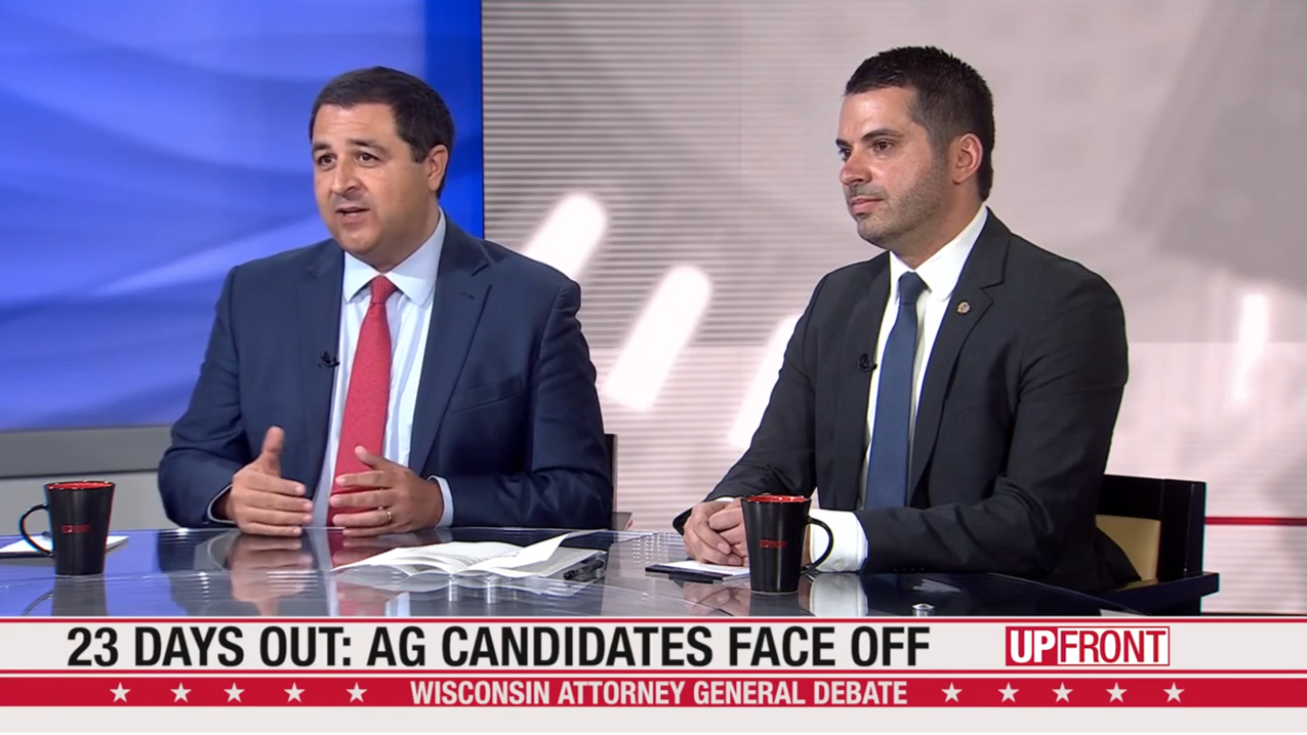
Wisconsin’s AG candidates sparred over the Trump administration, the state’s voter rolls, crime and the state crime lab in a debate Sunday on “UpFront,” produced in partnership with WisPolitics.
Josh Kaul, the incumbent Democrat seeking a third term, and Republican Eric Toney, the Fond du Lac County district attorney, appeared in what will likely be their only debate ahead of Election Day. It’s a rematch of the 2022 contest.
Kaul has joined other Democratic attorneys general in suing the Trump administration more than 70 times in the past two years.
Some of the lawsuits include efforts to protect federal funding, birthright citizenship and absentee voting.
Kaul sought to draw a distinction between the lawsuits pursued by his office and his Republican predecessor, Brad Schimel, saying he was protecting Wisconsinites while Schimel was “playing politics” with his legal challenge to the Affordable Care Act.
“One of the things I think is critical is that our attorney general is protecting the people of Wisconsin,” Kaul said. “There are people across our state who are hurting right now because of actions that the Trump administration have taken.”
“And we keep winning, by the way,” Kaul said. “We win over and over again because the administration is openly flouting the law.”
Toney said he would “absolutely step up to protect the people of Wisconsin.” But he did not answer whether he would have joined any of the lawsuits Kaul has pursued against the Trump administration and accused Kaul of being a partisan actor.
“Unfortunately, what we’ve seen from the attorney general is it depends on who is in the White House, who’s in the governor’s office when he makes those types of decisions,” Toney said.
Pressed by moderators, Toney said he would have intervened on West Virginia’s behalf in a lawsuit where that state was sued over its ban on transgender athletes in girls and women’s sports, “to protect women and girls sports that the attorney general failed to stand up and protect,” he said.
Kaul in turn said Toney was “ducking saying if he’ll stand up to Donald Trump.”
Toney said he would uphold state law when asked about the Trump administration’s efforts to obtain the state’s voter data.
The Trump administration is suing Wisconsin, seeking the state’s voter data — an effort Dem Gov. Tony Evers and bipartisan state election officials have rejected.
The administration has said it’s an effort to prevent fraud and ensure undocumented immigrants are not voting in Wisconsin elections.
“I’ll defend the state laws we have in Wisconsin,” Toney said when asked if he would turn over that data to the Trump administration, while continuing to accuse Kaul of operating as a partisan actor.
Kaul disputed the administration’s claims that it needed the state’s voter data to crack down on voter fraud.
“We know that because, as you just mentioned, they have held people accountable or at least brought cases with information they currently have,” Kaul said. “What we’ve seen, though, is an effort from the Trump administration to gather lots of personal information about people, not just our voter rolls, but SNAP data, TANF data, Medicaid applicant data, CDL data, because they’re trying to gather lots of information about the American people.”
Kaul blamed a lack of state investment for increasing turnaround times at the state crime lab, while Toney accused Kaul of “passing the buck.”
The attorney general oversees the state crime lab, which analyzes and tests evidence for criminal investigations.
A recent state audit found turnaround time continues to increase. And the latest Department of Justice report found the average time for DNA test results has increased from 84 days in 2022 to 129 days in 2024.
Kaul pointed to what he said was a lack of investment by the GOP-led Legislature “and specifically Eric Toney’s political allies.”
“I have asked for a significant investment in the crime lab and specifically for DNA analysts in each of the last two state budgets, and in each of those budgets, the Legislature provided zero additional DNA analysts,” Kaul said. “This is remarkable.”
In the 2023-25 state budget, Kaul requested 16 additional crime lab positions. The final budget approved three. In the most recent budget, Kaul requested 19 and received zero.
Toney, who critiqued Kaul’s handling of the crime lab throughout the debate, called Kaul’s answer “an example of the attorney general passing the buck.”
“He actually got more DNA analysts in 2019 in that budget from the Republican Legislature, and he said that he thought he had enough DNA analysts to do the job,” Toney said.
He also noted he had advocated with Kaul to add more crime lab positions in 2023.
“And then what we saw a year later when a nonpartisan audit came out of our crime labs, the attorney general hadn’t even filled the new positions that he received,” Toney said. “And he had six or seven less DNA analysts filled, and we’re starting to see why. Earlier this year, he had a hiring freeze in place over various amounts of time dating back to 2022, which is probably why these key public safety positions haven’t been filled.”
Kaul countered.
“First, there was a sleight of hand there,” Kaul said. “He talked about getting additional positions. Those were not DNA analyst positions. He knows that. Secondly, he talks about a hiring freeze. I encourage your viewers, they can go online, they can see there are positions being hired by the DOJ right now.”
Toney then placed several pieces of paper on the desk he said showed when the DOJ had instituted a hiring freeze.
“These are emails his office provided to the state Senate that we got through a public records request,” Toney said. “And so now what he’s doing is playing a sleight of hand, saying that well, now maybe they don’t have a hiring freeze during an election year.”
Both candidates called for guardrails on Flock cameras, automated license plate readers in use across many Wisconsin municipalities.
Law enforcement has credited the cameras with helping solve crime. But numerous municipalities have ended contracts with the company in recent months, often citing data privacy concerns.
Toney noted he’s serving as a special prosecutor in a homicide where Flock cameras have helped identify a suspect.
“But we’ve seen even my local law enforcement, in talking with them when they discontinued that use, with the concerns they have for protecting active investigations and privacy of victims and community members,” Toney said. “It’s clear that we need more action from the Legislature and the governor’s office, and until then local municipalities are the ones that are having to make these decisions with local sheriffs and chiefs that are having to maintain that public trust.”
Kaul also called for legislative action while noting the cameras had helped find missing children and senior citizens.
“I want to make sure there’s a limit on the disclosure of data, so it’s being limited by law enforcement. I don’t want to see this going to private entities. And then there should be regular auditing in place and punishments if folks are misusing the technology,” Kaul said.
The candidates split on expanding background checks and new red flag gun laws while knocking each other’s record on violent crime.
Kaul has unsuccessfully pushed for expanded background checks and a red flag law, which allows a court to temporarily take guns from someone deemed a danger.
He noted the “Safer Wisconsin” plan he pitched years ago that included “common sense gun safety measures” the Legislature had not taken up.
“Right now you can sell a gun out of the trunk of your car to a total stranger without having any idea who that person is, and there’s nothing that law enforcement can do because we don’t have universal background checks,” Kaul said.
Asked about expanding background checks or a red flag law, Toney noted existing state law allowed for a court to take away guns from people with mental health issues.
“It has due process. People can have a trial. They can get in front of a judge. They can have their firearm rights taken away, but they can also petition to have those rights return to them, and so we have some laws on the books right now that can be used to make sure that we’re protecting people,” Toney said.
Toney criticized Kaul for a rise in homicides since Kaul took office in 2019, noting homicides are up by one-third as of 2025 and drug deaths had hit a record high under Kaul’s term in office.
Kaul noted drug deaths had fallen significantly since then and that overall crime was at its lowest number in decades, with violent crime at its lowest since 2011.
He also took aim at Toney for a recent increase in violent crime in Fond du Lac County. The Fond du Lac police chief has previously cited a rise in domestic violence.
See more from the show.