

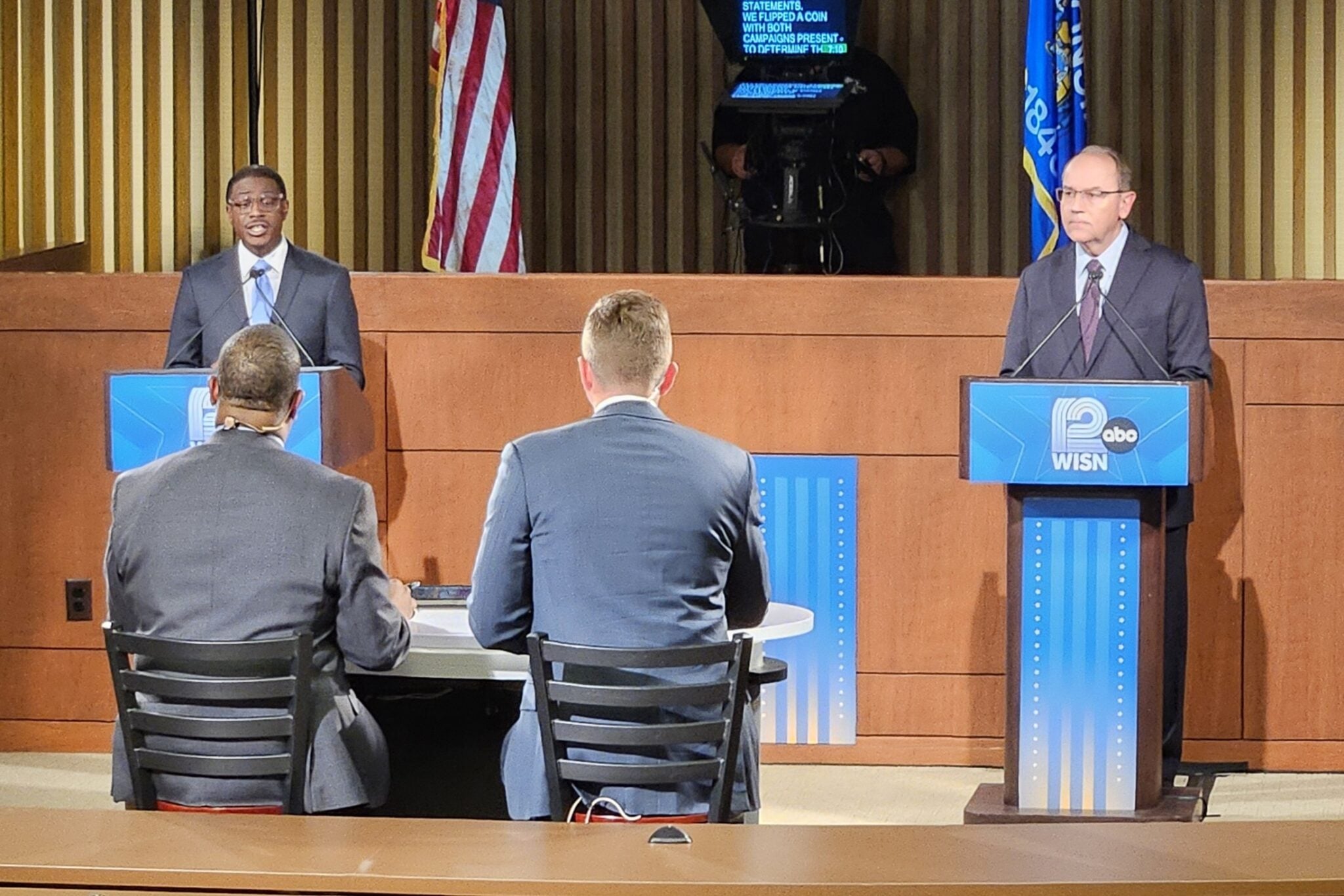
MILWAUKEE — GOP gubernatorial candidate Tom Tiffany accused Dem rival David Crowley of flipflopping on tax breaks for data centers.
Crowley fired back that Tiffany couldn’t be trusted on the issue, saying the Minocqua congressman has voted for tax breaks going to big tech companies and fast-tracking the development of data centers without proper environmental reviews or input from local communities.
“Don’t pay attention to what Congressman Tom Tiffany has been saying here in the state of Wisconsin,” the Milwaukee County exec said in the only debate of the campaign. “Just look at his record as he’s been in Washington, D.C.”
Tiffany accused Crowley of supporting subsidies for data centers “from the beginning,” saying it was a clear difference between the two of them as he ticked off a series of requirements he wanted to place on the projects.
Crowley in recent days has said he would sign legislation to repeal a state sales tax break for data centers after previously saying he wanted to consider it as part of a more holistic approach to the tax code.
“I will not put my finger to the wind when making decisions like this,” Tiffany said.
It was one of several exchanges between the two in the debate organized by WISN-TV and produced in partnership with WisPolitics. Moderators Matt Smith and Gerron Jordan, host of WISN-TV’s “UpFront,” repeatedly tried to pin down both candidates on specifics with mixed success as Crowley and Tiffany often stayed focused on their talking points.
Asked if he would impose a higher tax bracket for wealthy Wisconsinites, Crowley said he wanted to take a holistic approach to the state’s tax code but didn’t commit to a number for higher earners.
Tiffany has repeatedly vowed to return a surplus of nearly $3 billion to taxpayers, and moderators tried to pin him down on how he’d do that. Tiffany eventually said he would prefer not to do a one-time check and instead do long-term tax reductions.
Crowley declined to offer specifics on how he would use the projected surplus, only saying he would work with the Legislature to fund childcare, health care, education and other costs that contribute to what he said was an “affordability crisis” created by Tiffany and those in Washington, D.C.
Meanwhile, the moderators eventually got Crowley to commit to vetoing legislation that would end Milwaukee’s school choice program, as he said the public school system wasn’t prepared to absorb the voucher students if that happened.
Asked if he’d lift income limits on those in the voucher program, Tiffany said he’d be willing to consider it, but only after talking to lawmakers.
The moderators were successful at getting the two candidates to directly answer questions on transportation funding. Asked to answer yes or no, Tiffany said he wasn’t open to new user fees, tolling or indexing the gas tax for inflation.
Crowley said he was open to user fees and tolling, but not indexing the gas tax.
Tiffany insisted he would still be able to put more money into transportation, saying he did it while in the Legislature.
“We are going to put additional money into transportation,” Tiffany vowed.
Crowley countered that Tiffany didn’t have a plan for transportation.
“How are you going to get the revenues when you continuously cut the amount of revenue coming into government?” Crowley said.
Throughout the campaign, Crowley repeatedly accused Tiffany of doing the bidding of President Donald Trump and the billionaires he said were funding his rival’s campaign.
GOP megadonors Diane Hendricks, Dick Uihlein and Liz Uihlein have collectively given the state Republican Party $39.2 million since Jan. 1. The party in turn has transferred nearly $34.4 million to Tiffany, accounting for the bulk of the $39.7 million the Republican had raised through Sept. 23.
Crowley several times accused Tiffany of working for the billionaires funding his campaign, saying he “doesn’t work for the people.”
At one point, Tiffany told the moderators they’ve interviewed him numerous times and never heard his promise to reduce billionaires’ taxes to zero.
“He’s over there ranting constantly about billionaires,” Tiffany said. “We need a governor who’s going to be focused on people here in Wisconsin, doing what’s best for the people of Wisconsin, not worrying about others, not saying what you’re against, but saying what you’re for.”
On other topics:
Abortion: Tiffany said he wouldn’t sign legislation as governor that would ban abortions after six weeks even though he introduced such a bill while in Congress that included no exceptions for rape or incest. Tiffany said he supported the state’s ban on abortion after 20 weeks, which he voted for while in the Legislature. Crowley declined to say where he would draw the line on when abortions should no longer be performed during a pregnancy, saying those are “decisions that need to be made between a patient and their healthcare provider.” Crowley knocked Tiffany for celebrating a 2022 U.S. Supreme Court ruling that ended the national right to an abortion, saying, “Women are holding their breath every four years just to make sure that they can get access to the care to protect themselves, and we need to make sure we’re doing exactly that.” Tiffany later said, “All you women out there, you will not have to hold your breath when I’m governor.”
2020: Tiffany said he voted in Congress to overturn the 2020 election results because of private money from a foundation funded largely by Mark Zuckerberg that went to Wisconsin communities to help cover the costs of putting on an election during a pandemic. Tiffany didn’t mention what critics call “Zuckerbucks” in his Jan. 5, 2021, statement explaining why he planned to vote against certifying the presidential results. At the time, he only mentioned what he viewed as irregularities in Milwaukee and Dane counties. He also mentioned those during the debate after initially focusing his answer on Zuckerbucks. “I objected to Mark Zuckerberg putting $15 million in primarily blue cities, not spreading it out throughout the state,” he said. The Center for Tech and Civic Life distributed nearly $10 million to more than 200 Wisconsin municipalities ahead of the 2020 election, with $6.3 million of that going to Green Bay, Kenosha, Madison, Milwaukee and Racine. Crowley knocked the answer, “You can’t trust Congressman Tom Tiffany to certify the elections when it comes to the 2028 presidential election, because he’s shown us that because of one disagreement, he’ll throw them out.” Tiffany later told the moderators that he would certify the 2028 presidential results as governor, regardless of who wins.
Wisconsin Elections Commission: Tiffany said he was open to eliminating the state Elections Commission, but only if he could reach an agreement with lawmakers on what would replace it. Tiffany said if there’s not a better option, the commission would have to remain. Crowley accused Tiffany of wanting to get rid of the commission because it has been “a frontline defense” against the Trump administration’s attempts to obtain unredacted information about Wisconsin voters for what it says is an effort to combat fraud. “Look, I’m not saying that everything that they do is great,” Crowley said. “But you cannot sit there and say that you’re going to change each and every single entity just because they disagree with you, just because they’re fighting back against those who continue to support your campaign, congressman.”
Marijuana: Tiffany said he supports recreational marijuana, and then “we’ll take a step-by-step approach. Crowley affirmed his support for full legalization so long as there are guardrails to protect children and products are clearly labeled so consumers know the contents of what they’re taking.