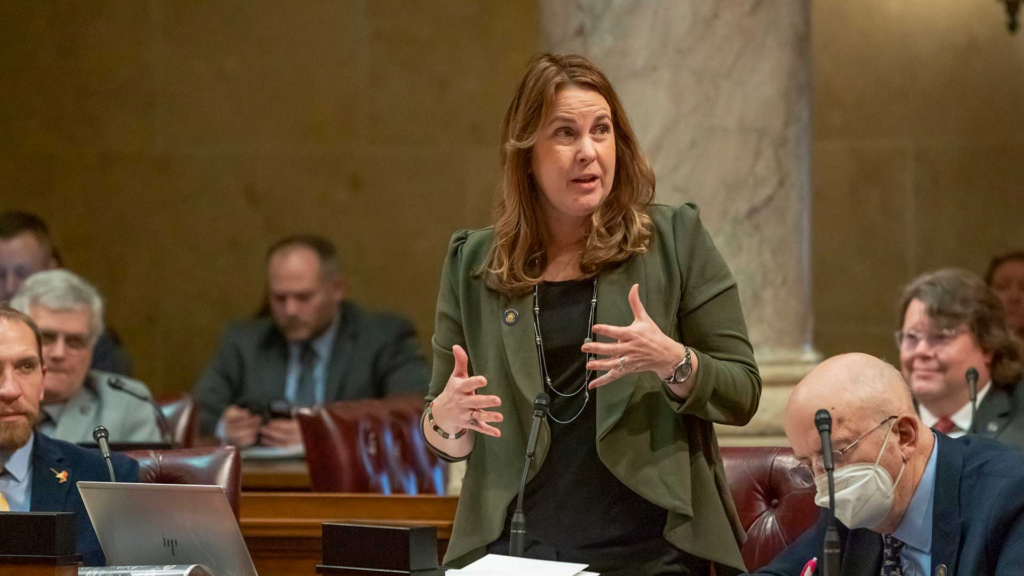
Senate Dems want to boost the state’s share of special education funding to 90%, to offset the impact of school costs on homeowners and to boost the Homestead property tax credit.

Minority Leader Dianne Hesselbein, D-Middleton, believes they can accomplish all of that — and then some — without a tax increase if the Legislature makes affordability a priority in how it builds the next state budget.

The state is projected to finish the current biennium with $770 million in the general fund, and there’s about $2 billion in the state’s rainy day fund. Bumping the state’s share of special education funding to 90% — more than double what it is now — would top $2 billion over the biennium, according to some estimates.

“The people of Wisconsin sent us here to get to work and to solve problems. We have solutions to what people are talking about when it’s rising costs, it’s grocery costs, prescription costs, and unfortunately, Republicans are refusing to get the job done,” Hesselbein said in a new WisPolitics interview.

Dems have introduced bills on boosting special education reimbursement, the Homestead credit, prescription drugs and other priorities with few signs of Republicans being interested in moving the legislation. In many cases, GOP leaders have called the proposals fiscally irresponsible, predicting they would lead to budget deficits or tax hikes.

Hesselbein argued the legislation is a sign of Dems’ goals and they might not be able to reach covering 90% of special education funding. Funding put into the state budget was designed to provide a reimbursement rate of 42% in 2025-26 and 45% in 2026-27. But DPI notified districts that the interim proration rate for 2025-26 is 35% after costs in 2024-25 increased by 9% rather than the expected 4%. Before the increase in the budget, the rate was 32.1%.

Hesselbein pledged if Dems control the statehouse after the 2026 elections, they would take a “holistic” approach to funding education that she believed could help free up more money for public schools. That includes taking a closer look at how the state funds both public and private schools, which receive money through the state’s voucher program.

“Because these are things we’ve been hearing about that I’ve been here over a decade, that people in the state of Wisconsin care about, and it’s about time that people in this building are listening,” Hesselbein said.

Hesselbein also said:

*She won’t endorse in the Dem guv primary, which includes current lawmakers Kelda Roys and Francesca Hong as well as former members of the Legislature such as Mandela Barnes, David Crowley and Brett Hulsey.

“I’m friends with a lot of these people, right?” Hesselbeing said. “Like I said, I was in closed caucus with them for years. I know what they’re made of, and I’m really excited to be working with them.”

*She wouldn’t follow the “rule of 17” in determining what bills make the Senate floor, should Dems take control after the 2026 elections. Republicans have generally adhered to the principle that legislation only comes up for a floor vote if it can pass with just GOP support, necessitating 17 votes from the caucus. It hasn’t been an ironclad rule, however, with several high-profile examples in recent years, from an overhaul of the state’s policies for the manufacture, distribution and sale of alcohol to public funding for maintenance at the Milwaukee Brewers stadium.

Hesselbein said delivering priorities that help Wisconsinites reduce costs is more important than having a standard that 17 Dem votes would be required to take legislation to the floor.

“Whether it’s a new Republican idea, our doors are open to the best ideas to help the people in the state of Wisconsin, and that’s our focus now, and that’s gonna be our focus in the future,” Hesselbein said. “Honestly, Senate Democrats have talked about this, and we want to work with everybody. A lot of these issues are not partisan. They should not be partisan. It’s unfortunate the Republican Party is making them so.”

*She was optimistic about Dems’ chances of taking control of the chamber next fall. There are four seats getting the most attention: the 5th SD, represented by Republican Rob Hutton, of Brookfield; the 17th, represented by Republican Howard Marklein, of Spring Green; the 21st, represented by Republican Van Wanggaard, of Racine; and the 31st, represented by Dem Jeff Smith, of Brunswick. Republicans now control the chamber 18-15, and Dems have to win three of those four seats to take the majority.

Hesselbein said Kamala Harris, Joe Biden, Tammy Baldwin and Tony Evers all won more votes in those seats than their GOP rivals in their elections. Mary Burke, the Dem guv nominee in 2014, won some of the seats even as she lost statewide by nearly 5.7 percentage points.

“So we feel very good about our chances next election cycle, because we know we have the right message,” Hesselbein said. “We are talking about rising costs. We are talking about how we can be helping families and also, more importantly, we’re listening. We like to listen to people and see how we can solve their problems.”

*She believed lawmakers could reach a deal on overhauling the state prison system before spring. Evers proposed a series of changes that called for closing the prison in Green Bay, revamping Waupun into a facility focused on jobs training, and converting the state’s troubled youth prisons in northern Wisconsin into a medium security adult facility. Republicans rejected the plan, which would’ve resulted in a reduction of about 700 beds in the state’s current capacity. It also included an expansion of an earned early release program. Republicans rejected including the proposal in the state budget and instead set aside $15 million for planning. The Building Commission voted in October to release the money.

“I will tell you that it did come up in our budget negotiations, and I was told we would be dealing with it this fall,” Hesselbein said of conversations with GOP legislative leaders. “We haven’t been dealing with it this fall, so I’m hoping we can get something done that’s meaningful.”