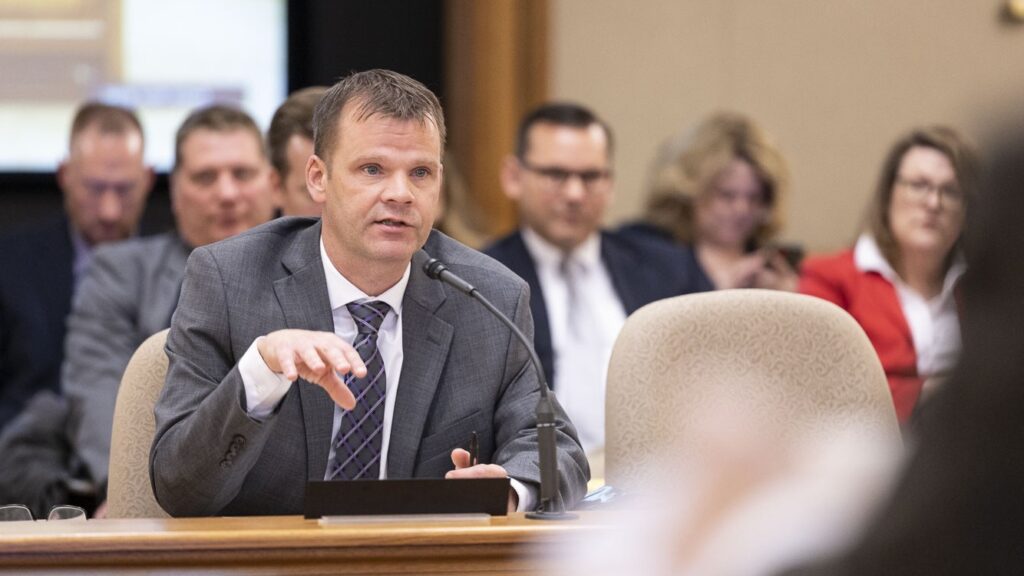
Senate Majority Leader Devin LeMahieu, R-Oostburg, says regulating the THC industry will be a top priority for the spring floor period.
But with three competing GOP bills, it won’t be easy.
LeMahieu told WisPolitics in a year-end interview that one of his top priorities is making sure that minors aren’t able to buy the products.
“You know, the concern is, potentially, if we do nothing, some of the good actors won’t produce it anymore, and all we have is bad actors in the state of Wisconsin, since it’s illegal federally,” LeMahieu said.
>> WisPolitics is now on the State Affairs network. Get custom keyword notifications, bill tracking and all WisPolitics content. Get the app or access via desktop.
There are now three GOP-authored hemp bills introduced this session:
- AB 503/SB 499 seeks to bar the sale of hemp-derived products with THC.
- AB 606/SB 681 seeks to regulate hemp-derived products as the state does alcohol, with a three-tiered system for manufacturers, distributors and retailers.
- AB 747/SB 682 seeks to bar the sale of hemp-derived cannabinoid products to those under the age of 21.
Dems have also introduced AB 680/SB 644, their own push to restrict the sale of intoxicating hemp products to those under the age of 21.
The state efforts to regulate the industry come with a federal ban on them looming. The 2018 farm bill removed hemp from the list of controlled substances, a move that was hailed at the time as a way to provide farmers a new crop that could be used in products such as paper and clothing.
But it also opened the door to products with low doses of THC, such as gummies and beverages. The continuing resolution President Donald Trump signed earlier this year includes a clause that bans the “unregulated sale of intoxicating hemp-based or hemp-derived products” in one year.
LeMahieu said he hasn’t spoken with Gov. Tony Evers, who has advocated full legalization of marijuana, about the hemp bills.
“It’s going to be illegal again, federally in a year, if Congress doesn’t take action,” LeMahieu said. “So we sort of have to figure out how that factors in, and we’ve got three months to figure it out.”
LeMahieu’s comment on three months refers to the final regularly scheduled floor period of the session that runs March 11-20. LeMahieu said the Senate will be in at some point during that window.
In a year-end interview wrapping up 2024, LeMahieu told WisPolitics he hoped to pass legislation by the spring that would give utilities with existing infrastructure the first option to build coming transmission lines. Dubbed ROFR for “right of first refusal,” the bill was the most lobbied during the first six months of 2025 with utilities and others lining up behind it, while groups such as Americans for Prosperity-Wisconsin were opposed.
LeMahieu, a co-sponsor, said Dec. 17 he doesn’t believe the bill will move before the session ends.
One main contention in the debate has been whether giving incumbent utilities first crack at building the coming transmission lines would save Wisconsin ratepayers. Backers argued having ROFR on the books would allow state utilities to spread out the cost of those lines to other states that are part of a network covering the Midwest. Opponents countered competition was necessary to drive down costs.
“I think the opposition to it has been pretty effective in obfuscating, confusing the issue, when in reality, I think it’s a pretty simple issue to understand,” LeMahieu said.
LeMahieu also said:
*there’s “probably a solution” to WisconsinEye going off the air, but it “may not look the same as it currently looks.” The public affairs network, a frequent collaborator with WisPolitics, went dark on Monday, citing a lack of funding after numerous appeals for private money. The state budget includes nearly $10 million in matching funds if the network could raise the money to get it, but that effort so far has failed. Amid its financial woes, the network appealed to lawmakers for additional state funds, and Dems this week proposed legislation to create a state-owned public affairs network. LeMahieu noted the state owns all the cameras installed in the Capitol and the solution could simply involve the state taking over livestreaming hearings and floor sessions.
“We just have to look at all avenues,” he said.
*the Department of Health Services has “made a good case” to hire additional workers to check eligibility for those on the Supplemental Nutrition Assistance Program, known as FoodShare in Wisconsin. The One Big Beautiful Bill Act included several changes to the program, including dialing back the federal government’s share of administrative costs to 25% after it had traditionally covered 50%. It also included new penalties if states’ error rates climb to 6% of those on the program. In federal fiscal year 2023-24, Wisconsin’s error rate was just under 4.5%. If it climbed to 6%, Wisconsin would have to cover 5% share of the costs for benefits, about $68.2 million. If the error rate climbed to 10%, that share would jump to $204.6 million.
LeMahieu said his priorities include ensuring counties aren’t hit with additional administrative costs. With the feds now moving to 25% of administrative costs rather than 50%, it’s projected to require about $30 million in general purpose revenue over 2026-27 and 2027-28 to shield counties from additional costs.
After multiple discussions with his caucus, LeMahieu was confident lawmakers could find a solution to that and provide additional employees to DHS to conduct eligibility checks to keep the state below the 6% mark.
“Every month that goes by, there’s a greater risk that we don’t hit under that 6% error rate, and then we’re backfilling the federal government with 10s of millions of dollars to cover SNAP in Wisconsin,” LeMahieu said.
*he’s been encouraged by some early polling that Senate Republicans have done in key districts and “we’re actually sitting pretty good.” Over the past month, Dems have run up big margins in winning the guv’s races in New Jersey and Virginia. They’ve also overperformed in a string of special elections at the legislative and congressional level. Still, LeMahieu said he’s been encouraged by the voter intensity in key seats.
He also noted November 2026 is 11 months away, and it remains to be seen how affordability is playing with voters when the next election rolls around, particularly who they blame for any concerns they have.
“If their main root is that it’s Trump causing it, how does that work in the gubernatorial race? How does that work in a state Senate race where we obviously have no control over what our president does?” LeMahieu said.