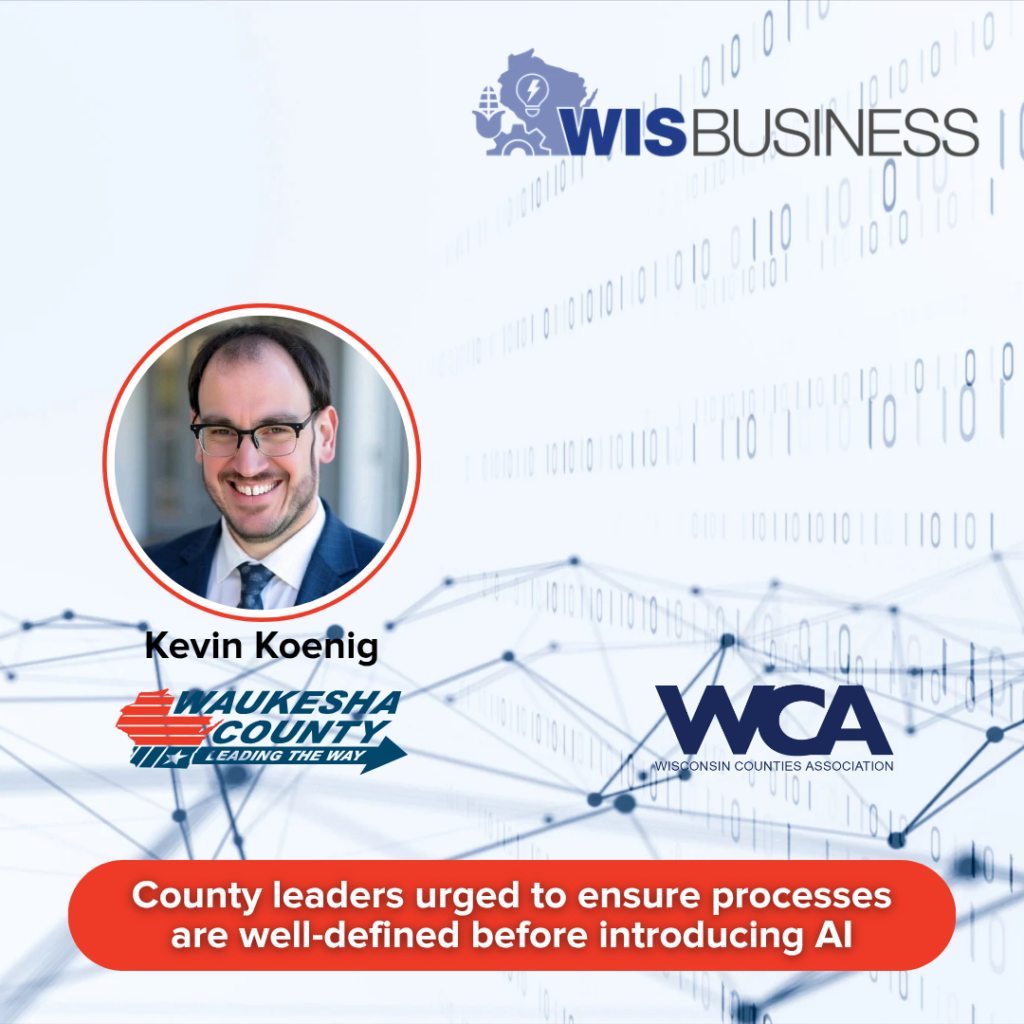
A data expert with Waukesha County urged local government leaders to ensure any processes they’re looking to automate with AI are well-defined, to avoid higher costs and other pitfalls.
Kevin Koenig, the county’s IT data and solutions engineering manager, yesterday addressed members of the Wisconsin Counties Association during the group’s annual meeting in Wisconsin Dells.
“If we cannot describe the process, we are not ready to automate it,” Koenig said. “We are definitely not ready to hand parts of it off to an AI agent … many of our processes cross departments, cross systems, cross policy.”
He noted the visible portion of a given county’s process for a government funtion may not represent the full scope, including various records-keeping requirements and approval chains. Koenig urged county staff to “think across” the organization when deploying an AI system, not just the piece of the process they handle.
When considering deploying an AI tool, especially an agentic system that can take more substantial actions on its own, he urged attendees to consider who’s in charge of approving changes to the target process, what happens when there’s exceptions, which records are created and what policies govern what’s being done.
“Process clarity is AI readiness,” Koenig said.
He also noted AI can be extremely useful, but can’t compensate for an undefined or inconsistent workflow and can “scale the confusion faster” if used in an improper way.
“Risks of unclear process could be inconsistent resident service, faster mistakes, reduced staff trust, harder troubleshooting, poor auditability and high usage cost due to re-work and repeated prompts to the AI,” he said.
And because AI systems are so heavily reliant on data, he cautioned county leaders that data within government is subject to numerous retention and public records requirements, raising issues about privacy for residents.
“Some of the risks with poor data include wrong recommendations, conflicting answers, overexposure of sensitive information, low trust and higher operating costs,” Koenig said. “So trustworthy AI starts with trustworthy data, and cost-effective AI starts with well-scoped data.”