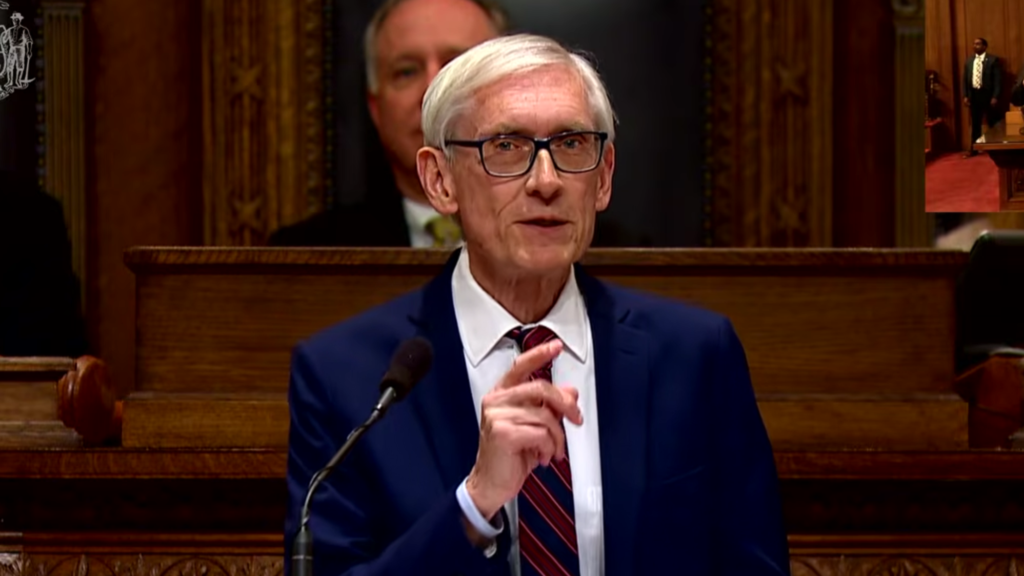
Dem Gov. Tony Evers tonight demanded GOP lawmakers provide additional funding for K-12 education and property tax relief while pushing the Legislature to continue working with him on an unfinished agenda rather than heading out for the campaign trail.

Evers, who leaves office in less than 11 months, threatened to continue calling lawmakers back into extraordinary session if needed to prod them to finish the job with the state looking at a $2.5 billion surplus by the end of this budget in mid-2027.

He also dismissed a $2.3 billion package GOP legislative leaders sent him earlier this week. The package included a $1.5 billion tax rebate plan, $500 million for a property tax credit and $200 million to boost special education reimbursement. 

Evers said he’s worked with lawmakers over the past seven years to give working families a “little more breathing room.” The governor added he’s hopeful that a bipartisan deal can be reached to put meaningful resources into K-12 education while providing property tax relief.

“And it must balance these important obligations a heckuva lot better than the plan Republican leaders sent me this week,” said Evers, who spoke for more than an hour.

Assembly Speaker Robin Vos, R-Rochester, knocked Evers for drawing “bright lines in the sand,” saying he’s never found that to be productive.

“We need to be able to sit down and talk about things that are important to both the Legislature, the taxpayers and the governor,” Vos said. “It should not be a ‘my way or the highway’ type negotiation.”

The governor didn’t offer specifics on what he considered a meaningful investment in K-12 and property tax relief other than calling for additional state aid to ensure schools receive the special education aid reimbursement they were projected to receive when the budget was signed.

A $1.3 billion offer he sent GOP leaders earlier this month also included $200 million for special education reimbursement, which would get them to the 42% and 45% rate expected when the budget was signed. It also included $550 million for the school levy credit and $450 million in state aid for K-12.

But Evers said he’s not negotiating with GOP lawmakers over putting more state money into the FoodShare program to account for changes the federal government made in Republicans’ One Big Beautiful Bill Act.

The Department of Health Services last year asked for $32.3 million more in general purpose revenue in state fiscal year 2026-27 to account for the federal government covering a smaller share of program administrative costs. The agency also sought an additional 56 employees to conduct eligibility checks with FoodShare recipients.

Under the federal changes, if more than 6% of a state’s enrollees are ineligible, they will lose federal dollars to cover the costs of the benefit starting in federal fiscal year 2027-28.

In federal fiscal year 2023-24, Wisconsin’s error rate was just under 4.5%. If it eclipses 10%, Wisconsin would lose $204.6 million.

Senate Majority Leader Devin LeMahieu, R-Oostburg, and Vos included the funding in their $2.3 billion offer to the governor.

Evers said the state must make the investment now to avoid losing as much as $200 million due to penalties.

“If the Legislature fails to provide the funding that is needed, Republicans will be to blame for the penalty fees taxpayers will be forced to pay,” Evers said. “It’s not good. It’s pretty simple. Let’s get it done.”

Delivering the GOP response on PBS Wisconsin, LeMahieu said the state is strong in spite of Evers, not because of the governor’s actions. LeMahieu slammed Evers for the 400-year veto he issued in the 2023-25 budget to allow annual increases of what schools can spend between state aid and property taxes of $325 per student. LeMahieu blamed that for the property tax increases homeowners saw on the bills they received in December and said the state stands at a crossroads with the projected $2.5 billion surplus.

“You know, I love Wisconsin,” LeMahieu said. “I’ve chosen to live here most of my life. I’ve owned a small business for 20 years. I want to make Wisconsin even stronger. We can make it stronger by lowering property taxes, supporting schools and returning the surplus to the people who created it, the taxpayers. It’s up to Gov. Evers to make this compromise a reality.”

Evers announces plan to purchase renewable energy hours 

Evers, who announced in July that he wouldn’t seek a third term, said early in his final State of the State that he was “going to save my long list of gratitude for my farewell address later this year.” But he still ticked off some of the more than 800 bills he’s signed over the past seven years, including an expansion of tax credits for child care, providing Medicaid coverage for telehealth services and a package to provide public money to the Milwaukee Brewers baseball stadium to keep the team in Wisconsin through at least 2050.

His final State of the State was his longest at 6,400 words, eclipsing last year’s speech by about 600 words. Evers’ shortest State of the State was his first, coming in at about 2,600 words. 

He also offered several new initiatives, though he didn’t give  many details in his speech. They included the purchase of 225,000 megawatt hours of renewable energy every year for the next two decades, which Evers said was enough to power more than half a million homes.

According to Evers’ office, the initiative will include requesting bids for the state to purchase renewable energy credits from Wisconsin-based projects. The credits are issued when electricity is generated and delivered to the grid by a renewable source. Since 2007, the state has purchased more than 1.8 million such credits, and the request for proposal will seek options capable of delivering the credits starting in January 2031 for a 20-year term.

Evers also announced a partnership with UW-Madison’s Department of Nuclear Engineering and Engineering Physics to study nuclear energy opportunities in Wisconsin. Touting it as a safe source of carbon-free power, he said it could “be a game-changer for our state.”

The governor also called on lawmakers to tackle several topics yet this year, including an overhaul of the state’s prison system. Evers introduced a plan a year ago to revamp the system with a goal of closing the Green Bay Correctional Institute by 2029. But Republicans dismissed it, in part because of his call to expand earned early release and because it would leave the state with about 700 fewer prison beds than it now has.


Instead, the Building Commission led by Evers in December approved $15 million in planning funds to close Green Bay, complete the process of moving youthful offenders out of facilities in northern Wisconsin and make other changes.

Evers said he was hopeful a deal could still be struck this year, though he ruled out GOP calls for a new prison in the Green Bay area.

“We don’t need to ask taxpayers to pay for a brand-new prison that won’t be done for a decade,” Evers said. “My plan remains the safest, fastest, and cheapest option available. I don’t care who gets the credit. It doesn’t make any difference. I’m going to be gone in a few months. Let’s just get it done, please.”

Evers: Republicans have failed to address gun violence

Evers also announced a new partnership with the Milwaukee Bucks to combat domestic violence as he chided GOP lawmakers for rejecting his call to make the Wisconsin Office of Violence Prevention permanent.

Evers in late 2024 signed an executive order creating the Office of Violence Prevention and dedicated $10 million in federal COVID-19 funds for grants that became available late last year.

The governor included in his budget a provision to make the office permanent under the Department of Administration with $13.3 million in funding, including $12 million for violence reduction grants to boost evidence-based outreach programs and deterrence strategies.

Evers noted that domestic violence homicides in Wisconsin jumped 20% between 2021 and 2022 to a new record high of 96. That was topped in 2024, when 99 Wisconsinites were killed in a domestic incident.

Saying that trend is headed in the wrong direction, Evers also knocked Republicans for rejecting a request to provide $66 million for Victims of Crime Act grants after the federal government cut funding.

Calling on lawmakers to approve bills codifying the Office of Violence Prevention and funding the Victims of Crime Acts grants, Evers said there’s no issue Republicans have done less about during his seven years in office than gun violence.

“This much is clear: if Wisconsinites want to get something—anything—done about gun violence, we must elect legislators who will do a damn thing to change it,” Evers said.

Evers’ to-do list for lawmakers included reauthorizing the state’s stewardship program, whose authorization expires June 30, and to pass legislation to address PFAS after $125 million was first set aside in 2023 to fund the work. 

The governor said he’ll call a special session this spring to take up a constitutional amendment to ban partisan gerrymandering. Though Evers can call a special session, he can’t force lawmakers to actually meet, and GOP leaders have regularly ignored his directives.

He also threatened to continue calling special sessions into the heart of campaign season if needed to address his priorities.

“We can’t afford for lawmakers to lose focus on the future we’ve been working hard to build together just because it’s an election year,” Evers said. “So, I know the Legislature would rather hit the road and take the rest of the year off, but I’m going to ask lawmakers to stick around until our work here is finished.”

Read Evers’ prepared remarks here.

See press releases from Evers regarding the State of the State address:

Gov. Evers: Announces Wisconsin to join growing coalition of states in joining World Health Organization Global Outbreak Alert Response Network

Gov. Evers: Announces launch of new state film office and tax credit program

Gov. Evers: Announces partnership with Milwaukee Bucks to raise awareness, prevent domestic violence across Wisconsin

Gov. Evers: Evers, Evers administration continue to do what’s best for kids through ‘Get Kids Ready’ school readiness program

Gov. Evers: Announces new efforts to bolster Wisconsin’s clean energy future

Gov. Evers: Celebrates four consecutive years of record-high enrollment in state’s registered apprenticeship program, announces new training pathways and opportunities for growth in high-demand fields

Gov. Evers: To call Legislature into special session to ban partisan gerrymandering in Wisconsin once and for all