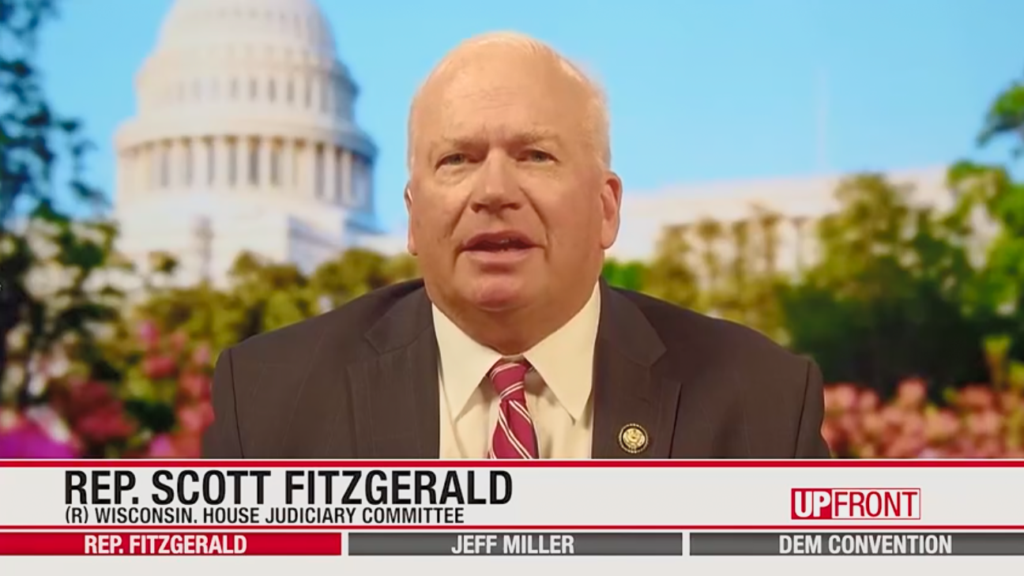
Fresh off his hearing on Capitol Hill, U.S. Rep. Scott Fitzgerald said the NFL may be violating the Sports Broadcasting Act and quickly dismissed concerns from the Green Bay Packers about any changes to the league’s shared revenue model.
“That’s absolutely ridiculous and almost laughable,” Fitzgerald said on WISN 12’s “UpFront,” which is produced in partnership with WisPolitics-State Affairs. “Let me just say, when it comes to the NFL, shared revenue is not an issue, and as a matter of fact, I don’t care how the NFL divides up the pie amongst the teams in the NFL. It’s not something that’s even affected by the SBA, so that is absolutely the Packers going for kind of hair on fire, oh my gosh, the world’s coming to an end if this would be tweaked.
“When it comes to the NFL, the Packers are going to be fine,” he added.
Fitzgerald led a hearing last week in a House Judiciary subcommittee about the 1961 Sports Broadcasting Act, which allows the NFL to negotiate national broadcast deals collectively and then distribute the revenue equally among all 32 teams.
>> WisPolitics is now on the State Affairs network. Get custom keyword notifications, bill tracking and all WisPolitics content. Get the app or access via desktop.
“This isn’t something that we just dreamed up,” Fitzgerald said. “I mean, there’s a class action lawsuit in the 9th Circuit going after the NFL. Now the FCC has opened an investigation and the Department of Justice, so it appeared it was time for the antitrust committee, which I’m chairing right now, to dig into this issue and explore it. I thought the hearing did a very good job kind of laying out the different issues related to the Sports Broadcasting Act.”
Fitzgerald said he believes a case could be made that the NFL is in violation of the act at this point, though he doesn’t want to fully eliminate the SBA.
“No, I don’t think that would be necessary,” Fitzgerald said. “And actually some of the witnesses we had that testified kind of gave at least some credence to the idea of there’s certain things that should be tweaked, but overall the full elimination of it could create kind of the wild, wild west and nobody wants to see that.”
The Packers recently wrote to Fitzgerald that changes “would pose an existential threat to the Green Bay Packers and their existence in Green Bay as we know it.”
In the meantime, Jeff Miller, the NFL’s executive vice president of public affairs and policy, countered Fitzgerald’s assertion the league may be violating the Sports Broadcasting Act.
“We don’t see it the same as the congressman,” Miller told “UpFront.” “This bill was passed in 1961 to provide the league and other sports leagues the opportunity to collectively negotiate the distribution of our media rights, and we’ve done that for the past 65 years.”
Miller said the league is in routine discussions with Congress, including discussions surrounding the SBA.
“We talk to Congress all the time about this,” Miller said. “We certainly get the importance of it as a fan issue and a constituent issue. So we’ve been in talks about our media distribution policies not just with the House but with the Senate, with the FCC, with anybody else who wants to talk about it.”
“I’m not sure exactly what he’s trying to do,” Miller said, referring to Fitzgerald’s hearing. “I think that the system works incredibly well for the city of Green Bay and Packers fans. After all, this is really important to me as somebody who grew up in Wisconsin, the fact that we can share all of our games and distribution of them and share the revenue collectively among all 32 teams permits the Green Bay Packers to exist, to thrive on the field and off the field.”
Also on the program, state Democratic Party Chair Devin Remiker says his confidence is an 11 out of 10 coming off this weekend’s state party convention and looking ahead to November.
“An 11, yeah,” Remiker told “UpFront.” “I’m incredibly confident. Listen, we are used to doing the work here at the Democratic Party of Wisconsin. This is going to take a heck of a lot of work. But this is what everything we have done has led up to. We fought our way back from basically extinction as a political party in this state. I mean, in 2017, we didn’t even have a candidate for Supreme Court. That’s how devastated Democrats were by our loss in 2016, but we fought tooth and nail. We scrapped. We clawed. We beat, and now we are here.”
The most recent Marquette University Law School poll from March showed 58% of Wisconsinites view the Democratic Party as unfavorable, including 52% of Independents and 21% of Democrats.
“Well, I think Democrats are a major driver of that force, right?” Remiker said. “I think the problem is there are a good number of Democrats who don’t believe the Democratic Party has fought hard enough, especially in the early months, the first year of the (second) Trump administration. They didn’t quite see the response from national Democratic leadership that they were hoping to see, and I think that as we go along, we are starting to figure out how voters can weigh in on the process in the context of our primary.
“That’s also one of the reasons why I think this is healthy. There’s a lot of questions about what the future of the party looks like, what is our next step? And this is a way where voters get to have an input on that without feeling like the choice was made for them.”
The seven candidates running for governor spoke at this weekend’s convention. The party, though, doesn’t endorse ahead of the Aug. 11 primary.
“There’s a piece of advice that I’ve shared with gubernatorial candidates who ask,” Remiker said. “How are you thinking about what’s on voters’ minds? And I think you need to have a proactive, positive vision for the future. It’s just not enough to be against Donald Trump.”
in another segment, GOP state Rep. Tony Kurtz, one of the co-authors of the bipartisan shared revenue law, says he’ll propose several changes during the next legislative session to prioritize public safety funding.
“Let’s just be brutally honest with that, the answer is no,” Kurtz told “UpFront” when asked if the law was working as intended for increased public safety funding.
Kurtz was part of a panel at the Professional Fire Fighters of Wisconsin conference this past week alongside state Rep. Kalan Haywood, D-Milwaukee, and state Sens. Pat Testin, R-Stevens Point, and Jodi Habush Sinykin, D-Whitefish Bay.
“When Sen. Felzkowski and I started that process back in, how many years ago, the goal was to get more money for public safety. Period,” Kurtz said. “And just like everything else in Madison, everybody wants their little piece of the pie. Some of the townships, they wanted more money for roads. Some of our leagues and municipalities, you know, they wanted more for infrastructure. So we had to change what that extra money had to be used for. Do I like it? No. But that was the reality.”
Kurtz said some communities did “a bait and switch.”
“You know that money, what we wanted it to go to fire or police, and they said ‘OK, well, we’re just going to do a little shell game,’ and that’s what they did,” Kurtz said. “We need to tweak that.”
Kurtz said he’s considering several options, including supplemental aid solely directed to police and fire and first responders or directing future sales tax growth to those priorities.