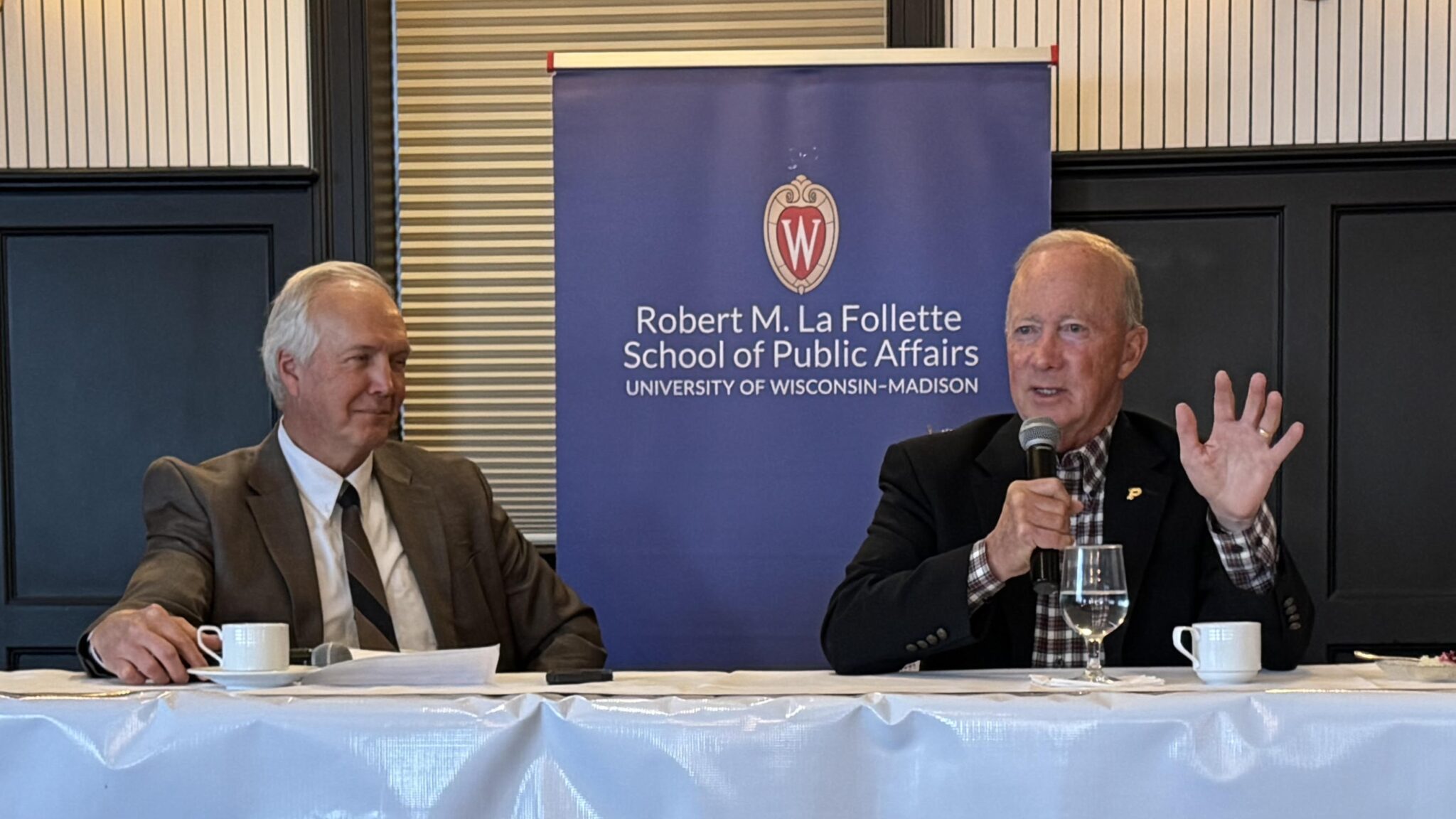
Former Indiana Gov. Mitch Daniels praised Wisconsin’s purple streak but bemoaned the state’s practice of electing judges, saying it “was never a good idea” and erodes faith in the judiciary.

Daniels noted 37 states have single-party control of government, including Indiana, most of which have legislative supermajorities. He also pointed out during the WisPolitics-State Affairs breakfast held Tuesday in conjunction with the UW-Madison La Follette School of Public Affairs that only a handful of states have U.S. senators from both parties, as does Wisconsin.

Daniels, a Republican, served eight years as governor before leaving in 2013 to become president of Purdue University, a post he held through 2022. He was on the UW-Madison campus Monday as part of a La Follette school speaker series.

Daniels said he worked under divided government for half of his tenure and GOP control for the other half. While he said working under one-party control was better for the short term, too few places now have competition. That competition, he said, “leads to improvement and to better outcomes.” 

He said divided government brings frustration, but “that’s what James Madison had in mind that quarter millennium ago that we’re celebrating right now.

“So on those days when you find, for some reason, find your current situation difficult or exasperating or something, I’d say, count your blessings. Because government’s got problems enough, and when it becomes fat and complacent and there is no pressure and no meaningful countervailing force, it’s not in the public interest. So good for you.”

Daniels said during his visit to Madison he found it unsettling to watch a judicial campaign ad he called “the most insipid political commercial” he’s seen in a while. He declined to name which candidate the ad was about.

“I was embarrassed for the candidate—a judge—to have to appear in an ad like this, you know, feigning empathy with some citizen and so forth as if they were running for county surveyor,” he said. “I just think that—you’re not the only state that does this—but electing judges was never a good idea.”

He bemoaned the increasing view of the judiciary as just another partisan branch of government, saying media add to the perception by ascribing political labels to judges and highlighting the party of the person who nominated them. 

“Remember, Lady Justice wears the blindfold,” he said. “And all but a few that I’ve ever observed at any level are trying to do that, and we need them to do that, and we need the public confidence that that’s what they’re doing.”

During the discussion, Daniels also called upon Congress to reassert its authority under Article 1 of the Constitution, saying lawmakers have let presidents over the years claim too much power for the executive branch.

“They need to step up to their Article 1,” Daniels said. “There’s a reason it’s Article 1 responsibilities, and that’s what the Supreme Court told them once or twice already, and I hope it’s getting ready to tell them again.” 

He said the Supreme Court will soon come out with its decision on a case challenging Trump’s tariffs.

“I hope they smack them down hard and basically say, ‘No, the executive branch doesn’t have that unilateral power,’” he said. 

Daniels noted one area Congress has pushed back is against cuts the Trump administration made to universities.  

“It’s one of the few counterexamples to what we just talked about,” he said, “because the Congress has restored the research funding in large part, and Republicans voted for that, and they should have. That would have been a bad, self-inflicted wound if it had stuck.”

He said there is a kernel of validity to many of President Trump’s criticisms of higher education, but the administration’s initial proposals to address them “would have thrown out a very large baby with a small amount of bathwater.”