
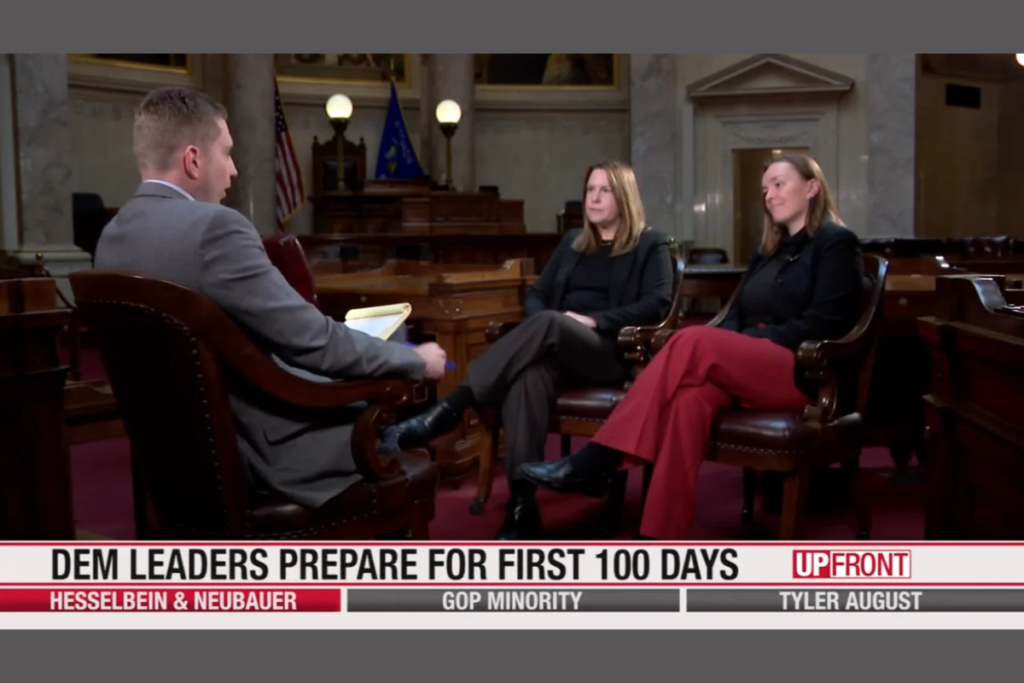
Incoming Dem legislative leaders are promising an ambitious agenda in January, dismissing concerns they’ll do too much too fast as they prepare to take power for the first time in 16 years.
“People have been waiting a very long time for this moment,” incoming Senate Majority Leader Dianne Hesselbein, D-Middleton, told WISN 12’s “UpFront,” produced in partnership with WisPolitics.
Hesselbein appeared alongside incoming Assembly Speaker Greta Neubauer, D-Racine.
“We are going to do a lot of things that our Republican colleagues probably aren’t going to be happy with,” Neubauer said. “But we also are very committed to hearing their ideas and to giving some bills hearings and hopefully seeing them passed.”
Both said they were still weighing the first bills they will introduce in each chamber in January.
“We’re going to consider multiple options,” Neubauer said. “But of course, that includes things like healthy school meals for all. It is looking at property taxes and investing in schools, cost of healthcare, of course, and prescription drugs. We’ve got a number of things that we’re considering for those first items.”
Hesselbein and Neubauer said they would likely propose directing money from the projected $3 billion surplus to special education and general school aid “and other buckets of money that would address the rising property taxes” while dismissing the idea of sending rebate checks to taxpayers.
“Yeah, I think we’re thinking about some longer-term ways to really lower people’s costs,” Neubauer said.
Hesselbein said Democrats are looking at proposals to raise the minimum wage and raise taxes on the wealthiest Wisconsinites but didn’t offer a specific tax plan.
“We’re going to consider a couple of options,” Neubauer said. “I wouldn’t say we have a specific proposal we’re aligned on yet.”
Legalizing marijuana, both said, is also a top priority.
“People across the entire state have had these referendums saying they want to legalize marijuana,” Hesselbein said. “And we know that we’re losing money to our neighboring states. We need to get that done.”
Democrats have long advocated using tax revenue from legalized marijuana to help fund their priorities.
A past proposal from Gov. Tony Evers to legalize marijuana was projected to bring in more than $113 million in revenue over two years.
“I don’t think there is one magic solution,” Hesselbein said.
Neubauer added, “It’ll help. We will need those dollars to come in so that we can make the budget work, but of course there’s a lot of pieces to figure out.”
Both committed to repealing Act 10, the 2011 law that eliminated collective bargaining for most public employees.
Neubauer said Dems will need to consider the full impact on local governments and school districts of repealing the law, which includes requiring higher payments from public employees for their healthcare and pensions.
“We’re going to work really hard to not have working people feel increases in their costs over the next two years,” Neubauer added when asked about tax increases if Act 10 is repealed. “We know it is our responsibility to help people make ends meet.”
Democrats are now poised to redraw Wisconsin’s congressional maps ahead of the next census. Gov.-elect David Crowley said last week on “UpFront” he would sign the bill into law. GOP incumbents lost in the 1st and 3rd congressional districts under current maps Dems say favor Republicans. Donald Trump won the 3rd by 7.5 percentage points in 2024 and the 1st by 4.
“Donald Trump put us in a place of needing to respond to his efforts to permanently entrench his power and the Republican Party’s power,” Neubauer said. “We are very invested in making sure the will of the voters is heard.”
Democrats nationally and in Wisconsin are also pushing a plan to split with the Electoral College and join a movement that would give Wisconsin’s electoral votes to the winner of the presidential popular vote, a move Republicans have decried as unconstitutional.
“I think the people of Wisconsin might enjoy not being at the center of every presidential election and having their televisions flooded with ads for months on end,” Neubauer said. “You know we’re going to, of course, be talking to more people of Wisconsin and to our members and to the governor about this proposal, but I do think that it is good to consider ways to make sure that the people of this state and the people of this country feel confident that the will of the voters is heard in every election.”
GOP Rep. Tyler August, the incoming Assembly minority leader, says Republicans will look at a number of options as they prepare to govern under Dem control.
“There’s procedural things that you can do within the rules,” August told “UpFront.” “I’m the former speaker pro tem, so I’m very well versed in those. And, you know, we’re not going to do that on everything, but there are things that probably need to be slowed down and taken a look at a little more just so that the public can weigh in on some of these things, and so we’ll be looking at those kinds of options. But really our job is to stand up and say, hey …you didn’t campaign on these things. This is not what you were elected to do.”
August said come January, there will be just three Republicans in the Assembly who have governed in the minority.
“It’s a big change for a lot of our members,” August said. “Republicans have been leading the state with now just two blips of minority for really 30 years, so there’s going to be a bit of a learning curve for our members.”
August said the GOP caucus will push back on Democrats’ legislative priorities, including repealing Act 10.
“I was there for Act 10,” August said. “I voted for Act 10. It’s one of the best votes I’ve ever taken, still to this day. The amount of money it’s saved local municipalities, and which ultimately saved taxpayers, so I think when they say they’re moving fast, they’re kind of admitting that they’re trying to get things passed before people actually have a chance to stand up and say, wait a minute, this isn’t what we voted for.”
August said he was unsure if any Republicans would back Democrats’ efforts to legalize marijuana.
“I think it totally depends on what it looks like,” he said. “We’ve had members, myself included, that have been more open to that idea than other Republicans in the past. I think the wise way to do it would be maybe go down the road of medical marijuana first. There’s not been a lot of states that have ever gone from no legality of cannabis at all to have just full-blown recreational and medical all at the same time.”
August also said there would be immediate litigation if Democrats push through a plan that would give Wisconsin’s electoral votes to the winner of the presidential popular vote.
“I imagine there will be a lot of people that sue over this,” August said. “We haven’t had internal discussions as a party or as a caucus about that, but there’s been outside groups already that have indicated that if they go down this road, there will be litigation. I think there’s some significant constitutional questions surrounding this, and if this is what the new majorities are going to be focusing their time on, I don’t know how that helps the average Wisconsinite who’s struggling to pay bills right now.”
See more from the show.