By Larry Sandler
For WisBusiness.com
Jim Doyle still dreams of what might have been.
The former Wisconsin Democratic governor backs a revived plan to extend Amtrak service from Milwaukee to Madison. But he bemoans the loss of the more extensive plan he championed 16 years ago.
In January 2010, Doyle’s administration won an $810 million federal grant that would have covered the full cost of upgrading and extending Amtrak’s Chicago-to-Milwaukee Hiawatha route, with six of the Hiawatha’s seven daily round trips continuing to Madison at 110 mph. Unlike most federal grants, the state would not have been required to pay any of the project’s capital costs.
But Republican Scott Walker campaigned against the high-speed trains in his bid to succeed the retiring Doyle that year. Walker focused his opposition on the extension’s projected operating costs of $7.5 million a year, which would have been largely offset by fare revenue and expected additional federal grants.
After Walker beat Milwaukee Mayor Tom Barrett, Doyle put the project on hold while U.S. Transportation Secretary Ray LaHood tried to convince Walker to let it move forward. When Walker insisted he wanted to spend the money on highways instead, the federal government yanked the grant and redistributed the money to other states before he took office.
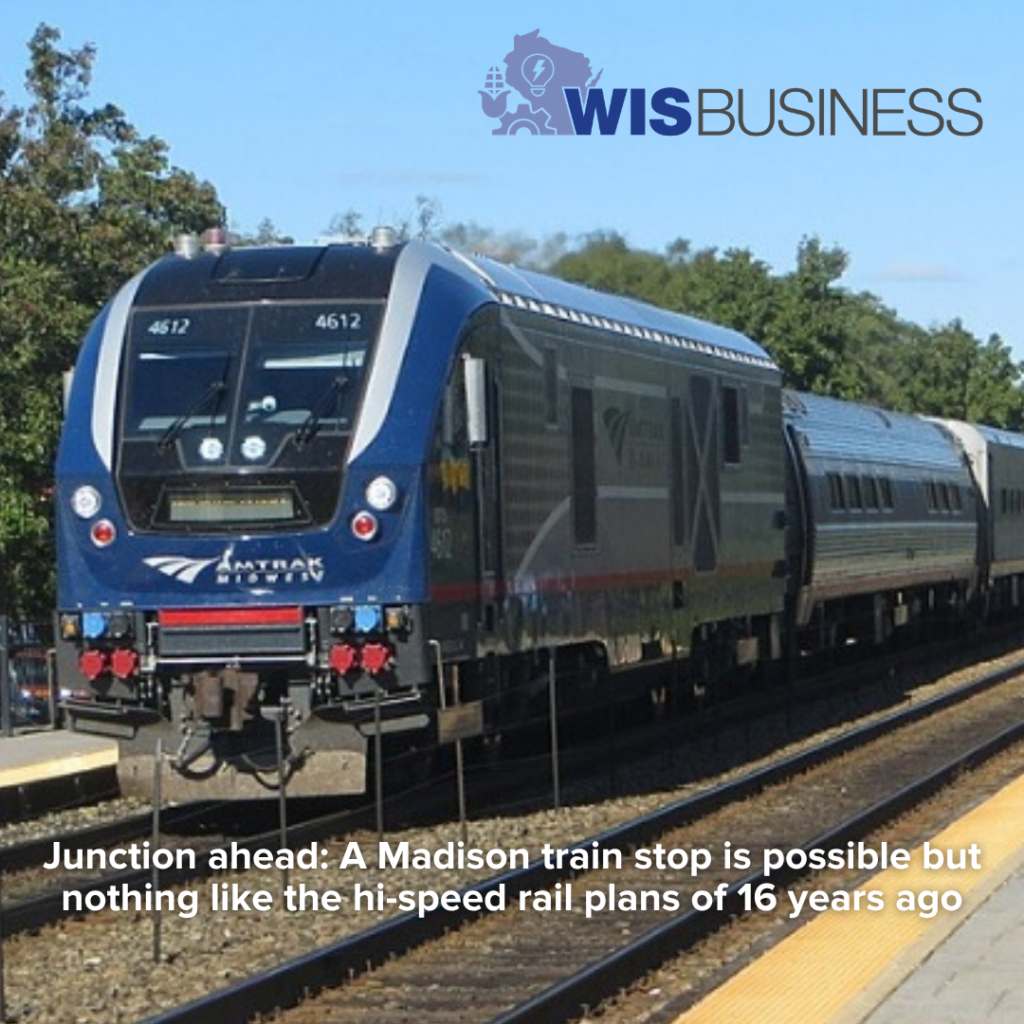
Now Amtrak and the Wisconsin Department of Transportation are studying a 79-mph extension to Madison, which Amtrak calls the Hiawatha West. If the project is approved and funded, service could begin in the early 2030s, Amtrak spokesman Marc Magliari said. With two round trips daily, Amtrak projects ridership at 255,500 a year.
“This is such a minor thing compared to what Walker killed before,” Doyle said in an interview. The two-term chief executive added that he still thinks the new plan is a good idea and “something is better than nothing.”
Under the federal Bipartisan Infrastructure Law, WisDOT landed a $500,000 grant to start studying the Milwaukee-to-Madison extension. Like its earlier version, the new route eventually could extend to the Twin Cities by way of Eau Claire. WisDOT has completed the preliminary phase and is awaiting Federal Railroad Administration approval and additional funding to continue planning.
Meanwhile, Amtrak has jumped in to speed up the process by launching its own study of how the Milwaukee-to-Madison segment could work, including possible schedules and new stations in Pewaukee, Watertown and Madison. Those are details that WisDOT otherwise would have had to figure out.
Amtrak has scheduled a webinar for 7 pm April 14 to inform the public about the project. The railroad also has set up a website to gather public comments.
Madison has already chosen two possible sites for a station, while Watertown and Pewaukee have agreed to work with Amtrak on selecting station sites, officials in all three cities said. Watertown initially included $100,000 in its 2026 city budget to acquire a station site, but removed the appropriation because of uncertainty about when it would be needed, Mayor Robert Stocks said.
In another move to hasten the process, service is likely to start with temporary stations, as on Amtrak’s new Mardi Gras line from Mobile, Alabama, to New Orleans, Magliari and local officials said. Temporary stations were installed in Wauwatosa, Elm Grove, Pewaukee, Oconomowoc and Watertown during a three-month trial extension of the Hiawatha in 1998. But the new Watertown and Pewaukee stations wouldn’t necessarily be in the same places, Stocks and Pewaukee Mayor Steve Bierce said.
However, the Hiawatha West isn’t a sure thing. Like other medium-range routes, it would require state operating subsidies, which means its fate will rest with the new governor and Legislature elected in November.
Democratic Gov. Tony Evers has supported passenger rail expansion, while the top two Republican legislative leaders, Assembly Speaker Robin Vos and Senate Majority Leader Devin LeMahieu, have adamantly opposed funding trains to Madison. None of those three is seeking re-election. Democrats, meanwhile, are optimistic about their chances of holding the governorship and capturing at least one house of the Legislature.
Intercity rail had bipartisan support when Republican Tommy Thompson was governor in the 1980s and 1990s. Thompson, who also served as Amtrak board chair, energetically advocated for passenger rail expansion across the Midwest, including the route to Madison.
But Doyle said Republicans seized on high-speed rail as a wedge issue to help mount a backlash to first-term Democratic President Barack Obama in the 2010 midterm elections.
“This was all caught up in the politics of 2010 and Obama and the (2009) stimulus act,” which boosted spending on infrastructure to help pull the economy out of the Great Recession, Doyle said. “The Tea Party was on the rise. … If that train had come up two years before, without the election being right there, who would have turned it down?”
Ohio Republican John Kasich took the same position as Walker in his own successful 2010 gubernatorial campaign, rejecting a $400 million federal grant for a high-speed route that would have connected Cleveland, Columbus and Cincinnati.
During the Wisconsin campaign, Thompson supported Walker’s position that the money should go to highways. In 2019, Thompson told Wisconsin Public Radio that the 2010 plan was flawed because it called for stops in Brookfield and Watertown, instead of express service from Milwaukee to Madison. He did not respond to requests for an interview for this article.
Walker’s views haven’t changed. After Madison chose its top two train station sites for the proposed route, he posted on social media, “This is a dumb idea.” Walker claimed his 2010 stand was vindicated by multi-billion-dollar cost overruns for California’s Los Angeles-to-San Francisco high-speed rail plan. But that’s a far more ambitious project: stretching almost 500 miles, compared with 80 miles from Milwaukee to Madison; almost entirely on all-new track, instead of completely on upgraded existing tracks; at a top speed of 220 mph, the highest in the nation, instead of 110 mph; and at a cost of $126 billion, rather than $810 million.
Doyle said “Republican politicos” lumped Milwaukee-to-Madison high-speed rail together with two entirely different proposals that had already become more partisan: a Milwaukee-area light rail system and a commuter train line linking Kenosha, Racine and Milwaukee. Walker had fought light rail and the succeeding streetcar project as a state lawmaker and Milwaukee County executive, while Vos had battled commuter rail since he was a Racine County supervisor.
At the same time, Doyle believes conservatives harbored a particular animosity toward serving the liberal bastion of Madison, even as rail supporters saw logic in linking Wisconsin’s two largest cities. By contrast, Vos, LeMahieu and other Republican leaders never have expressed a public position about extending the Hiawatha to Green Bay and other Fox Valley cities, another idea under study by WisDOT.
In the 2023-’25 state budget, the GOP-led Legislature sliced Evers’ request for a $3.5 million boost in passenger rail funding to $971,200 over two years. That was still enough to cover the state’s share of operating costs for the new Borealis route to the Twin Cities, which started in May 2024. The line’s single daily round trip follows the same route as the Chicago-to-St. Paul segment of Amtrak’s long-distance Empire Builder, by way of Milwaukee and La Crosse.
Evers then sought to more than double rail funding in the 2025-’27 budget, partly to plan for expansion on multiple routes. But Republican lawmakers deleted his request, freezing the appropriation at $7.3 million a year. Faced with inflation and rising costs, WisDOT raised Hiawatha fares by an average of almost 15%; eliminated the bus route that allowed Hiawatha passengers to continue from downtown Milwaukee to Green Bay; and trimmed other expenses.
On March 13, Democrats introduced a bill to add the $15.2 million in passenger rail funding cut from Evers’ budget. Although that measure died when the regular legislative session ended 10 days later, rail supporters “wanted to keep the conversation going” and set the stage for the next governor’s 2027-’29 budget, said Sen. Mark Spreitzer, D-Beloit, the bill’s lead Senate sponsor.
“What happened in 2010 was incredibly unfortunate, and we’re still feeling the effects,” Spreitzer said. “We could have been so much further” ahead on rail expansion if the original project had been completed.
Since then, interest in passenger rail has been stimulated by rising gas prices and air travel hassles, said Chris Ott, president of the Wisconsin Association of Rail Passengers. Doyle also pointed to increases in Illinois highway tolls and Chicago parking rates.
Businesses see economic benefits as well, Ott said. Since 2023, 70 companies and nonprofit institutions have signed on to a statement supporting passenger rail expansion “as a needed and worthwhile investment” to attract new businesses and employees and to spur development and tourism. The list includes such high-profile organizations as the Green Bay Packers, Milwaukee Bucks, Madison Gas & Electric, Molson Coors and Schneider National. Leaders of the Wisconsin Business Coalition for Passenger Rail did not respond to requests for comment.
Amtrak sees the Hiawatha West as “an extension of the successful Hiawatha service,” similar to the Borealis, which has already exceeded expectations, Magliari said.
The Hiawatha is Amtrak’s most frequent, most heavily used and most lucrative route between the East and West Coasts. For the federal fiscal year that ended Sept. 30, it carried 631,990 passengers on six daily round trips, down from 665,279 the prior year, when one of its seven trips was converted into the Borealis. Meanwhile, the Borealis carried 212,909 passengers in its first full fiscal year of service.
Fares covered 63% of Hiawatha operating costs and slightly more than 50% of Borealis operating costs in the most recent fiscal year. Outside the East Coast, the only other routes with farebox recovery ratios above 50% were the Chicago-to-St. Louis Lincoln and the Chicago-to-Michigan Wolverine.
Together, the Hiawatha and Borealis have “a history of success, showing there is interest” in a passenger rail alternative to driving on Wisconsin freeways, Magliari said. Separate WisDOT studies are underway on increasing service on both routes.
While no cost estimates have been developed yet for the Milwaukee-to-Madison segment, it’s expected to be significantly less expensive than the 2010 version, because it’s not high-speed rail and will require fewer infrastructure improvements, Madison Transportation Director Christof Spieler said. However, inflation has likely driven up some costs, Spreitzer added.
For the latest plan, the 80-mile route from Milwaukee to Madison includes 45 miles of Canadian Pacific Kansas City freight tracks already used by the Borealis and Empire Builder, plus 35 miles of state-owned track operated by Wisconsin Southern Railroad. Although the Wisconsin Southern tracks have been upgraded since 2010, they would need more renovation to handle 79-mph passenger operations, while the CPKC tracks might need work to increase capacity.
Walker’s opposition also increased state costs because the original grant did not require a state match, Doyle noted. Many of the Chicago-to-Milwaukee Hiawatha upgrades that would have been included in the original project at the federal government’s expense have since moved forward with the state paying part of the cost, including renovations at the downtown Milwaukee and Mitchell International Airport stations.
In 2012, over Walker’s objections, Vos and other GOP lawmakers refused to honor a deal that Doyle had reached for Spain’s Talgo to build its European-style trains in Milwaukee for the existing Hiawatha. Talgo sued and a settlement resulted in the state spending a total of $60 million, not including interest, on two trains that the manufacturer eventually resold to Nigeria. Later, the state spent another $13 million as its share of other new trains for the Hiawatha.
Doyle, now 80, says “it would be nice” if he could ride on the proposed extension one day. But he adds, “I would rather be riding one of those (Talgo) trains at those (110 mph) speeds.”