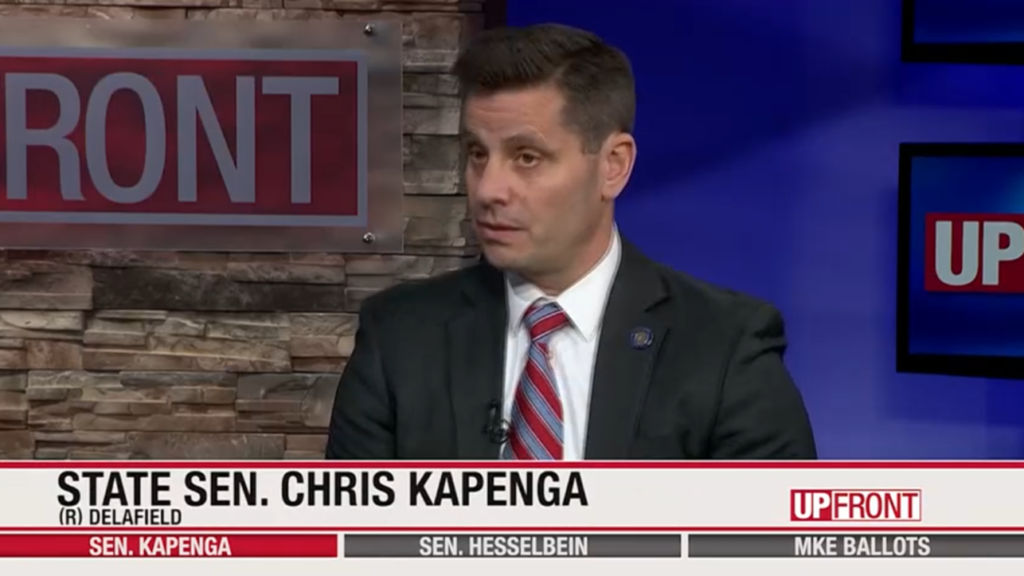
GOP State Sen. Chris Kapenga says Senate Majority Leader Devin LeMahieu could lose his leadership post if he brings the online sports betting and NIL bills to the floor for a vote Tuesday, as both face some Republican opposition.
“Precedent has always been you’ve got to have the rule of 17, if it’s Republican or Democrat votes,” Kapenga said on WISN 12’s “UpFront,” which is produced in partnership with WisPolitics. “So I hope the majority leader doesn’t go there. I think it’s very dangerous for him if he does go there, so I just hope it doesn’t happen.”
Kapenga said neither bill has enough Republican support to pass without Democrats.”I’ve heard the word shameful, so I will use that in my comments,” Kapenga said, referring to the online sports betting bill. “It’s shameful that when you look at the money that’s behind this, and you don’t have a coalescence of the Republican votes, that’s very concerning to me, so I hope it does not go to the floor.”
The legislation, which passed the Assembly, would legalize online sports betting operated through Wisconsin tribes.The NIL bill, which passed the Assembly 95-1, would allocate nearly $15 million annually for debt services for UW-Madison athletic facilities, freeing up money for payments to athletes.LeMahieu is the lead co-author in the Senate of the NIL bill, which Kapenga and three other Senate Republicans voted against in committee last week. Republicans have an 18-15 majority.
>> WisPolitics is now on the State Affairs network. Get custom keyword notifications, bill tracking and all WisPolitics content. Get the app or access via desktop.
“We’ll just have to see what the majority leader does,” Kapenga said. “But he absolutely would have to go to Democrat votes to get it done because there’s a large part of the caucus that does not support it.
“On ongoing tax relief negotiations between Republicans and Gov. Tony Evers, Kapenga said Senate Republicans are still united in demands that any compromise include rebate checks.
“Each side has to move to the middle,” Kapenga said, referring to Evers’ demands for more education funding. “So if we see something that keeps our rebate checks in place, we would be open to having a discussion about it.”
Meanwhile, Senate Democratic Minority Leader Dianne Hesselbein says “a lot” of Senate Democrats support the online sports betting bill, adding it has a strong chance of passing if brought to the floor for a vote.”I think a lot of us are in favor of this right now,” Hesselbein told “UpFront.” “Sports betting is happening in the state of Wisconsin, but it’s happening with these companies from out of state, out of the country. And I think it makes sense to have our Native American tribes be able to benefit.”
Hesselbein wouldn’t specifically say if she’s pressuring Senate Majority Leader Devin LeMahieu to bring the sports betting and NIL bills to the floor for a vote.
“It’s just a lot of conversations, a lot of phone calls that I’m making with members saying what their thoughts are on it, what they think of it,” Hesselbein said. “There are certain people in favor, and some people aren’t, so just trying to figure out what people want to do.”
Beyond that, Hesselbein said Democrats plan to introduce a series of amendments Tuesday beyond the bills that will be placed on the calendar.”
We are hoping to continue to push our amendments that really help with affordability and the rising cost in the state of Wisconsin,” she said. “We know that people, we’ve been listening to people actually since day one when it first started this session, about what healthy meals at school could do, free healthy meals for kids would give free meals at lunchtime, but they would do better in school, and it would also help parents like $1,500 with their grocery bills. That’s real money that would be an instant savings, so we’re hoping that Republicans will listen to us and actually get a vote on that to move things forward.”
Don Millis, a Republican member of the bipartisan Wisconsin Elections Commission, says it would be a challenge to implement parts of the SAVE Act in Wisconsin if passed by Congress and signed by President Donald Trump.
“There could be a lot of impacts,” Millis told “UpFront.” “The SAVE Act, as it passed the House, just really has two provisions, the citizenship requirement and the voter ID requirement. We already comply with the voter ID requirement. The citizen requirement would be, that would be a challenge. I know that in the Senate, there have been talks about adding other things into the SAVE Act. That, I think it would be hard for Wisconsin or other states to comply if it is enacted, if it passes the Senate, it was signed by the president and it survives a court challenge.”
Millis also weighed in on Milwaukee’s 2020 absentee ballots, which have not yet been destroyed because of ongoing litigation, amid growing concern from local election officials that the FBI could subpoena election records in Wisconsin.
“I would think that it’s possible,” Millis said when asked whether the ballots should have already been destroyed. “They’re having two lawsuits, one against the city, which has been resolved, and then one against the county. And if you’re representing the county or the city, it seems to me your first obligation is to tell the judge ‘Look, the election deniers or conspirators who are trying to sue us and want all these sorts of documents, and all that they may be entitled to certain documents, they shouldn’t be entitled to these secret ballots,’ and it seems to me that they should have made an effort. The attorneys or the county should have made an effort to get a court order allowing them to dispose of these ballots as they are normally disposed of everywhere else in the state 22 months after the 2020 election.”
“My understanding, I don’t have personal knowledge, is that those efforts have not been made,” Millis added. “And my concern is if the county clerk can’t stop some yahoo from central Wisconsin who wants to look at these ballots, have access to them, how is the clerk going to stop the FBI with a search warrant or the Department of Justice?”
Millis, though, said there’s no evidence yet the FBI is set to subpoena records, as it has in other states like Arizona.
Tourism Secretary Anne Sayers says the state is already seeing interest after recently launching Wisconsin’s new film office and tax credits to produce films in the state.
“By finally having a film office and the film tax credit, the announcement got a lot of attention,” Sayers told “UpFront.” “We’re seeing a lot of interest, so stay tuned because I think we will be seeing more Wisconsin on our screen soon.”
The new provisions, part of the most recent state budget, create the Wisconsin film office and allocate $5 million a year in tax credits.
“Anytime we’re filming in Wisconsin, we are translating that into big bucks for Wisconsin,” Sayers said. “So anything we take on, whether it’s the ‘Top Chef’ that we saw in the past, huge income for Wisconsin. And it’s the kind of thing that leads to more income down the road because people are doing what’s called set-jetting. It’s two-thirds of global travelers who are actually deciding where to take vacations based on what they’re inspired by seeing on the screen.”
She said the new office and credits make Wisconsin competitive.
“It’s kind of amazing to think that just a couple of months ago, we were one of four states that didn’t have an office, one of 14 states that didn’t have any tax credits,” Sayers said. “Now, suddenly, we can be competitive when those productions are being made. We can keep our filmmakers in-state and attract out-of-state filmmakers in a way that we just didn’t have the ability to be competitive only a few months ago.”