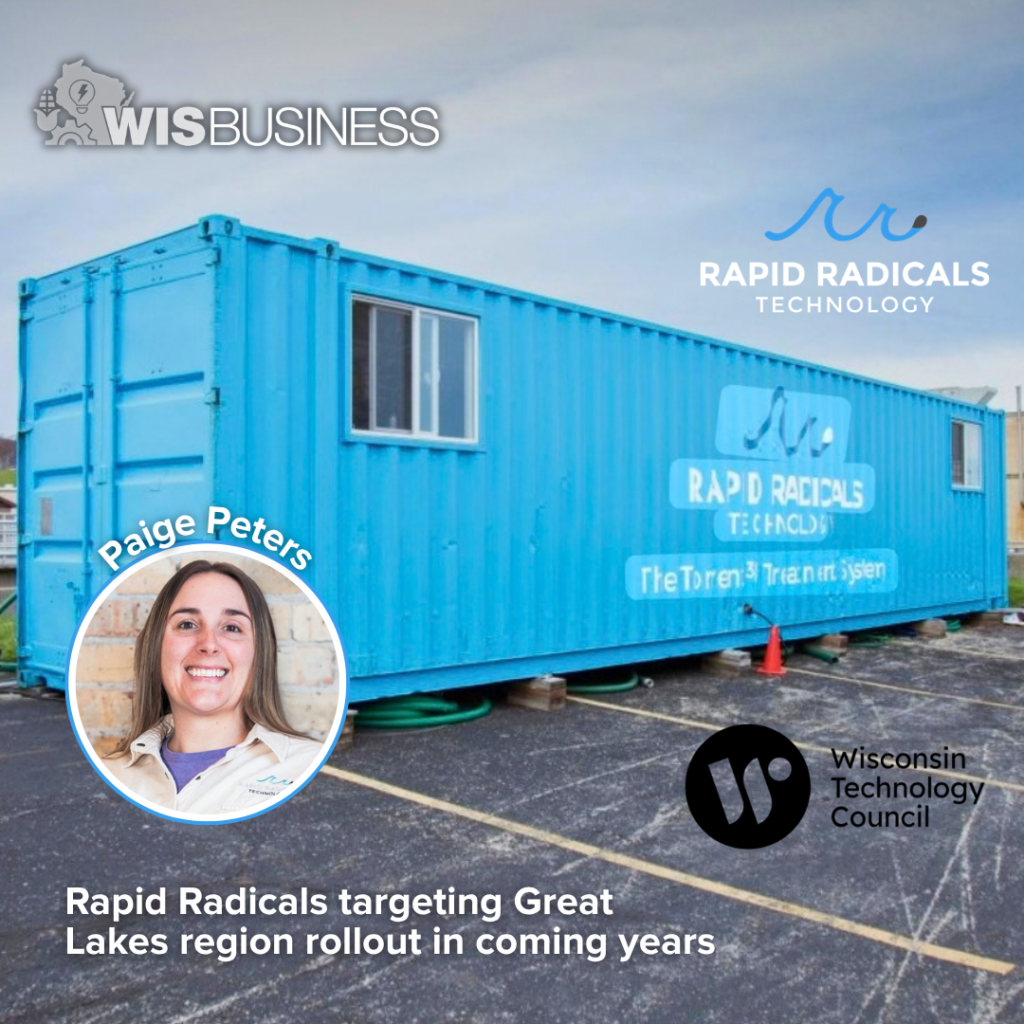
After securing a patent late last year for its wastewater treatment technology, Rapid Radicals aims to deploy the tech in major Midwest cities and coastal communities in the coming years.
That’s according to founder and Chief Technology Officer Paige Peters, who spoke yesterday during the Wisconsin Technology Council’s Launch Wisconsin conference at Marquette University in Milwaukee.
Her Milwaukee-based business, which previously won the grand prize in the Wisconsin Governor’s Business Plan Contest in 2022, offers a water treatment system packaged into a modular shipping container called the Torrent3.
Along with reducing the footprint needed for municipal and industrial water treatment, the company boasts a substantial reduction in hauling and operational costs for customers.
“I truly believe that it can solve some really important problems,” Peters said yesterday of her company’s technology and where it’s headed. “Seeing blue containers on … the five most important sewer overflow locations for the Great Lakes cities and coastal cities, seeing this deployed at industrial facilities where we can really help, like I said, solve problems and eliminate burden on municipalities.”
She launched her company 10 years ago as a spin-off from Marquette University after establishing a method for treating municipal wastewater 22 times faster than conventional treatment systems currently in use. The business has since expanded its scope to include industrial wastewater.
While Peters expressed confidence in the effectiveness of her company’s solution to wastewater treatment, she noted the sector she chose to target is capital-intensive and highly technical.
“We are trying to sell to a very slow-moving, risk-averse, long sales cycle industry, which means that timing can be incredibly unpredictable,” she said, adding “there’s statistics that say it takes 12 years for any sort of water technology to leave the lab and enter the market. We did it in nine years, so I feel really excited about that.”
Meanwhile, Peters urged other entrepreneurs in attendance to ensure what they’re developing is truly responsive to “the problems of the market,” especially those with a built-in customer base.
She referenced Rapid Radicals’ efforts to apply its tech elsewhere, such as dairy processing. Within three months of making that pivot, the company had its first customer and had started deploying its system on-site.
“A problem is really only something someone is willing to pay to solve, not just a nuisance, not just an inconvenience,” she said. “So factoring that in as I scaled the technology was really, really crucial.”