
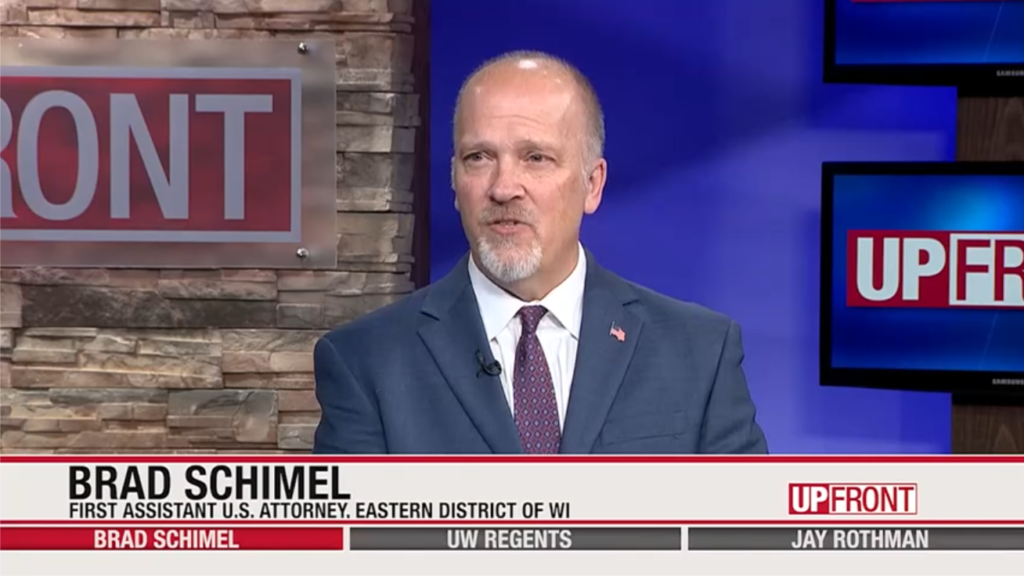
Brad Schimel, the first assistant U.S. attorney in the Eastern District appointed by former Attorney General Pam Bondi, says he feels no political pressure from the Trump administration on how to lead the office.
“Nothing,” Schimel said on WISN 12’s “UpFront,” which is produced in partnership with WisPolitics-State Affairs. “We have biweekly meetings with someone from the office of the deputy attorney general; all U.S. attorneys nationwide are on it.
“The pressure we’re getting: We want you to go after terrorists. We want you to go after drug traffickers. We want you to go after people who are pulling triggers and harming other people in our communities. The newest initiative is one I’m thrilled about, and that is Acting Attorney General Blanche has announced a huge focus on fraud against public benefits and against the United States and our state government. I’ve seen things that are making my head spin in the amount of fraud that goes on” here in Wisconsin.
Schimel added: “We’re going to go after the big stuff, and there’s going to be plenty. There’s going to be plenty for the picking.”
>> WisPolitics is now on the State Affairs network. Get custom keyword notifications, bill tracking and all WisPolitics content. Get the app or access via desktop.
Bondi recently appointed Schimel to the post after his interim 120 days as U.S. attorney ended and federal judges in Milwaukee declined to make him the permanent U.S. attorney.
“I have everything but the title,” Schimel said. “There are a few glitches, a couple of things that you have to be an actual U.S. attorney to sign off on, but we just have the attorney general’s office take care of those things. But largely, I run the office.”
Critics, like Democratic Sen. Tammy Baldwin, have criticized the process.
“This is actually what the law provides,” Schimel added. “What’s happened with this blue slip process is they’ve given a veto to senators of the opposite party of the president, and that’s what happened in Wisconsin; I got vetoed.”
Baldwin and U.S. Sen. Ron Johnson, R-Oshkosh, use a commission to identify candidates for federal appointments. The members of that commission last year failed to reach consensus on any applicants, and no candidates were forwarded to the White House for consideration. The president also has submitted to the Senate any nominations for the U.S. attorney’s office in the Eastern District.
President Donald Trump has urged the Senate to end blue slips, a tradition that allows senators the ability to approve or object to judicial or U.S. attorney nominations.
“I think it should stay in place for judicial appointments,” Schimel said. “For judicial appointments, that is a lifetime, and you are completely independent. No one controls what you do expect if they appeal you. But with appointments for U.S. attorney and U.S. marshals, you answer to the president, and the president can fire you at any time with no reason at all.”
Schimel, the former Republican attorney general, lost by 10 points in last year’s Wisconsin Supreme Court race to now-Justice Susan Crawford in what was the most expensive court race in the nation’s history.
“Judge Lazar handled herself with grace,” Schimel said, referring to Maria Lazar’s 20-point loss to Chris Taylor on Tuesday. “I’ve been there. It’s the most devastating moment. …And she really handled herself well, and that’s so critical because the voters in our state need to see that. They need to see that you accept the results of an election. You move on. It’s a peaceful process.”
Schimel blasted the current state law, backed by Republicans and signed by former Gov. Scott Walker, that allows unlimited donations to state parties, which then can be transferred to individual candidates.
The state GOP transferred $9.3 million to Schimel’s campaign for the Supreme Court and reported another $245,194 in in-kind contributions from the party.
“It’s a terrible law,” Schimel said. “Now, I used it, of course, last year, because I had to.”
Ousted Universities of Wisconsin President Jay Rothman says the system “needs a Board of Regents that is functional” after the board unanimously voted to fire him.
“A board that speaks with one voice to the management team — that it’s not 18 people providing what their views are,” Rothman told “UpFront.” “You have to have a board that has courage to make really tough decisions and back up the management team when they make tough decisions. You have to have a board that speaks with one voice when they choose to speak, and not have individual regents reach out to media or otherwise on background or for direct attribution without some level of coordination going forward.”
When asked if he was referring to the current board, Rothman said, “I’m not going to comment on the existing board. I’m looking at the future.”
Board of Regents President Amy Bogost told lawmakers Thursday that the board stands by its decision and criticized Rothman for his recent interviews.
“I believe his objective is to get his narrative out and be one-sided,” Bogost said. “He knows I cannot rebut what he’s saying, and he knows the truth. He knows the truth and understands what this is about.
“To do the media circuit that he’s on denigrates our wonderful universities, and that makes me really sad,” she added.
Rothman said he had no regrets after broadly lobbying Republicans for more state funding while also working on a bipartisan deal that included a freeze in diversity, equity and inclusion hires.
“I had to make difficult decisions,” Rothman said. “The decision around DEI was hard. The decision around branch campus closings was hard, and I know when you make hard decisions, you were going to cause some people not to be happy with those decisions. But at the end of the day, my North Star has always been what’s in the best interest of the University of Wisconsin, and I don’t regret those decisions. Did I make mistakes? Of course I did. I learned from them — I hope I did.”
Rothman also said he does not plan to fight the firing, noting that the board has the ability to terminate his contract with or without cause.
“They’ve chosen to do that,” Rothman said. “I would have asked, and I did ask multiple times, for a reason, and I was not given one. And they may not owe that reason to me, but I suspect they owe it to the state of Wisconsin, to the universities, to the taxpayers and, quite frankly, all residents of the state.”
See more from the show.