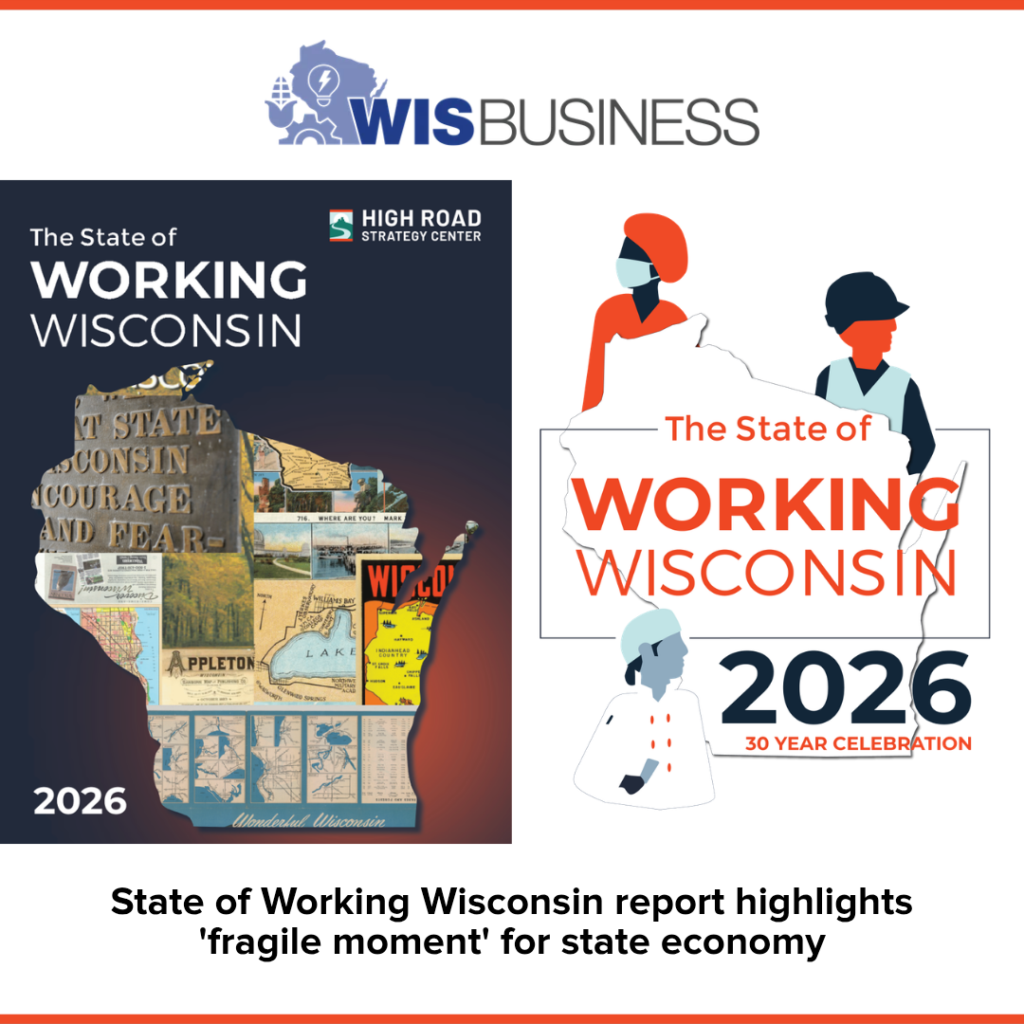
The latest State of Working Wisconsin report highlights “a fragile moment in the economy” as record-high wages are offset by rising inflation and faltering job growth. 

The report, now in its 30th year, was created by the High Road Strategy Center, a UW-Madison think tank formerly named the Center on Wisconsin Strategy. 

Report author Laura Dresser says the latest report “still shows some very bright spots, but the clouds are gathering on the economic horizon.” 

Wisconsin’s inflation-adjusted median wage reached a record high of $26.17 per hour in 2025, rising from about $24 per hour in 2022, the report shows. Dresser calls this “very good news” for workers, noting wages are the clearest measure of job quality in the state. 

But while wage data for this year aren’t yet available, “the signs there are troubling,” wrote Dresser, the center’s associate director. 

“Inflation has risen, and wage gains have been weaker,” she wrote. “As it did in 2022, inflation could wipe out the wage gains of 2026. The median wage provides an aggregate picture but cannot illuminate deep and shifting gaps by race, gender, ethnicity, and education.” 

The median wage for men in Wisconsin was $28.25 per hour last year, more than $4 more than women’s median of $24.24. 

Among groups broken down by race, ethnicity and gender, white men had the highest wages with $29.37 per hour. That’s followed by $24.92 for white women, $24.04 for Black men, $20.67 for Black women, $19.96 for Hispanic men and $18.99 for Hispanic women. 

Meanwhile, the state’s job market “has gone flat” since late 2024 after four years of steady job growth led to the state’s record high of 3,051,000 jobs in November 2024. That’s fallen to 3,042,900 in July. 

“Wisconsin’s economy has grown slowly relative to the national economy for years, and now job growth has ground to a halt,” Dresser wrote. 

And though the state’s unemployment rate remains low at 3.3%, it has risen from the “unprecedented” low of 2.6% in early 2023. 

“With the state losing jobs, it is likely that the rate will continue to rise,” Dresser wrote. “If unemployment climbs further, workers will lose leverage.” 

The report also spotlights “much more” rapid increases in unemployment among Black Wisconsinites. This compounds existing disparities in the state. 

In the first quarter of this year, the unemployment rate for white residents was 2.3% — well below the rate for Black residents, which had risen to 7.2% at that point. Asian Americans and Pacific Islanders came in at 2.9%, while Hispanic residents had a higher rate at 4.1%. 

Between 2024 and 2025, white and AAPI Wisconsinites had no change in their unemployment rate but Black residents saw unemployment jump by 0.9 percentage points. Over the same period, Hispanic residents saw a decline of 0.1 percentage points. 

“It is disturbing to see this resurgence in Black-white disparity in Wisconsin,” Dresser wrote. “The Wisconsin disparity in Q1 2026 was the highest Black-white disparity in the nation.” 

Another section of the report highlights the state’s declining unionization rate, which has dropped from 22% in 1989 to 7.5% in 2025. While the national rate has fallen over the same period, it’s been a less steep decline, going from 20% to 11.2%. 

On a more recent timeframe, the state-level change is more dramatic. Wisconsin’s unionization was cut in half between 2011 and 2025, from 14% to 7.5%. By comparison, the national rate dipped from 13% to 11% over the same period. 

“Wisconsin’s union rates are collapsing as national unionization rates and the rates in neighboring states have fallen less rapidly,” Dresser wrote. 

See the report.