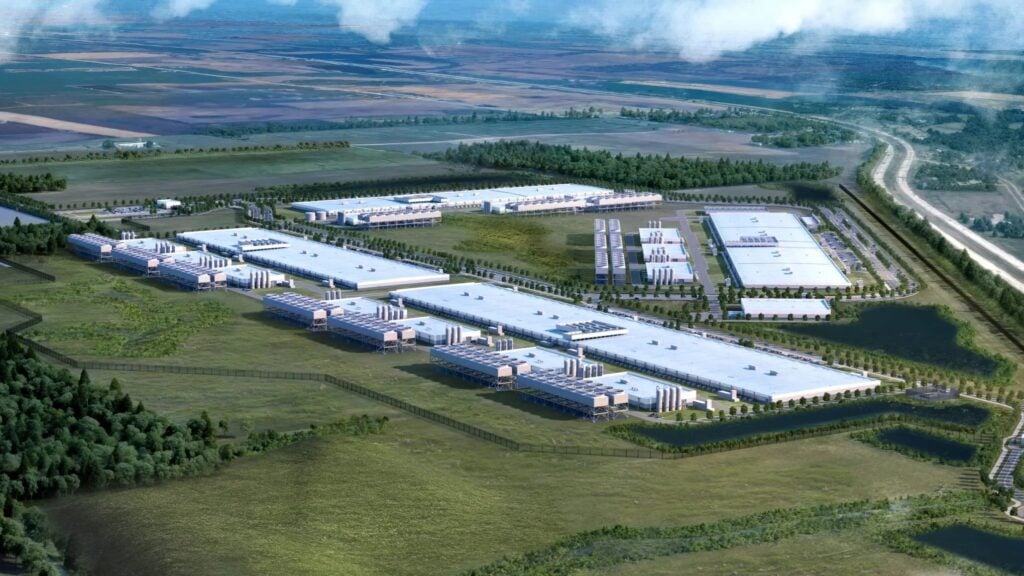
The developers of the Port Washington data center and the utility that powers it are asking the Public Service Commission to reopen the case that set the terms by which data centers buy power.

Vantage Data Centers, Cloverleaf Infrastructure and WEC Energy Group, parent of We Energies, argued in a filing yesterday that credit and collateral requirements imposed by the PSC under its “very large customer” tariff “will significantly narrow the pool of investors willing and able to fund data centers” in Wisconsin.

Specifically, they say meeting those requirements could cost data center investor Oracle, which has a market cap of $592 billion, more than $100 million in fees annually. 

Commissioners in April approved strict financial security requirements on “very large customers” in We Energies’ service area, like the $15 billion Port Washington “Lighthouse” campus. Oracle is set to be the primary tenant of that facility.

Under those rules, utility customers are required to either maintain a certain credit rating and liquidity and tangible asset benchmarks or post the collateral to cover the value of “bespoke” power plants being built to serve the data centers. 

The Port Washington plant is expected to demand some 1.3 gigawatts of power in the next five years and up to 3.9 gigawatts in the long run. Meeting that power need is expected to spur billions of dollars in new generation. 

Vantage and Microsoft, which is developing its own data center campus in Port Washington, meet the credit rating and financial security requirements set by the PSC, which are more stringent than originally proposed by WEC. 

But Oracle doesn’t. As a result, it would need to get the financial security – most likely in the form of a letter of credit – to meet the required collateral, which the company pegs at around $7 billion. 

Maintaining that credit would cost the company over $100 million per year in bank fees alone, Oracle Vice President of Infrastructure Capacity and Sourcing Julia Robin argued in an affidavit submitted to the PSC yesterday. 

Robin also noted that the PSC did not require Meta to post collateral for its 220 megawatt data center in Beaver Dam. But that facility, which is in Alliant’s service area, is not expected to directly result in new generation being built. 

“This decision has the potential to impose significantly increased costs on Oracle as the tenant of the Lighthouse data center, as discussed in the accompanying affidavit submitted on behalf of Oracle, and to defer future investment in the State—a presumably unintended consequence,” WEC and the data center developers wrote in their filing.

Oracle, WEC and the data center developers are asking for the PSC to revisit its decision and modify its tariff to instead require “investment-grade” companies like Oracle to provide a percentage of the collateral currently required, along with a guarantee to pay for the value of any new generation. 

Oracle said it was willing to post a letter of credit worth 10% of the power plants built to serve the Port Washington campus, or $700 million.

It’s also asking for the PSC to restore a provision originally proposed by WEC that would have allowed the utility to exempt customers from the tangible asset and liquidity tests, which Oracle says it would also be unable to meet. 

This would be subject to commissioners’ approval.

Consumer advocacy group Citizens Utility Board argued in support of collateral requirements – and against an exemption based on credit ratings – to prevent Wisconsin consumers from being saddled with the cost of so-called “stranded assets” if data center operators fail and leave their “bespoke” power resources underutilized. 

CUB Executive Director Tom Content wrote in a text message yesterday that the advocacy group’s attorney was still reviewing the proposal submitted by WEC, Vantage and Cloverleaf. 

“The issue is among the consumer protections CUB advocated for in this case and we certainly appreciated the steps that the commission took to safeguard the We Energies customers we represent from data center-linked costs,” Content wrote. “But we will take the time to review the utility’s request.”