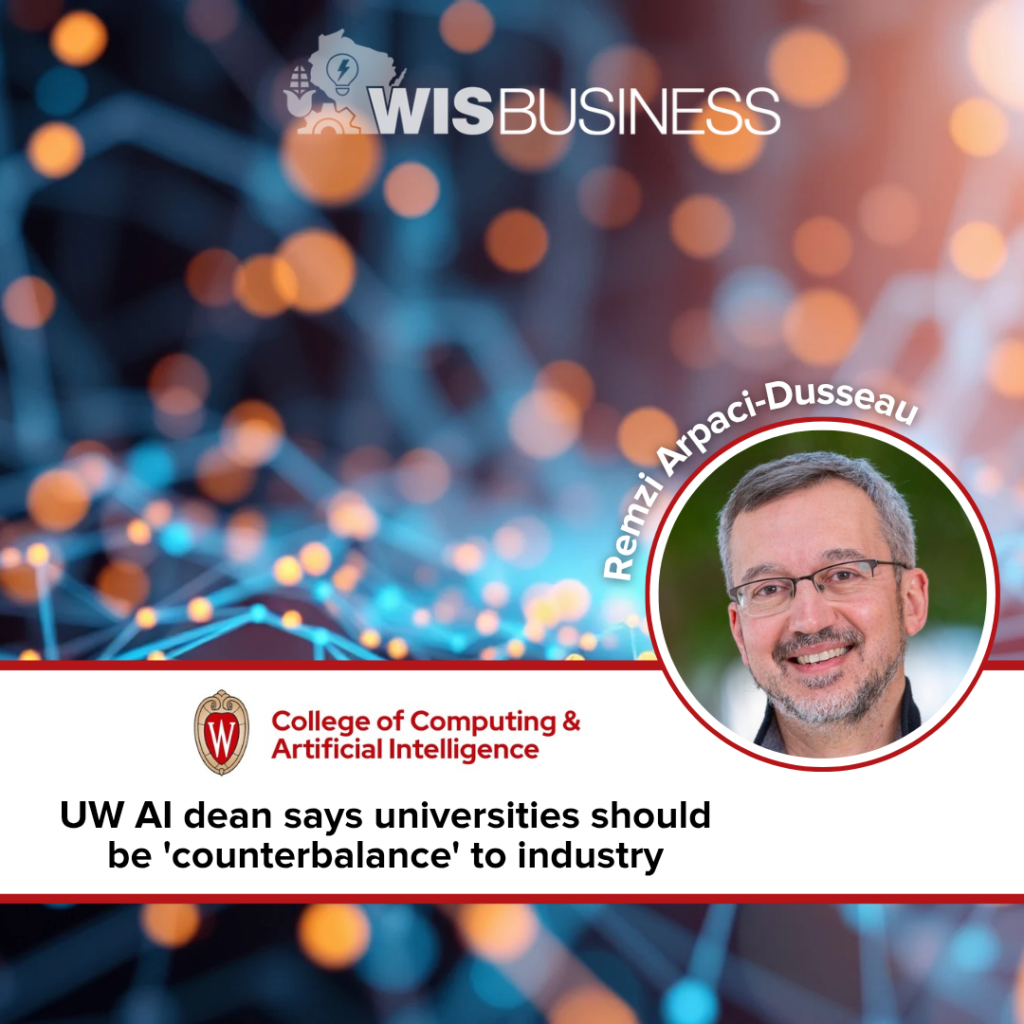
The founding dean of UW-Madison’s new College of Computing & Artificial Intelligence sees universities as a “counterbalance” to industry in the AI field, ensuring the technology benefits society. 

Remzi Arpaci-Dusseau, who led the effort to recently launch the university’s first new college in more than 40 years, discussed his vision for its role during a recent UW Now webinar hosted by the Wisconsin Alumni Association. 

“It’s an opportunity, but it’s more so a responsibility to really shape this technology for individual good, for public good,” he said. “Industry … it’s of course huge and powerful, the biggest industries in the world are participating, in fact, in a race to be the leaders in this space.” 

That includes established tech companies like Google as well as newer players such as OpenAI and Anthropic. Arpaci-Dusseau discussed the concern among these firms that one of their competitors will develop AI enough to “get way ahead” of the others, driving advancement in the sophistication of available models. 

“But a counterbalance needs to be somewhere, and the university is a perfect place for that, to give a clear-eyed, balanced view,” he said, adding “it is also a huge opportunity to accelerate research … to build new companies, and that’s happening all around us.” 

But despite the opportunity and responsibility presented by the AI wave, Arpaci-Dusseau cautioned “there’s many problems” with the technology, warning it’s not a panacea. 

He pointed to a study in the Harvard Business Review that found large language models consistently recommend strategies that align with current buzzwords rather than offering a true depth of knowledge. While AI chatbots can create large amounts of “seemingly authoritative” text very rapidly, that can prove to be deceptively shallow. 

At the same time, college students face a “danger of overdependence” given that AI can easily provide answers to many questions they face in their studies, Arpaci-Dusseau said. 

“It can be an angel on your shoulder, helping you understand something but it can also be the opposite of that, because you go to the answer too soon instead of going through the learning process,” he said. 

He also noted his personal pet peeve with AI: trying too hard to anthropomorphize the technology with analogies, such as describing a tool as “like a PhD” or a team of software developers. 

“It’s really not any of those things,” he said. “It’s a piece of software that does certain things well and certain things poorly, and we should just treat it as such.” 

While students navigate this new landscape, educators are also facing challenges such as having to adjust their assessments to ensure students are actually learning the skills they need, rather than just going to ChatGPT. 

“There’s a danger, learning is hard. It’s hard to learn,” he said. “I remember the hardest things I learned, I would sit with for minutes, hours, and you have to go through that to really learn something new. So there’s a struggle there, and if you don’t engage in that struggle, you’re not learning.” 

Watch the video.