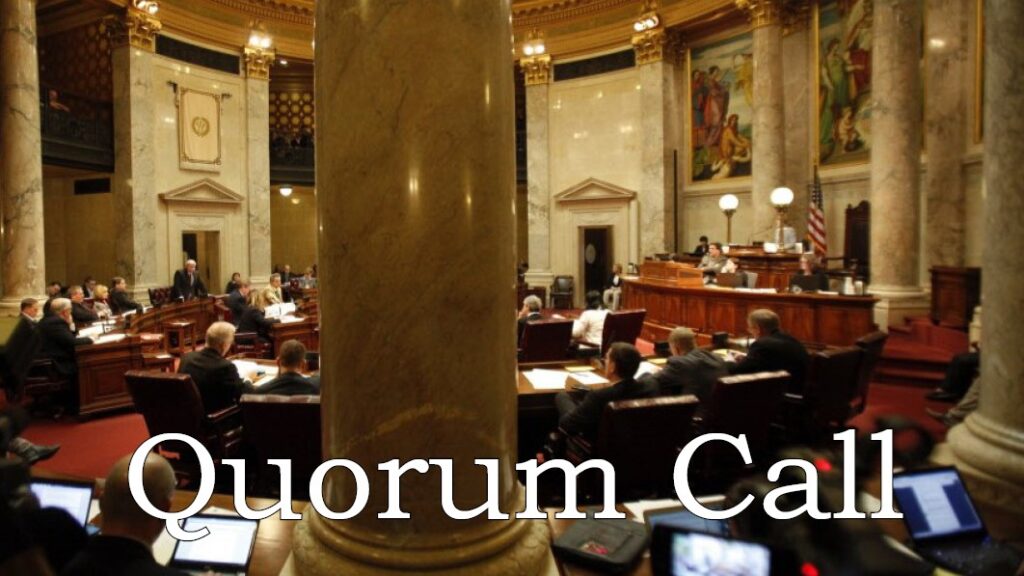
The Assembly cleared the way for voters to decide whether governors should be allowed to use their partial veto authority to raise a tax or fee.
The chamber yesterday also voted to overturn Dem Gov. Tony Evers’ 400-year veto.
Evers’ move in the 2023-25 budget to extend an annual increase in per pupil spending over the next four centuries sparked the amendment, which now heads to voters this fall.
Currently, governors are only limited in that they can’t create a new word or write out individual letters in a spending bill. They also can’t create a new sentence by stitching together parts of two or more lines in a bill.
>> WisPolitics is now on the State Affairs network. Get custom keyword notifications, bill tracking and all WisPolitics content. Get the app or access via desktop.
Three years ago, lawmakers sent Evers a budget that called for a $325 per-student increase in school spending in both 2023-24 and 2024-25. Evers struck the “20” and a dash from the reference to “2024-25.” That changed the end date to “2425.”
The state Supreme Court last year upheld the veto.
The Assembly passed the constitutional amendment to the veto power 54-41 along party lines, sending it to a statewide referendum.
Rep. Amanda Nedweski, R-Pleasant Prairie, said SJR 116 “restores balance by reining in the overreaching power of the executive branch.”
She argued that if the resolution was not passed and voters were not given the opportunity to approve the amendment in November, a future Republican governor could use the veto power to approve a 400-year tax increase to fund charter schools or U.S. Immigration and Customs Enforcement.
Nedweski invoked next month’s planned No Kings protest to needle Dems.
“Can they really say they are against kings if they continue allowing governors to raise taxes and fees on our residents without representation?” she said. “Mr. Speaker, you never know for sure who’s going to be the next governor.”
No Dems spoke during the debate.
Meanwhile, SB 389 was approved along party lines 54-40 to end the annual increase in the cap on per-pupil spending after the 2026-27 school year. That cap applies to what districts can spend between general state aid and property taxes. The 2025-27 budget didn’t include any new money in general aids, allowing districts to raise property taxes to cover the entire spending increase.
Senate Republicans have demanded the increase be repealed as part of any deal to address property taxes with the state’s projected $2.5 billion surplus.
Some Republicans on the floor appealed to Evers to sign the bill as a show of good faith.
“If we’re going to be neighborly, if we’re going to work in a bipartisan manner, then we should be able to negotiate in good faith,” said Rep. Scott Allen, R-Waukesha.
Democrats, in turn, dinged Republicans for failing to increase state school aid commensurate with inflation and characterized the 400-year veto as an instrument of last resort after the GOP failed to increase school funding.
“That adjustment, modest as it is, has been one of the only consistent increases in district revenue limits in a system that has been systemically starved out for more than a decade,” said Rep. Angelina Cruz, D-Racine.