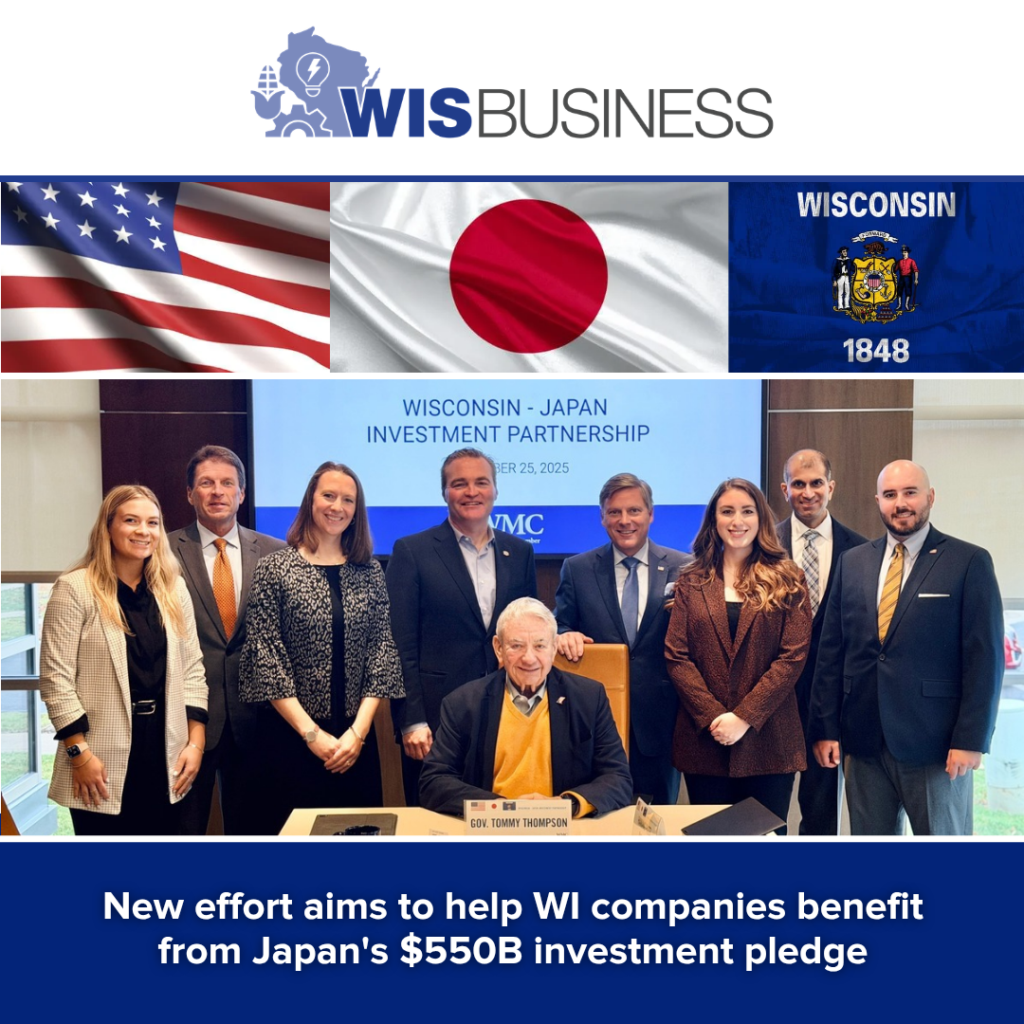
The newly formed Wisconsin-Japan Strategic Investment Partnership aims to help companies in the state benefit from Japan’s pledge to invest $550 billion in the United States.
This commitment was made as part of a trade deal between Japan’s government and the Trump administration, which was struck last summer. Trade officials from both countries signed a memorandum of understanding in September outlining more details for the agreement, which also secures lower tariffs on Japanese imports.
Kurt Bauer, president and CEO of WJSIP partner Wisconsin Manufacturers & Commerce, says the effort seeks to “maximize Wisconsin’s chances” of attracting Japanese investment across targeted sectors. That includes advanced manufacturing, critical minerals and metal extraction, energy, medical products and shipbuilding.
He and others involved in the partnership spoke Friday during an online news conference hosted by WMC.
Former Gov. Tommy Thompson, who chairs the WJSIP, called Japan’s pledge a “tremendous” opportunity for the state. He touted earlier Japanese investments in Wisconsin, pointing to soy sauce maker Kikkoman as a sterling example.
The company, which has been in the state since the early 1970s, broke ground in 2024 on a new $560 million production facility in Jefferson County, adding to its existing presence in Walworth County.
“You got to realize that Japan is really invested in Wisconsin … Japan is way and away the biggest investor in Wisconsin’s economy of any country in the world,” Thompson said Friday.
Thompson’s comments on Kikkoman were echoed by Andrew Seaborg, honorary consul of Japan in Wisconsin and co-founder of the Japan America Society of Wisconsin. In addition to highlighting the soy sauce manufacturer’s new facility — slated to open later this year — he noted Japan’s Fujifilm is spending $200 million on a new North American headquarters in Madison.
“This is an absolutely unbelievable opportunity,” he said of Japan’s half-trillion dollar pledge. “Both the United States and Japanese governments want to identify the highest quality projects possible, and our goal here is really to give Wisconsin companies the maximum possible lead time.”
He explained Japan’s Strategic Investment Initiative has an asymmetric funding structure, with project cash flows being split 50-50 until the capital expenditure amount is recovered. After that point, profits are split 90% to the United States and 10% to Japan, Seaborg said.
Projects considered for funding through the SII will need to be large, ranging in the hundreds of millions to billions of dollars, with a confirmed Japanese partner on board.
Seaborg added the SII program will favor “proven, talent-ready regions” and later entrants will face a more competitive pipeline than those who get involved early. Referencing initial meetings and outreach being done by WMC and others in the partnership, he said no other states are taking such a proactive approach.
“Wisconsin really does have a head start,” he said.
Members of the partnership include Foley & Lardner, the Greater Madison Chamber of Commerce, the Japan America Society of Wisconsin, Metropolitan Milwaukee Chamber of Commerce, Michael Best & Friedrich, Michael Best Strategies, Milwaukee 7, Thrive, the Wisconsin Alumni Research Foundation, WMC and the Wisconsin Technology Council.