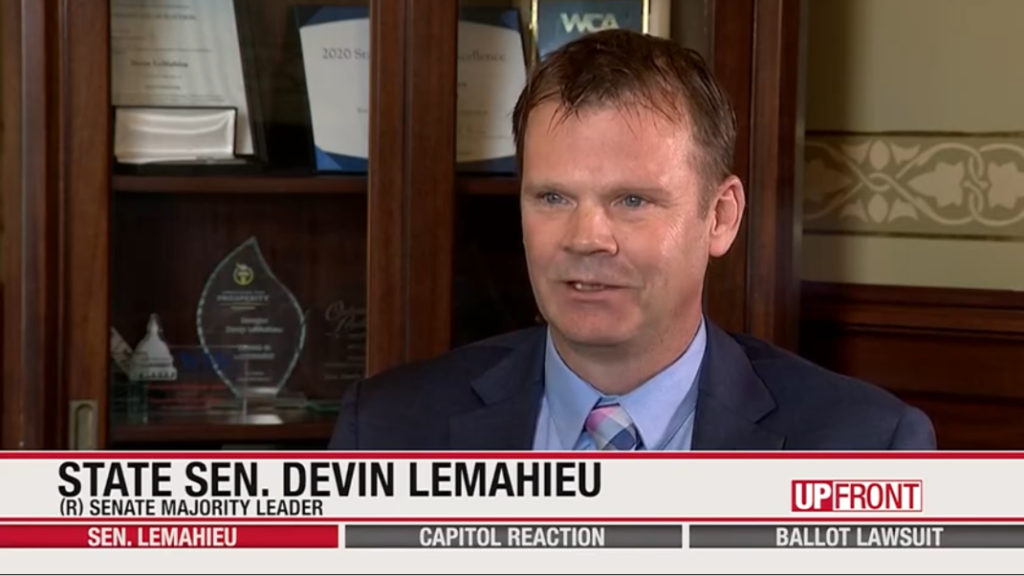
Senate Majority Leader Devin LeMahieu, left out of talks between Gov. Tony Evers and Assembly Speaker Robin Vos, says his pitch to give Wisconsinites rebate checks has support from some GOP Assembly reps.

“The irony is, since introducing the bill, I’ve had quite a few members of the Assembly Republican caucus reach out to me and either want to be the number one on the bill, support the bill,” LeMahieu told WISN 12’s “UpFront,” which is produced in partnership with WisPolitics. “I think it’s the cleanest path forward, so it’ll be interesting to see how the next four or five days go.

So far, there are no Assembly co-authors of the $1.5 billion plan to give rebates of $1,000 to married couples and $500 to all other filers.

“I think it frees us up to address it next year when we come back into session,” LeMahieu added, referring to broad property tax relief being discussed by Vos and Evers. “It’s not tying us to whatever solution we come up with, or the ongoing money that hamstrings the next JFC committee and puts a huge amount of pressure on them, because of putting an ongoing expense in right now.”

LeMahieu said he pitched the idea to Vos and the governor’s office during an initial virtual meeting, but “no one seemed to think that was a good idea.” 

And while Vos has appeared open to an agreement that doesn’t eliminate Evers’ 400-year veto, LeMahieu said that wouldn’t receive any Republican support in the Senate.

“Just putting a Band-Aid and not eliminating the cause of the problem, the 400-year veto, I don’t know why we would do that unless we’re just trying to score some political points,” LeMahieu said.

The Assembly is expected to complete its work Thursday for the legislative session, and LeMahieu said it’s “unlikely” a broad compromise will be reached.

“There’s a lot of things that would have to happen in a short amount of time,” he said.

Madison Mayor Satya Rhodes-Conway is pushing back at criticism after the city argued absentee voting is a privilege and not a constitutional right, as it faces a lawsuit for not counting nearly 200 absentee ballots in November 2024.

“I want to be clear,” Rhodes-Conway told “UpFront.” “I have never said that absentee voting is a privilege. I do not believe that absentee voting is a privilege. I understand, and I’m not a lawyer, but I understand that the state law says that absentee voting is a privilege. I disagree with that. I think the law should change. I hope the Legislature will revisit that.”

Law Forward is suing the city and seeking monetary damages on behalf of the 193 residents whose absentee ballots were not counted. The lawsuit accuses the former clerk and the city of disenfranchising their right to vote.

“I am so deeply sorry, and frankly frustrated and angry, that her ballot wasn’t counted, and that should never have happened,” Rhodes-Conway said, responding to one of the voters who wrote a recent op-ed about the lawsuit. “As you know, myself, the city, we’ve reached out, we’ve apologized, and we are taking numerous steps to make sure that never happens again in Madison.”

The city, though, argues the voters should not be compensated for the error. She called that a “dangerous precedent.”

“What I don’t understand is why that should result in municipalities having to pay money for a mistake,” Rhodes-Conway said. “Part of my concern here is precedent. I mean, certainly, I’m concerned for protecting taxpayer dollars, because if everything goes the way that this suit is suggesting, the city of Madison would have to pay upwards of $30 million. We don’t have $30 million in our budget, and if we did, I would want to spend it on the clerk’s office and improving the clerk’s office, and our process and our elections.”

— Meanwhile, Scott Thompson, a staff attorney for Law Forward representing the Madison voters, says it’s important the lawsuit “sends a message.”

“It’s quite the oversimplification to suggest that either this case is just about money or that we should be ignoring what’s on the court record,” Thompson told “UpFront.” “This case is about the right to vote for the 193 voters whose ballots were not counted. And no matter what people are saying publicly, on the court record where it mattered, there were arguments that when absentee ballots are not counted, it doesn’t violate voters’ right to vote, and that’s just plain wrong.”

Thompson dismissed concerns that the lawsuit could lead to more litigation surrounding election errors.

“First of all, municipal clerks are some of the most hard-working officials in our democracy,” Thompson said. “We rely on them. They do a great job. We are not aware that the type of mass disenfranchisement that occurred in Madison, where 193 ballots were found with enough time to count them but were still left out of the official tally, we’re not aware of that ever happening before.”

Thompson said he was confident they would win but also wouldn’t speculate about any potential agreement or settlement.

“I can never predict the future, and I am loath to do so in my own lawsuits, but I will say this,” Thompson said. “I recognize the city of Madison has been a longtime steward of the right to vote. We are not suggesting anything different than that, but in this instance, there was a big problem.”

See more from the show.