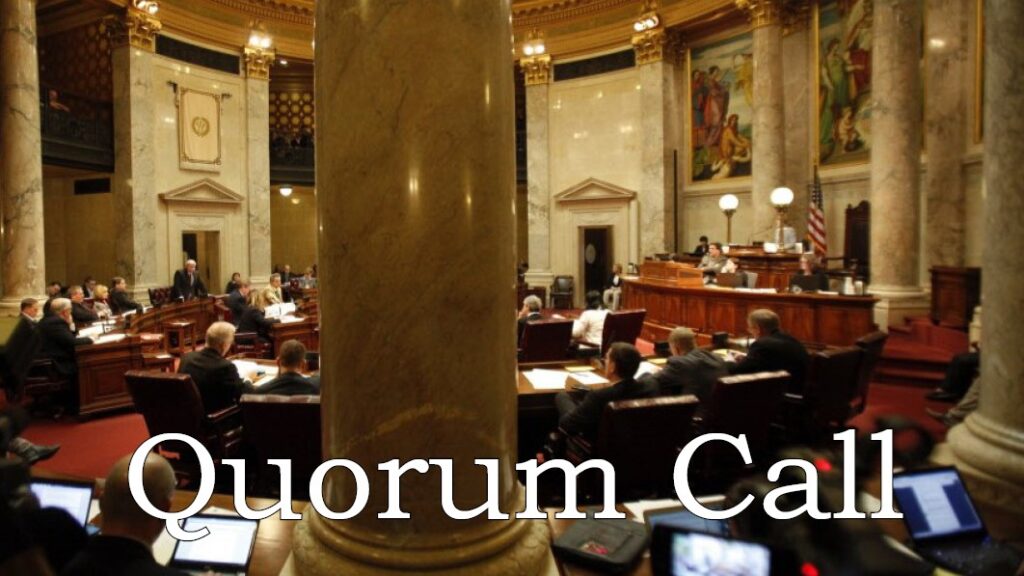
WisconsinEye would get $585,631 in state money over the next 12 months to remain on the air as the state seeks bids for a permanent public affairs network under amended legislation the Senate approved via voice vote.

As originally proposed, SB 994 would seek bids to maintain a public affairs network in Wisconsin without providing any funding. An amendment added to the bill would set a deadline of June 30 for those proposals while allowing WisconsinEye to seek monthly payments to remain on the air.

Sen. Mark Spreitzer, D-Beloit, voted against the bill in committee. But he signaled his support after two amendments, including the funding, were introduced yesterday and added to the bill. He said the funding creates a “bridge” for a year to ensure whether it’s WisconsinEye or another operation “that we have a chance to truly figure out the best way to provide public affairs coverage of the Legislature, as well as other government meetings.”

The Senate bill takes a different approach to public funding for a public affairs network than legislation that cleared the Assembly unanimously. That bill called for taking nearly $10 million now set aside for matching funds that WisconsinEye can apply for and instead putting it into an endowment. Interest from that fund would then support network operations.

The Assembly bill didn’t include any bridge funding to cover network operations until the interest begins to accrue. Meanwhile, the Senate bill doesn’t include permanent funding for network operations beyond the one year outlined in the amendment.

Senate co-author Julian Bradley, R-New Berlin, said he hoped the other chamber would sign onto the new approach.

Speaker Robin Vos, R-Rochester, said he hadn’t seen the Senate proposal and hadn’t reviewed it.

WisconsinEye went dark for more than six weeks amid financial troubles. It came back online this month after receiving $50,000 from the Legislature. The network has said it will go offline again unless it receives another $50,000 to help cover operations in March.

If the Senate bill became law, it would direct the Administration secretary to seek $585,630 from the Joint Finance Committee’s supplemental appropriation to fund WisconsinEye. The network would be eligible for monthly payments of $48,803 for up to 12 months.

Those payments would end if a new public affairs network was selected or if WisconsinEye failed to provide live broadcasts of state government and online access to its unedited digital archives.

The chamber also approved a Dem amendment barring the public affairs network from charging fees to access live or archived coverage of government proceedings.

Bills seek to limit influence of foreign adversaries

The Senate yesterday also approved a series of bills seeking to limit the influence of foreign adversaries in Wisconsin.

That includes signing off on a change the Assembly made to SB 7, which would bar those defined as foreign adversaries from owning land in Wisconsin. The Assembly amended the bill to include a provision to bar condemning land to develop a wind or solar energy facility.

That chamber also modified the definition of foreign adversary to include:

  • The People’s Republic of China, including the Hong Kong Special Administrative Region and the Macau Special Administrative Region.
  • The Republic of Cuba
  • The Islamic Republic of Iran.
  • The Democratic People’s Republic of Korea.
  • The Russian Federation.
  • Venezuela under the regime of Nicolás Maduro.

The Senate concurred via voice vote with the amendment, clearing the way for the bill to head to Gov. Tony Evers.

The Senate also approved:

  • AB 663, which would restrict academic collaboration and research partnerships between the Universities of Wisconsin and foreign universities located in one of seven “foreign adversary” nations, including China, Iran, North Korea, Russia, and Venezuela under Maduro. Collaboration would be prohibited unless the Board of Regents requested and received a “national security risk assessment” from a federal law enforcement agency. Sen. Brad Pfaff, D-Onalaska, joined all Republicans in backing the bill, which passed 19-14.
  • AB 672, which would create a penalty enhancer for a person who commits a crime while “acting as an agent” of a foreign government or terror organization. Proponents say this is to address “transnational repression” such as someone threatening a dissident, but Dem critics argue it could be used as a pretense to suppress anti-government action, like ICE protests. Pfaff joined Republicans as the Senate approved the bill 19-14.
  • AB 673, which would bar state hospitals and universities from using genetic software created by a foreign adversary nation or storing human genome sequencing data within a foreign adversary domicile. The bill includes an exception for data collected as part of clinical trials or biomedical research that follow federal regulations protecting personal and government data. The Senate approved it 20-13 with Pfaff and Sen. Sarah Keyeski, D-Lodi, joining Republicans in favor.
  • AB 674, which would bar insurers from covering organ transplant from a country known to have participated in forced organ harvesting, like China. The Senate approved it 21-12 with Pfaff, Keyeski and Sen. Bob Wirch, D-Pleasant Prairie, joining Republicans in favor.

The four Assembly bills also now head to Evers.