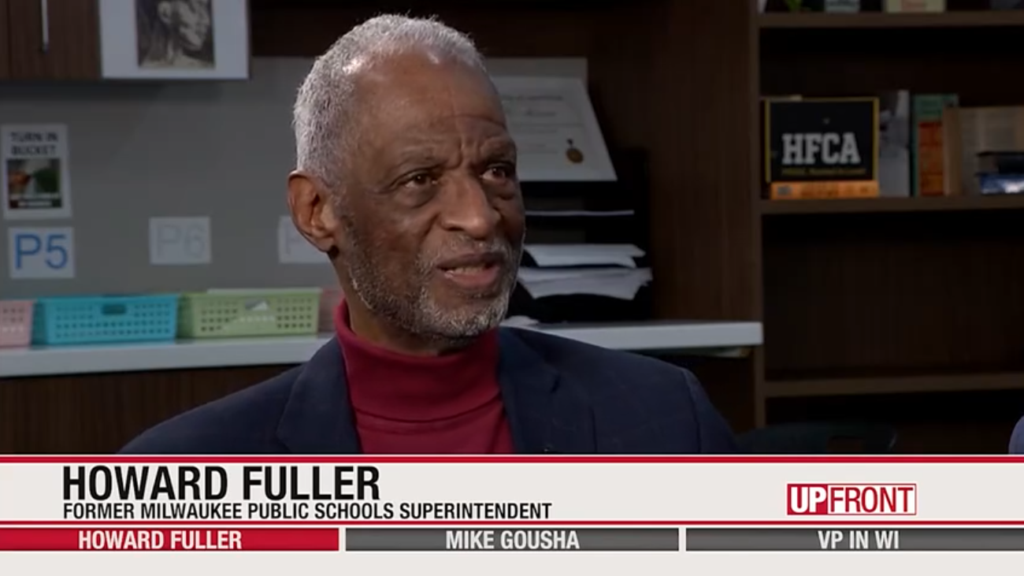
Howard Fuller, the former Milwaukee Public Schools superintendent and architect behind the first voucher school in the country, says universal school choice was never his intention.
“I want to be very clear about this; I don’t support school choice,” Fuller said on WISN 12’s “UpFront,” which is produced in partnership with WisPolitics. “I never have. I support parent choice. I did not get into this battle so that schools could choose kids. I got in it so that low-income and working-class parents would have the power that those of us that have money, and that is the power to choose the best educational environment for our kids.
“When I look around the country today, I have major concerns about some of the parent choice proposals because they’re universal,” Fuller added. “I never supported universal vouchers. I don’t see why people with money should get more money. What I was trying to do was to try to make sure that low-income and working-class people were able to get resources that those of us with money already have.”
Fuller is the focus of a new documentary, “A Fuller Education,” produced by former news anchor and “UpFront” host Mike Gousha. It chronicles Fuller’s life, including the push for Milwaukee’s first voucher school and national prominence, like his meetings with President George W. Bush.
>> WisPolitics is now on the State Affairs network. Get custom keyword notifications, bill tracking and all WisPolitics content. Get the app or access via desktop.
“I looked at it as I had this opportunity to be in rooms that people I cared about would never get into,” Fuller said. “That’s the thing that always pushes me, right, is that look, man, you’re in these rooms, don’t just be in here. Be in here and do something.”
Gousha said Fuller has some of the most unlikely adversaries and some of the most unlikely allies in his support of parent choice.”
“He is in a different place right now,” Gousha said. “He understands that the energy of the choice movement in many respects is toward universal vouchers, so income is not a problem. If you make a lot of money, you could still get a voucher. He’s just fundamentally opposed to that and thinks that’s sort of a betrayal of what he was talking about at the beginning.”
Fuller’s work crossing any political line is notable.
“When it comes to education, he’s willing to work with folks from different parts of the public sphere, and some people just have a hard time with that,” Gousha said. “That Howard would be, for example, a close personal friend of John Walton, the heir to the Walmart Foundation, the late heir; Howard worked with John Walton and was one of the few people who gave a eulogy at his funeral. There are some people who just have a hard time with that. The Washington Post had a headline, ‘Is he a tool of corporate billionaires?’ Howard did not like that and said, ‘Why am I a tool if this guy is willing to help kids here in Milwaukee?’”
Gousha spent three years working on the project after retiring following a career in TV and then leading the Marquette Law School Lubar Center.
“I think it’s a challenging time for journalists, and you guys know this better than I do at this point,” Gousha said. “We are a very polarized republic right now. We have people who just do not agree, and when we disagree, oftentimes the disagreement turns those we disagree with into enemies rather than simply people we might have a difference of opinion with.”
U.S. Rep. Tom Tiffany says he has to “introduce myself to a lot more people in the state” after the latest Marquette Law School poll showed roughly two-thirds of GOP voters were undecided despite the congressman being the only major Republican candidate.
Poll Director Charles Franklin told “UpFront” he thinks “that’s right.”
“All of these candidates have to introduce themselves to a lot more voters,” Franklin said. “You think of Tiffany as a congressman. You would think he’d be well-known, but the truth is, in all of our polling back to 2012 when we asked about individual members of the House of Representatives, they’re pretty well-known in their home districts, but they’re not well-known outside the district.
“Mandela Barnes has a bit of an advantage for having run statewide before,” Franklin said. “But all the rest of the Democrats have at least as big of a problem.”
The poll also showed 65% of Democratic primary voters said they were undecided as well. State Rep. Francesca Hong topped the list with 11% while Barnes was at 10%.
“I think the surprising thing is that the public just hasn’t tuned in,” Franklin said. “It is interesting that Barnes has a much higher name ID than the other candidates, but that didn’t vault him to a big lead in the vote choice. In fact, Hong is at 11, and Barnes is at 10. That’s effectively tied, with (Sara) Rodriguez at 6 and all the others at 3% or below. I think the real pitch here is that when Barnes got into the race, there was a lot of assumption that name ID would translate into a big lead, and we’re simply not seeing that happen at this point.”
During a stop in Wisconsin, Jay Timmons, president of the National Association of Manufacturers, says he’s pushing for certainty from the Trump administration after the recent U.S. Supreme Court decision on tariffs.
“Here’s one thing that we do know: the president likes tariffs,” Timmons told “UpFront.” “So there are going to be tariffs imposed one way or another, and manufacturers have to be able to respond to that.
“I understand the president’s frustrated because he thought he had a tool that he does not have,” Timmons said. “But he’s got plenty of other tools if he does want to implement this. Our request to the administration is whatever you do, do it in a targeted way to deal with true, economic uncertainty or an unfair playing field or national security concerns so that we can plan around that.”
Timmons is in the midst of a nationwide tour. His Wisconsin stops included Rockwell Automation, Komatsu and CNH.
“Thanks to some really good policies, by frankly, both Republican and Democrat administrations here, and the great work of Kurt Bauer and his team at Wisconsin manufacturers, I think that Wisconsin is in great shape for future investment and job creation.”
The latest federal data shows the state has roughly 460,000 manufacturing jobs, a number that has seen a slow decline.
“I think you’re going to see a major uptick in employment,” Timmons said. “My gut tells me that we’ve lost about 100,000 jobs nationwide over the course of the last year. I think it goes back to what we were talking about earlier, that uncertainty. As soon as we have that playing field set, I think it’s going to unleash a whole lot of that optimism, a whole lot of investment here in the United States.”See more from the show.