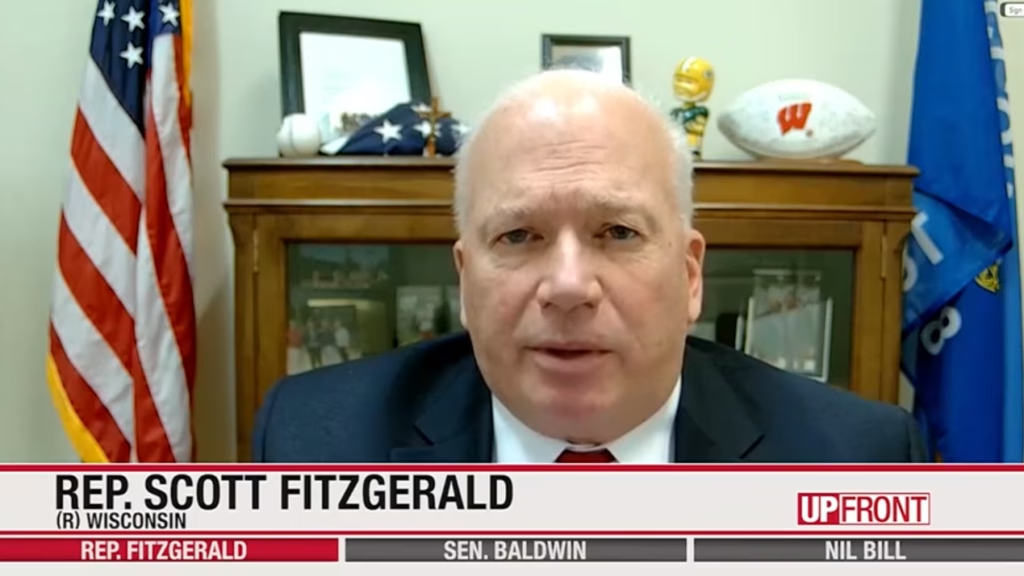
GOP U.S. Rep. Scott Fitzgerald says he expects the White House to soon ask Congress for more money for the Iran war “any day.”
“We had an open discussion about that within our own conference with Speaker Johnson,” Fitzgerald said on WISN 12’s “UpFront,” which is produced in partnership with WisPolitics. “They were just simply trying to make us aware there’s going to be a supplemental payment that’s going to be requested from the Pentagon and from the White House in the near future.”
Fitzgerald said the ongoing operations in the Middle East don’t warrant American troops on the ground at this point.
“I really don’t have the type of intel or knowledge. I don’t think any rank-and-file member of Congress would have that information to be able to say one way or the other whether or not they would or wouldn’t support that,” Fitzgerald said. “And it does appear, though, right now that obviously we’re having such great success with the carriers that are in theater, and certainly with the air superiority which we have already gained, which is amazing to me how quickly that was able to happen, that certainly doesn’t warrant it.”
>> WisPolitics is now on the State Affairs network. Get custom keyword notifications, bill tracking and all WisPolitics content. Get the app or access via desktop.
Wisconsin National Guard troops remain in the Middle East, specifically in Iraq and Kuwait.
Fitzgerald served in the U.S. Army Reserve for decades and retired as a lieutenant colonel.
“I’m not going to pretend that I have firsthand knowledge of troop movements, because it’s not something that’s typically briefed to members of Congress until it’s actually happening,” Fitzgerald said. “I know there are troops, in both the Army Reserve and in the Guard, and you have to remember, the Guard typically still are those with the weapons systems that are critical whenever you find yourself in a combat situation where the Army Reserves, and certainly the Air Force Reserves programs, a lot of times that are more service support staff, so they’re in a supporting role.”
Dem U.S. Sen. Tammy Baldwin says the Trump administration has not convinced her on the merits of the Iran war.
She told “UpFront” the U.S. should end its involvement immediately, adding, “I’m concerned about the intended consequences of getting into this war illegally.”
“We weren’t under any imminent threat of attack; we also were not under attack,” Baldwin added. “And those are the conditions that would give the president the authority to use the military absent congressional authorization.
“I went into the briefings last week wanting to hear why this president took action without seeking congressional authorization for it,” Baldwin added. “I was ready to hear that there was an imminent threat or that we were imminently going to be under attack. I heard nothing of the sort.”
Americans and Wisconsinites continue to evacuate the Middle East, some with urgency and needing the help of lawmakers and the U.S. State Department.
“We’re seeing a very chaotic process by which this administration is assisting U.S. citizens, either visiting countries in this region or working there, and we’re doing everything we can to assist helping people get to a country where commercial aviation is still ongoing, or getting charter flights or military flights to be evacuated out of the region,” Baldwin said. “That is an ongoing effort.”
Baldwin said she doesn’t see a scenario at this point where she will back the war.
“I will say without hesitation that the regime in Iran is dangerous and murderous, that they have a ballistic missile program, that they have a nuclear program,” Baldwin said. “Trump became president the first time. He ripped up the Iran nuclear deal, and I think set us down a course, a path that we find ourselves in this position now.”
UW-Madison Athletic Director Chris McIntosh is urging the state Senate to pass the name, image and likeness bill that passed the Assembly 95-1 to help the Badgers remain competitive.
“We will near a point in which something has to give,” McIntosh told “UpFront” when asked what would happen if the legislation didn’t pass. “We need to be competitive in a sport like football. Football generates 80% of our revenues. That is the financial engine that underwrites the cost of opportunity for every other sport. At the same time, we need to preserve the excellence that we have in Olympic sports, and we need to be able to preserve that opportunity for those hundreds of high-potential young people that have the opportunity to participate in a life-changing experience.”
A recent nationwide settlement allows universities to directly pay athletes and also requires back pay for athletes who previously competed. The legislation would allocate nearly $15 million annually for debt services for UW-Madison athletic facilities, freeing up money for the new revenue sharing.
“When the House settlement took effect, that allowed us, in addition to paying almost $3 billion over the next 10 years in back damages, that allows us to participate in revenue sharing directly with our student athletes. In year one, that figure is capped at $20.5 million. We had prepared for that. We’ve embraced that. We were supportive of that, and we’re fully participating in that.”
“It’s the lack of stability, the lack of even guidance around college athletics,” McIntosh added. “And that has resulted in payments above and beyond that $20.5 million in the form of NIL opportunities to student athletes.”
The legislation also codifies NIL agreements and sets certain stipulations for student athletes.
A new survey by the Tommy G. Thompson Center on Public Leadership found a vast majority of UW-Madison faculty said they identify as liberal as opposed to conservative.
“These are questions that really have been of interest to us and to a lot of people,” Alex Tahk, the center’s director, told “UpFront.” “There’s been a lot of discussion around these topics, but a lot of sort of claims about what people think, and not a lot of data on it.”
The TGT Center sent its survey to roughly 2,400 UW-Madison faculty and received 633 responses.
In it, 70% of faculty said they identified as liberal, 21% moderate and 9% conservative.
Click here to read the full survey.
“I think probably not a lot of people are going to be surprised that UW-Madison faculty lean to the left,” Tahk said. “I think having a better idea of exactly what percent lean to the right, and I think within that, I think only about 3% said they identified as conservative or very conservative. Most of the conservative ones identified as slightly conservative. But I think a lot of what we wanted to do in the survey is really just go beyond that, quantify how far faculty lean to the left, but go beyond just the question of their leanings and see how it affects other things in this.”
The survey asked about a wide array of issues, including hiring and the political climate on campus.
The survey found 79% of liberal faculty said they believe those with progressive views are welcome on campus. Conversely, 81% of conservative faculty said they believe conservative views are not welcome on campus.
“I think you could see there that there’s a gap amongst liberal faculty, that liberal faculty acknowledge that conservatives would feel a little less welcome, but when you ask conservatives, they think the gap is much larger,” Tahk said. “Everyone sort of agrees on how welcome progressives would feel on campus, but conservatives feel it’s a much less welcoming environment for a conservative.”
Tahk said he has yet to share the full findings with UW-Madison or UW System leadership.
“I don’t think everybody in the administration will have the same view,” he said. “I think there’s variation in how they view this situation already, and I expect that will show up in how they respond to it.”
“We worked with the UW Madison Survey Center in constructing this,” Tahk added. “They were very helpful, and so I hope they will actually look at this survey, see the questions and analysis, rather than jumping to conclusions before that.”
See more from the show.