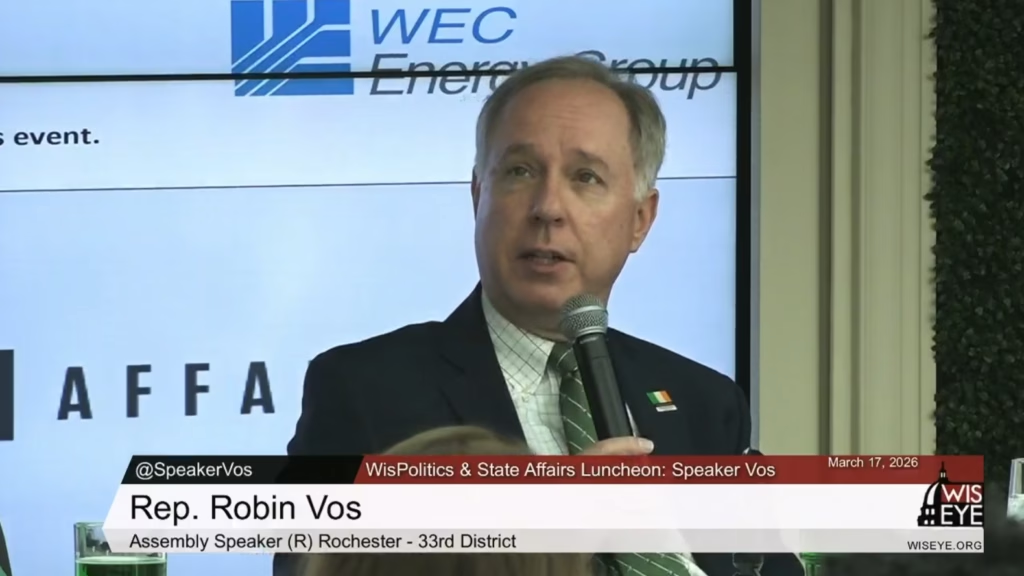
Assembly Speaker Robin Vos said Assembly Democrats’ $1.3 billion proposal to spend down the state’s surplus “wasn’t serious” but he was “open to” spending more on special education.

Democrats on Monday proposed to increase general school aid by $445.9 million and raise the special education reimbursement to 60%.

“The challenge the Assembly Democrats have is it’s been so long since many of them have been involved in governing,” Vos said, adding “It basically took the entire surplus and put it into funding special ed – which, frankly, I’m open to that idea, to some extent.”

Vos said at a WisPolitics luncheon any potential deal would have to include property tax relief.

Speaking after the event, the Rochester Republican declined to give a dollar figure for how much he’d want to see spent on special ed.

But he said there should be a 50-50 split between state investment and tax relief.

He also said he would be open to backfilling the current budget to reach the 42% and 45% special ed reimbursement targets the Legislature planned to meet but fell short of after cost projections were revised.

Otherwise, the speaker indicated that much of the potential deal between the Assembly, Senate and Gov. Tony Evers was yet to be decided. He later told reporters it was “possible” the Legislature could vote on a deal when it returns for a special session next month to consider a proposed amendment barring partisan gerrymandering. 

Vos said “nothing is off the table” with regard to Senate Republicans’ push to spend the surplus on rebate checks. Evers publicly rejected that proposal last month, criticizing it as “maximum politics.” 

Vos and Senate Majority Leader Devin LeMahieu, R-Oostburg, proposed a $2.3 billion package that combined special education funding with rebate checks and property tax relief.

He also said he hoped a surplus deal would not become a “Christmas tree” or a “mini-budget.” 

Vos during the luncheon called the state Senate not taking up a GOP-authored bill regulating data centers “absolutely sad” and warned it could cost Republicans in the fall.

“The state Senate should vote on that bill. Especially if they want to get back into the majority,” Vos said, adding that “people who don’t have that vote are going to regret it in October.”

A couple of Assembly Democrats crossed party lines to vote for AB 840, which orders the Public Service Commission to insulate ratepayers from new utility costs associated with data center development, limits developments of renewable energy developments serving the facilities and includes provisions to keep data center sites from becoming brownfields. 

Co-author Sen. Romaine Quinn, R-Birchwood, said two GOP senators blocked bringing the bill to the Senate floor. 

The speaker also weighed in on threats to LeMahieu’s leadership, the governor’s race, WisconsinEye funding, Donald Trump and the proposed gerrymandering constitutional amendment.

GOP Sen. Chris Kapenga said on “UpFront” that Senate Majority Leader Devin LeMahieu could lose his leadership post for bringing the online sports betting and NIL bills to the Senate floor, despite not having enough GOP votes to pass them without Dem support.

Speaking after the luncheon, Vos said “whoever” is saying LeMahieu could lose his leadership position “doesn’t really know how the world works.”

“Sometimes you have to have things passed because it’s in the best interest of the state. And if you can’t convince people, you have to find out how you get there,” the speaker said, saying he’d done the same in the Assembly. 

The sports betting bill passed the Senate Tuesday and is on its way to the governor.

Vos also said:

  • presumptive GOP gubernatorial nominee Tom Tiffany needed to improve his name recognition in southeastern Wisconsin to beat what he called the “seven dwarves” competing for the Dem nomination. 
  • he was “glad” for small businesses that the U.S. Supreme Court had struck down Trump’s global tariffs last month and that the president being “all-present” in the news cycle made it hard for Wisconsin Republicans to persuade swing voters. But Vos credited the president for what he said was a strong economy.
  • he wanted the nonprofit broadcast service WisconsinEye to remain independently managed, suggesting the Legislature could pay for a third of the cost to fund the service until the next budget cycle.
  • he was open to negotiations on Evers’ proposed constitutional amendment on partisan gerrymandering but that it should not factor in political affiliation and should be based “on the person, not the party.” The guv’s office did not immediately return a request for comment. 

Watch video from the luncheon here.