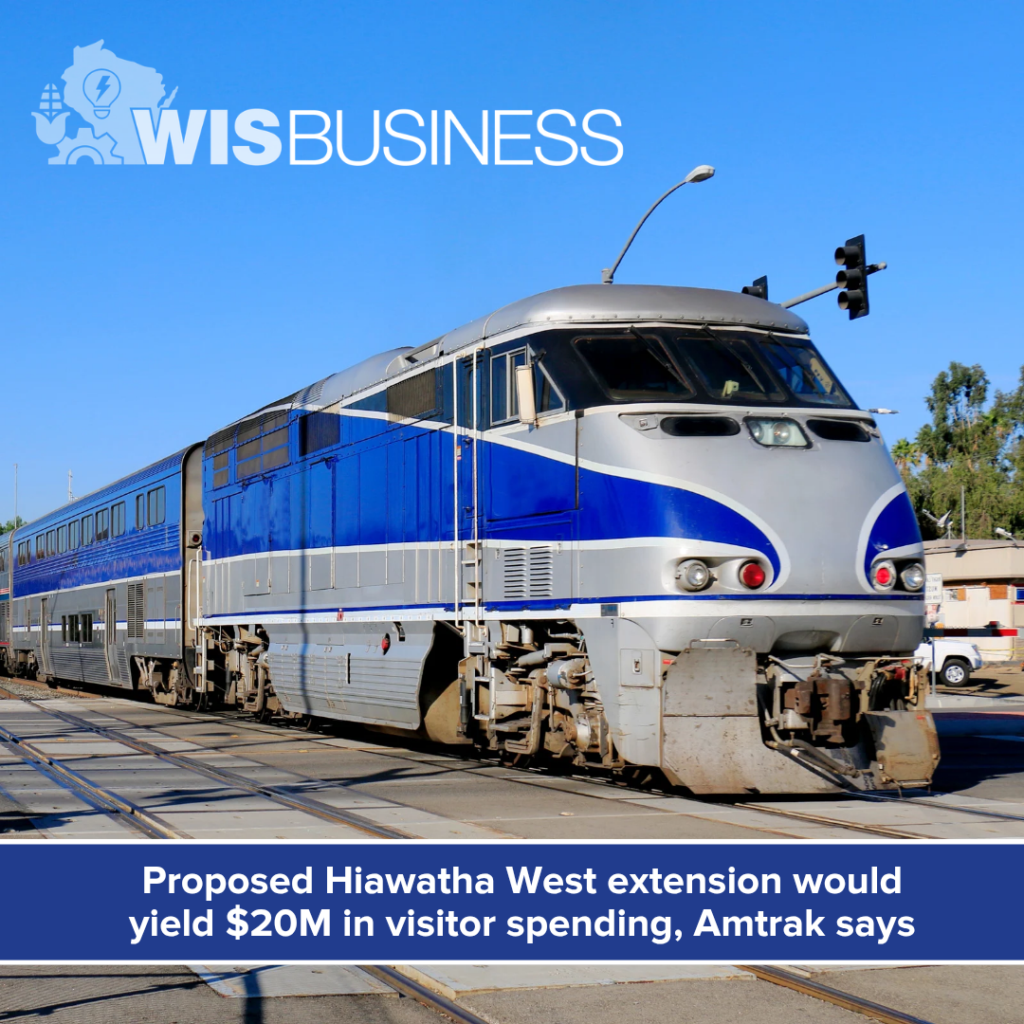
The proposed Hiawatha West extension of Amtrak service from Milwaukee to Madison would result in more than $20 million in projected visitor spending based on ridership forecasts. 

That’s according to Arun Rao, senior director of network development for Amtrak, who discussed the proposed project’s status during a recent public webinar. It’s currently in the corridor planning phase, and the rail service provider plans to complete a key service development plan in June before the project can progress. 

Rao last week touted the benefits of the proposed service extension, which comes after a more extensive proposal fell apart about 16 years ago amid political disagreements over the idea. 

The latest proposal for a 79-mph extension from Milwaukee to Madison would start service in the early 2030s, if approved and funded as currently proposed. 

Amtrak now projects more than 260,000 annual passenger trips for initial ridership, slightly higher than earlier forecasts. Officials said that number could change further as estimates are adjusted over time. 

“Implementation of the Hiawatha West would yield significant benefits for Wisconsin, for the station communities and for nearby communities, and communities elsewhere in the state,” Rao said. 

Currently, government operating support for Wisconsin is estimated at about $2.5 million for the first year, and Arun said that’s projected to yield up to $46.3 million in direct, indirect and induced economic benefits per year. 

The project would add train service for the state’s 2nd and 3rd most populous counties — Dane and Waukesha — that currently have no Amtrak service, Rao said. He noted it would provide a direct connection to Chicago and other economic hubs in the region for more areas of Wisconsin, while also creating more than 200 permanent jobs. 

The project is a conventional speed service, not high-speed rail as was envisioned in earlier proposals. But it would still result in upgrades to existing railroad infrastructure that would benefit both passenger and freight trains, according to Rao. 

“That means there’s fewer capital projects needed and lower operating costs, than a lot of other previous inter-city passenger rail projects you’ve seen along this corridor,” he said. 

In addition to providing a travel alternative to I-94 and I-90 for residents, Rao said cities along the route could leverage the service to help them attract and retain employers and residents, leading to further economic ripple effects. 

Total project costs are expected to be between $215 million and $275 million, with existing federal grant programs covering up to 80% of project costs and state and local partners covering the other 20%. 

“These capital investments will yield economic impacts, from the construction employment and spending in Wisconsin,” Rao said. “These benefits are in the process of being developed and quantified right now, and those will also be released soon.” 

As part of the ongoing corridor planning phase, through the Federal Railroad Administration’s Corridor ID program, Amtrak is exploring various aspects of the proposed service, including alternate routes and operations, needed infrastructure, related costs and more. 

The 81.6-mile extension includes a 46.6-mile segment between Milwaukee and Watertown, using a route that’s currently used by freight railroad CPKC, as well as a 35-mile segment used by Wisconsin & Southern Railroad spanning Watertown to Madison. These “host” railroads own the tracks for these routes and partner with Amtrak for projects like these. 

Once the service development plan is finalized this summer, the next step is to get the project obligated for preliminary engineering and environmental analysis, funded by a federal grant that Wisconsin has already been selected for, Rao said. 

When that’s complete, the project would leave the Corridor ID program and enter the pipeline for final design, construction and implementation, which would be accomplished through future FRA grant programs. 

Watch the video and see more in a recent story on the project.