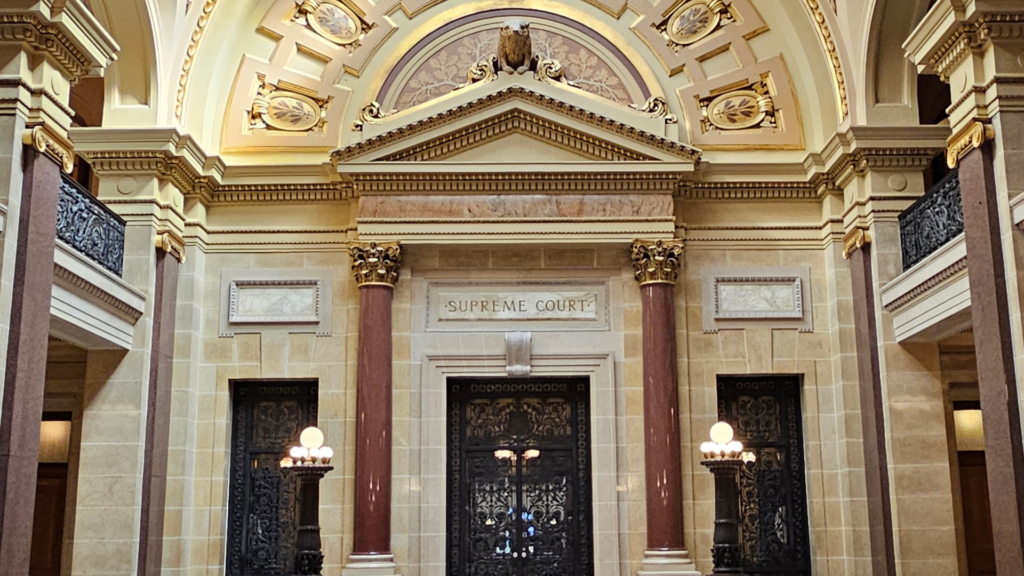
The state Supreme Court today agreed to decide if a three-judge panel properly dismissed a lawsuit seeking a new congressional map in Wisconsin that argued the current lines are an anti-competitive gerrymander.

The court also denied a request from the Wisconsin Business Leaders for Democracy for an expedited process as they seek new maps in time for the 2028 elections.

Conservative Justices Rebecca Bradley and Annette Ziegler dissented. Bradley accused her liberal colleagues of pre-judging the case after the “Democratic Party bought multiple seats on this court to achieve yet another outcome unobtainable democratically.”

“An astonishingly activist court will once again revisit precedent it doesn’t like in order to do the bidding of its political masters,” Bradley wrote.

Liberal Justice Rebecca Dallet wrote a concurrence to “respond to the false, inappropriate, and disingenuous charges leveled by the dissents.”

She added today’s ruling meant the court had decided to hear the case and “nothing more.”

“Deciding to hear a case does not reflect any weighing of the merits of any party’s claims, let alone prejudgment about who will prevail and why,” she wrote.

Dallet was joined in her concurrence by fellow liberals Jill Karofsky, Susan Crawford and Janet Protasiewicz.

A panel of three circuit court judges, appointed by the state Supreme Court under a 2011 law authored by Republicans, earlier this year dismissed the suit. The panel cited a 2022 ruling by the state Supreme Court when it had a conservative majority that found claims of partisan gerrymandering can’t be heard in Wisconsin courts. The panel ruled the claims of an anti-competitive gerrymander to protect incumbents was the functional equivalent of a partisan gerrymandering claim.

The current lines have helped produce a 6-2 GOP majority.

The Wisconsin Business Leaders for Democracy want the case sent back to the panel to hear the merits of their arguments.

Conservative Justice Brian Hagedorn didn’t indicate how he voted on the court’s decision to take the case, only noting in a separate writing that “failure to publicly dissent or comment on an order does not mean a justice agrees with the order.”