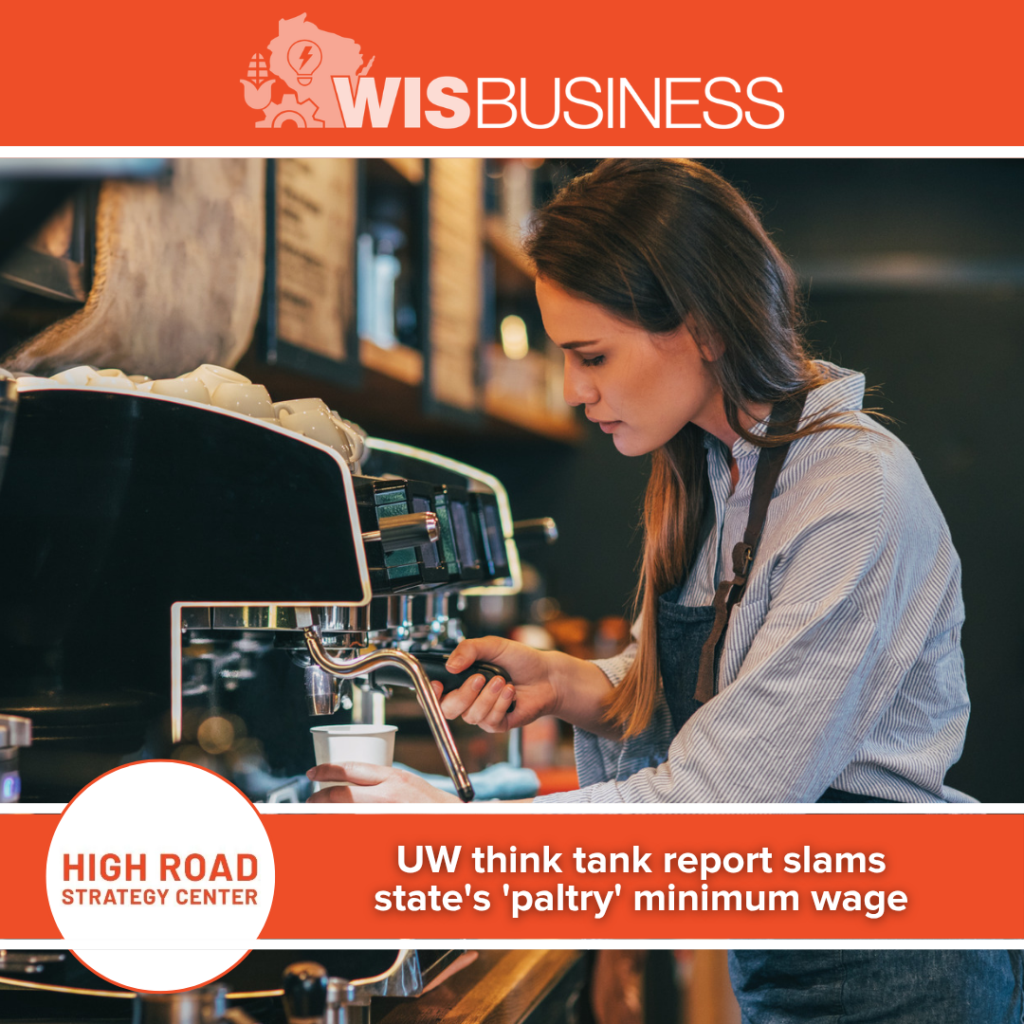
A UW-Madison think tank has issued a report criticizing Wisconsin’s “paltry” minimum wage, and called for boosting it to $20 by 2030 to benefit more than a fourth of all workers in the state.
The High Road Strategy Center, which describes itself as a think-and-do tank, this week rolled out an updated version of its “Can’t Survive on $7.25” report.
It notes the state’s minimum wage hasn’t risen from that hourly amount since 2009, even as inflation has reduced its purchasing power by nearly a third since then. If it had kept up with inflation, the minimum wage would be $10.60 per hour in 2026.
At the state’s current rate, minimum wage employees working full-time earn less than $15,000 for the year.
“Wisconsin’s paltry minimum wage standard has no credibility as a living wage,” report authors wrote. “High profits posted by firms with many low-wage workers add insult to injury.”
Neighboring states generally have higher wages for low-income workers, the report shows, ranging from $15 in Illinois to $13.73 in Michigan and $11.41 in Minnesota. Only Iowa has the same minimum wage, but its tipped wage of $4.35 per hour exceeds Wisconsin’s tipped wage of $2.33 per hour.
Report authors are calling for boosting the state’s minimum wage to $20 by 2030, which would increase wages for 27% of workers in the state or more than 730,000 people.
Of that total, 458,800 are workers that currently earn less and would get a direct pay bump from the change, while the other 277,700 workers included in the total would get higher wages indirectly as pay scales adjusted to the new minimum.
Authors also note the change would be “much more meaningful” for certain demographic groups, as 33% of women would get higher wages compared to 21% of men. Nearly half of Black or Hispanic workers would see their wages increase, nearly twice the share of white workers.
The report also references the “Fight for $15” effort that emerged in 2012, noting it was initially dismissed by policymakers and economists at the time.
“But workers knew they couldn’t survive in jobs with low wages, volatile and insufficient hours, and no paid time off,” authors wrote. “Their demands are changing pay in low-wage jobs.”