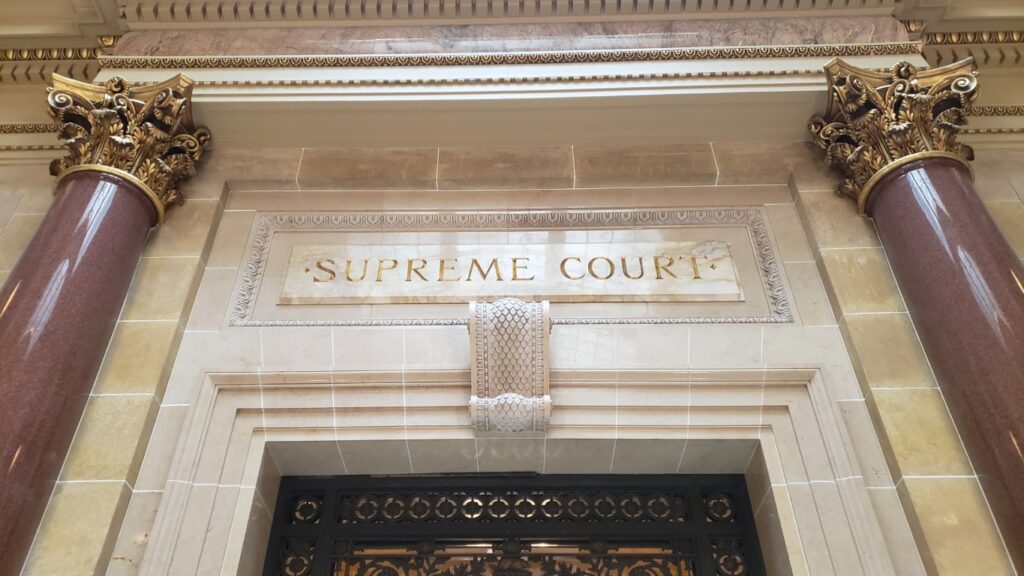
Promoting diversity in the student body and improving retention rates for some minority students isn’t a sufficient reason for the state to award scholarships based on race, the state Supreme Court ruled.

In doing so, the justices yesterday unanimously upheld an appellate court ruling that struck down the Minority Undergraduate Retention Grant Program. In both decisions, a U.S. Supreme Court ruling that barred the use of race in college admissions was a significant factor.

Writing for the court, conservative Justice Annette Ziegler found the U.S. Supreme Court has left narrow instances when race can be used, and it must be just one factor in a highly individualized, holistic review. 

But the Higher Educational Aids Board, which administers the program, used race as the only factor in deciding who gets the scholarships, Ziegler wrote.

She added HEAB had failed to show that increasing diversity and equalizing education opportunities for certain students were sufficient reasons to focus on race in awarding the scholarships. Ziegler also rejected HEAB’s attempts to argue the scholarship helped address retention and graduation rates. The court found there was no evidence that was part of the reason the program was created four decades ago.

“Ensuring that all public educational opportunities are offered to all students is vital to a free and fair nation. The schoolhouse doors should be open to all,” Ziegler wrote. “But before the government may impose a race-, national origin-, ancestry-, or alienage-based remedy, it must demonstrate through previous government-sanctioned discrimination, regulatory discrimination, legislatively demonstrated statistical findings, or otherwise that the problem it seeks to remedy actually existed when the statute was passed.”

Created in 1985, the program provided taxpayer-funded grants to financially needy Black, American Indian and Hispanic undergraduate students enrolled in private Wisconsin colleges.

Two years later, it was expanded to cover needy undergraduates who were admitted to the U.S. after Dec. 31, 1975, and were either a former citizen of Laos, Vietnam or Cambodia or who had ancestors who were. It also expanded to cover students attending Wisconsin technical colleges.

In the 2021-22 academic year, $819,000 was allocated to the program with grants of up to $2,500 per academic year to eligible students. 

A Dane County judge originally upheld the constitutionality of the program in late 2022. But the 2nd District last year cited the U.S. Supreme Court’s 2023 ruling on admissions in striking down the scholarship program, noting that federal decision did “away with all governmentally imposed discrimination based on race.” The three-judge panel unanimously ruled the state may no longer spend taxpayer dollars on the scholarship.

Yesterday’s Supreme Court ruling that the program is unconstitutional was unanimous. But Chief Justice Jill Karofsky wrote in a concurring opinion that while bound by the U.S. Supreme Court ruling, she had issues with that decision.

She also wrote the “historical and persistent reality that educational opportunities in Wisconsin have not been and are not currently equal.” She added the program could be constitutional “under an interpretation of the Fourteenth Amendment that honors its purpose—to combat oppression.”

“Why have we not learned from our past? Why are we not willing to recognize the harms this country has caused to those who are marginalized, disempowered, or disenfranchised?” Karofsky wrote in a concurrence that was joined by fellow liberal Susan Crawford.

Liberal Justice Rebecca Dallet also wrote a concurring opinion that while the Higher Educational Aids Board had failed to demonstrate a compelling interest under the program to address attrition rates among minority students, “the result may be different for other laws with greater factual support.” 

Karofsky and Crawford both joined that concurring opinion.

The conservative Wisconsin Institute for Law & Liberty represented the plaintiffs, and Vice President and Deputy Counsel Dan Lennington called it a “major win for students” that means taxpayers can now challenge other race-based programs in the state.

Meanwhile, state Sen. Dora Drake, D-Milwaukee, said she will introduce legislation next session that would reintroduce the program to gear it toward students based on income and ZIP code.

Drake, who said she received the grant while a student at Marquette University, added disadvantaged communities “need more resources, not fewer.”