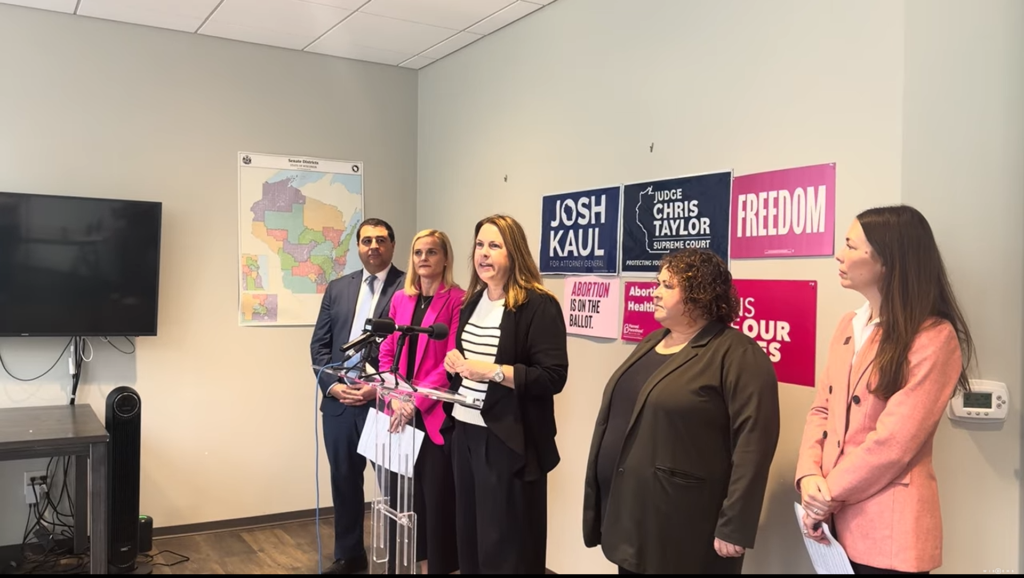
Wisconsin Democrats today called to repeal an 1849 abortion law and remove restrictions to reproductive healthcare access across the state if they secure a trifecta later this fall.

“A Democratic trifecta means we can pass laws that protect reproductive rights rather than restrict them. It means we have an Attorney General who will enforce those protections and fight back when they are challenged. It means a Governor who will not sign legislation that strips women’s autonomy away,” Senate Minority Leader Dianne Hesselbein said at a press conference today marking the fourth anniversary of the U.S. Supreme Court decision overturning the national right to abortion.

AG Josh Kaul said despite the state Supreme Court’s ruling in July 2025 that an 1849 state law that had been interpreted as banning abortion could not be enforced, a new state law could be passed that puts an abortion ban in place.

Kaul also said that if a Republican governor and a Republican majority in the Legislature are elected, abortion access is “very likely” to be restricted in Wisconsin.

“This is a critical election for the future of reproductive freedom in Wisconsin, and we have a real opportunity to continue making progress and moving the state forward this fall,” Kaul said.

Kaul also called out Fond Du Lac district attorney and Republican attorney general candidate Eric Toney for his past comments opposing the lawsuit which resulted in the state court’s ruling. 

A spokesperson for Toney’s campaign referred WisPolitics to a 2025 letter issued after the state court ruling stating his district attorney’s office will follow Wisconsin law and “any future changes to the law should be voted on by Wisconsinites and not decided by politicians in Madison.”

Republican gubernatorial candidate Tom Tiffany’s campaign did not immediately respond to a request for comment.

Despite the overturning of the 1849 law, Rep. Lisa Subeck, D-Madison, pointed to Wisconsin laws requiring a 24-hour waiting period and mandatory ultrasound requirements for abortions and the requirement that medication abortion be done with a physician in person.

Sarah Dobbins, a doctor of nursing practice and public health supervisor, said the U.S. Supreme Court’s ruling overturning Roe v. Wade has “drastically” changed how patients across the state receive care. She said she regularly sees women who travel to states with less abortion restrictions for reproductive healthcare.

“Wisconsinites should not have to travel out of state to receive the care they need. Our healthcare professionals should not be handcuffed by laws written by Republican legislators that prevent them from making decisions that are best for their patients,” Dobbins said.

If a Democratic majority is elected, Subeck said she would work to advance legislation that removes “medically unnecessary and inappropriate restrictions to abortion care.”

Subeck also championed bills that expanded postpartum Medicaid and breast cancer screenings that she said were passed in the face of “Republican opposition” and called out GOP lawmakers for refusing to hold hearings or voting against those bills until “the pressure was too great.”

Also today, U.S. Sen. Tammy Baldwin held a press conference on the Dobbs v. Jackson anniversary with Laurel Marcinkus of Kenosha, who had a life-threatening blood clot in her uterus between 20 and 21 weeks into her pregnancy. 

Baldwin, D-Madison, said in the wake of the ruling, Wisconsinites like Marcinkus were forced to wait until their lives were in danger before they could get help. 

Marcinkus said doctors at the time told her they would need to induce labor to save her life. 

“But due to Wisconsin’s abortion ban at the time, I had to wait hours for care as I bled vaginally and internally. When my labor finally was induced, my daughter survived for two hours after birth before dying in my arms,” she said. 

Marcinkus said she was so sick that it is difficult for her to recall those final moments. She said the then-ban stripped her of her dignity as well as her rights and ability to give her daughter a proper goodbye. 

Marcinkus said she ended up traveling out of state for care when she faced complications again with a later pregnancy due to the possibility of needing abortion care.