By Grace Carlson
Former childcare provider Corrine Hendrickson, of New Glarus, said she spoke with people who work in the disability rights and public education sectors, and they said the legislation “absolutely was not what was needed.”
“Yes, the special education (money) absolutely would have helped, but it was still sum-certain, not sum-sufficient, and the math has been historically bad in the budget and the percentage reimbursement has been significantly less than promised in prior years,” Hendrickson said.
A sum-sufficient appropriation provides whatever funding is needed to cover a program’s costs. A sum-certain appropriation places a limit on how much money is spent on the program during the two-year budget.
When the 2025-27 budget was signed, the reimbursement rate was expected to be 42% in 2025-26 and 45% in 2026-27. But demand for the funding drove that down to 35% in the first year of the budget.
A surplus package included $315 million to boost that funding, and the Legislative Fiscal Bureau projected it would amount to 42.7% in 2025-26 and 50% in 2026-27, though those rates would change depending on how much districts had sought from the state to cover their costs.
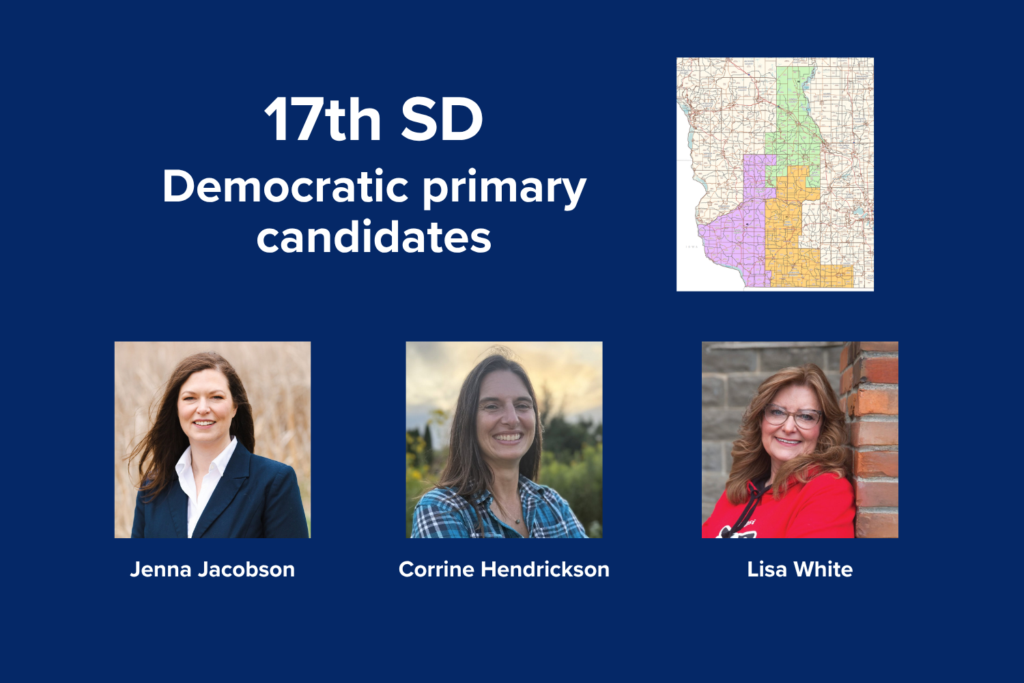
State Rep. Jenna Jacobson, who’s giving up her 50th AD seat to run in the 17th SD, was one of the 10 Assembly Democrats to vote for the surplus package. The Oregon lawmaker noted that it “wasn’t perfect,” but she “kept thinking about the schools in my Assembly district.”
“This surplus deal would have really impacted all the districts in my Assembly district to make sure that they were able to preserve some of those jobs and hopefully get them through until the Legislature can get a more meaningful reform on school funding,” said Jacobson, who’s been endorsed by Senate Dem leaderships.
The third primary candidate, businesswoman Lisa White, of Potosi, said the surplus package had “some Catch-22 elements to it,” and that she liked the “idea of getting more money for special education, even though it didn’t reach all of our goals.”
The 17th SD includes southwestern areas of Wisconsin, including Crawford, Grant, Green, Iowa and Lafayette counties, as well as part of Dane County. Marklein, R-Spring Green, was first elected to the district in 2014 and has served as co-chair of the budget-writing Joint Finance Committee. The Senate seat is one of four considered key in determining control of the chamber this fall.
The Dem primary candidates also disagree about whether a statewide moratorium on new data center development should be implemented. White and Hendrickson both say they believe a moratorium is needed, while Jacobson says it “would be hard to do” because the Legislature isn’t in session until January.
“[In January] is when we would be able to pass meaningful regulation around data centers,” Jacobson said. “I would encourage us to get it together so that we’re ready on day one when the Legislature comes back in and has that meaningful reform.”
However, White “personally helped lead” a moratorium in Cassville and would “like to see” one in place. Hendrickson also is in support of a moratorium so “we can pause and create legislation and guardrails that make the most sense and are the most impactful.”
All of the candidates strongly agree that the Knowles-Nelson Stewardship Program should be renewed, each citing personal experiences for renewing the funding. In addition, they all agree that state and local law enforcement should not have a role in assisting federal immigration enforcement efforts.