By Grace Carlson
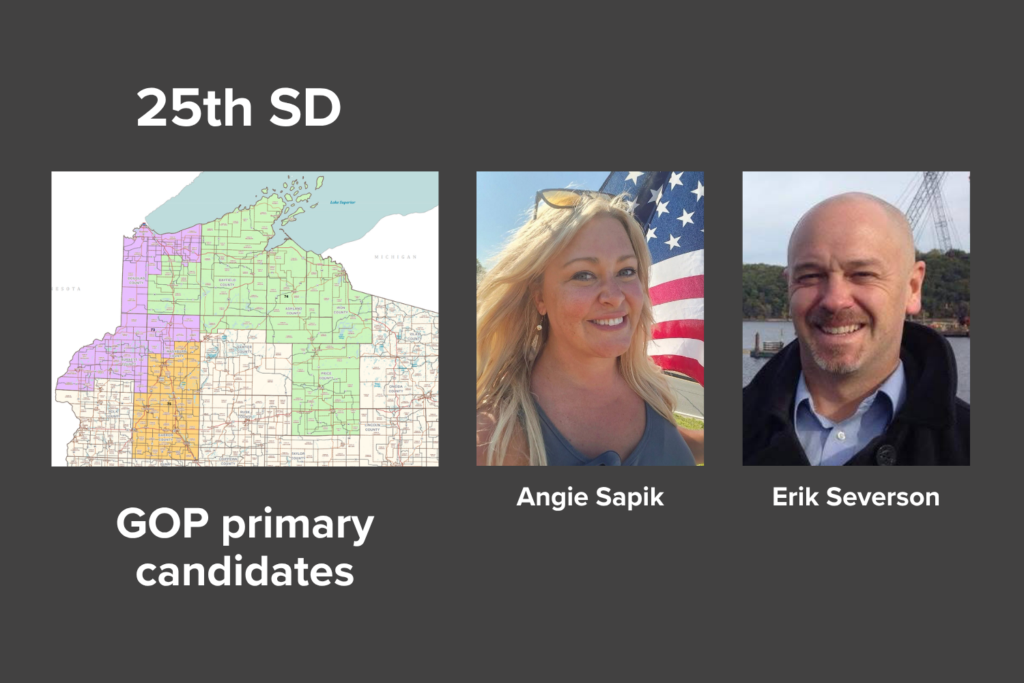
The GOP primary in the northern 25th SD features two former members of the state Assembly – Angie Sapik and Erik Severson – looking for a return to the Capitol.
Sapik represented the 73rd AD for the 2023-24 session, and Severson represented the 28th for two terms after his election in 2010. Now they want to succeed incumbent Sen. Romaine Quinn, of Birchwood, who’s running for the 23rd SD this fall. The 25th SD in northwestern Wisconsin encompasses Ashland, Bayfield, Burnett, Douglas, Iron, Polk, Sawyer and Washburn counties.
Sapik attributed her singular term to the “great gerrymander” in 2024 after the GOP-controlled Legislature approved maps drawn by Dem Gov. Tony Evers after the liberal majority on the state Supreme Court threw out the previous lines as unconstitutional. The new lines made the district she had been elected to significantly more Dem, and she decided not to seek reelection, running for the Douglas County Board instead. She served two years on the board.
In an interview with WisPolitics.com, Sapik called data centers a “necessary evil,” but specified that the location of data centers is important so as to not impede the needs of her constituents, stating a moratorium on development may be needed.
“The idea of a moratorium might not be such a bad idea, but I think we have to be a little more careful with the verbiage and make sure that we’re really articulating exactly what we mean when we talk about what a moratorium actually stands for,” said Sapik, of Lake Nebagamon.
Along similar lines, Severson, an Osceola doctor, said he wouldn’t necessarily support a moratorium on data center development but would support further researching the impacts of data centers, noting, “one of the biggest cons are expensive electricity rates.”
“I would support studying it a lot more,” Severson said. “I wouldn’t say for sure that there should be a moratorium or regulations, we just have to look at what it all is, what is going on with other ones, what the problems are.”
Their split on data centers emerged after the interviews as a significant issue in the race. Spaike today slammed Everson as “bankrolled by data center money.” Her campaign pointed out former GOP state Rep. Adam Jarchow is a lawyer for Metered North, which is pushing a data center project in the district.
Jarchow is also listed as the contact for Keep Polk County Rural, which reported $4,977 in mail opposing Sapik.
Severson said he didn’t know anything about the group or the mailer and was only focused on his campaign and his message.
“I don’t have anything to do with Keep Polk County Rural, and I am not funded in any way by data centers,” he said.
On the Knowles-Nelson Stewardship Program, Sapik expressed tentative support for its renewal, though she’d want additional scrutiny on where the funding goes.
“It’s a little more complicated than just a yes or no answer,” Sapik says. “I would say as long as it’s broken down, and we know where the funding is going, and it makes sense, then I would support it.”
Conversely, Severson would not support the renewal of the stewardship fund as it is currently written, stating it shouldn’t be used for land acquisition.
“We should probably be using the stewardship fund for stewardship of our lands and not necessarily buying new land,” Severson said.
Both candidates agree that they would have voted for the bipartisan surplus bill in May.
The largest parts of the $1.8 billion package included: $870 million for one-time rebates; $315 million to boost reimbursements for special education costs; and $302.5 million for a new school aid beginning in 2026-27 that would drive down the property taxes that districts collect. It would have also eliminated taxes on tips and overtime pay.
Sapik and Severson stressed the importance of giving money back to Wisconsinites. Additionally, both hold similar views that state and local governments should support federal immigration enforcement efforts.