By Grace Carlson
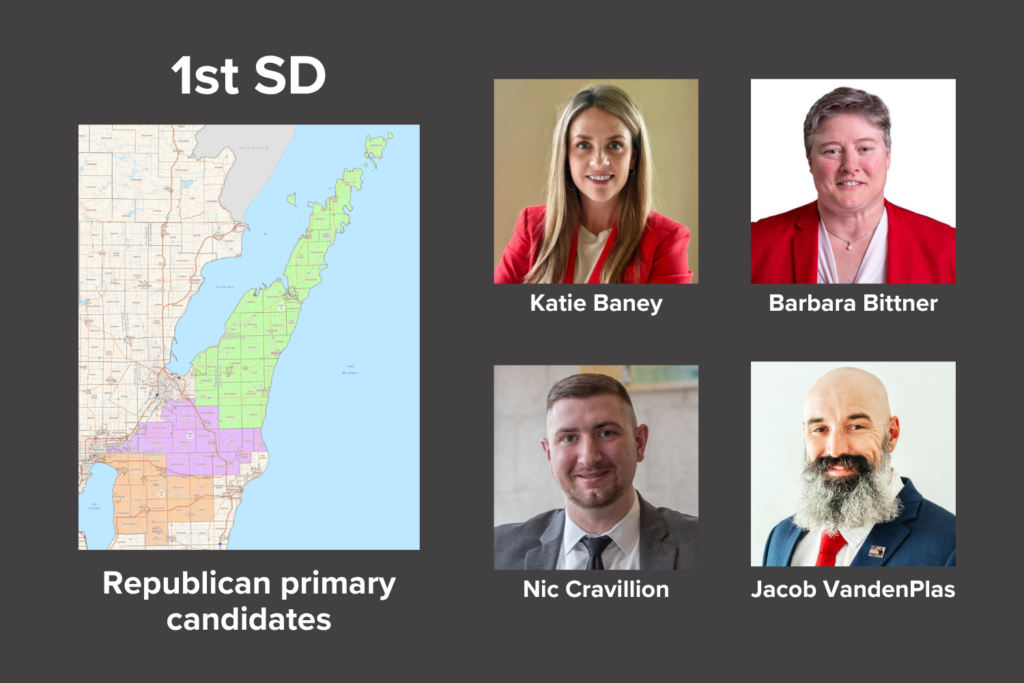
The GOP primary candidates in the 1st SD hold different opinions on a moratorium on data center developments, the failed $1.8 billion surplus package and renewing the Knowles-Nelson Stewardship Program.
The challengers are running for the seat of GOP Sen. André Jacque, who is not seeking reelection.
Katie Baney of De Pere is the managing director of government affairs at Delta Defense, a company providing firearms training and self-defense liability insurance. She hasn’t run for office previously and has worked with a variety of Republican politicians in her career.
She wouldn’t support a moratorium on data center development, because she said she thinks data centers are “going to be a local issue,” noting in an interview with WisPolitics that she is “very skeptical” of them.
“I want to empower locals to make the decisions of whether or not they want one in their area,” Baney said.
Nic Cravillion is an Army combat veteran and a dairy farmer from New Franken. He was the district director for Jacque for six years after being the campaign manager for Sen. Eric Wiemberger in 2020, but he hasn’t run for office before.
He supports a moratorium on data center development based on community support, noting “most communities don’t want the data centers.”
“If a community wanted to be able to do something like that, I’m all in favor of them being able to make those decisions,” Cravillion said in an interview with WisPolitics.
Jacob VandenPlas, a combat veteran and business owner from Oconto Falls, has run unsuccessfully for Congress as a libertarian in 2022 and 2024.
He supports a moratorium on data center development until “we can come to a conclusion on what the proper safety mechanisms need to be in place are,” he said in an interview with WisPolitics.
Barbara Bittner, farmer and business owner from Hilbert, did not respond to WisPolitics interview requests.
The 1st SD encompasses all of Door and Kewaunee counties, and parts of Brown and Calumet counties. Jacque, R-New Franken, was first elected in 2019 and has previously served eight years in the 2nd AD.
The candidates also disagree on whether the expired Knowles-Nelson Stewardship Program should be renewed. Cravillion supports the funding renewal, while Baney and VandenPlas are unsure of their stance.
Cravillion would support the renewal of the fund because of how much the 1st SD “utilizes those funds to the fullest” due to the state parks. But he also notes that other parts of the state don’t see as much benefit.
“There are certain individuals that didn’t see the benefit of Knowles-Nelson, especially if you look up in some of the Northwoods regions. I was told that it just didn’t seem like the communities saw the need for it when they were struggling with so many other issues,” Cravillion said. “I would be in support of finding ways to fund the Knowles-Nelson Stewardship Program.”
Baney said she isn’t sure if the stewardship program should be renewed but that the “DNR has been wildly out of control under Gov. Evers, and so I think we need to rein it in.”
VandenPlas says he “isn’t up to speed” on the fund, but he “loves the idea” of protecting land.
The $1.8 billion bipartisan surplus package also splits the candidates, with Baney and Cravillion unsure of their vote and VandenPlas opposing it. The surplus package failed in a special session in May. It included $870 million for one-time rebates, $315 million to boost reimbursements for special education costs and $302.5 million for a new school aid beginning in 2026-27 that would drive down the property taxes that districts collect, as well as eliminate taxes on tips and overtime pay.
Baney said the package had good elements, such as the repealing of tax on tips, but it also seemed “like sort of a gimmick in the sense that we had lame duck leaders in both the Senate and the governorship negotiate that deal.”
Cravillion “doesn’t know” if he would’ve been a yes vote because he wanted long-term relief and didn’t know everything that was discussed in caucus.
“I personally feel like everything that was addressed in that surplus package was short-term relief,” Cravillion said. “None of it really addressed any of our infrastructure problems that we have in the state of Wisconsin.”
Conversely, VandenPlas would not have voted for the deal and would’ve instead voted to “give all of the money back” to Wisconsinites.
“It’s a tax surplus, and that money needs to go back to the people,” VandenPlas said.
The candidates all agreed that local and state law enforcement should work with federal immigration officials to enforce immigration law.