By Grace Carlson
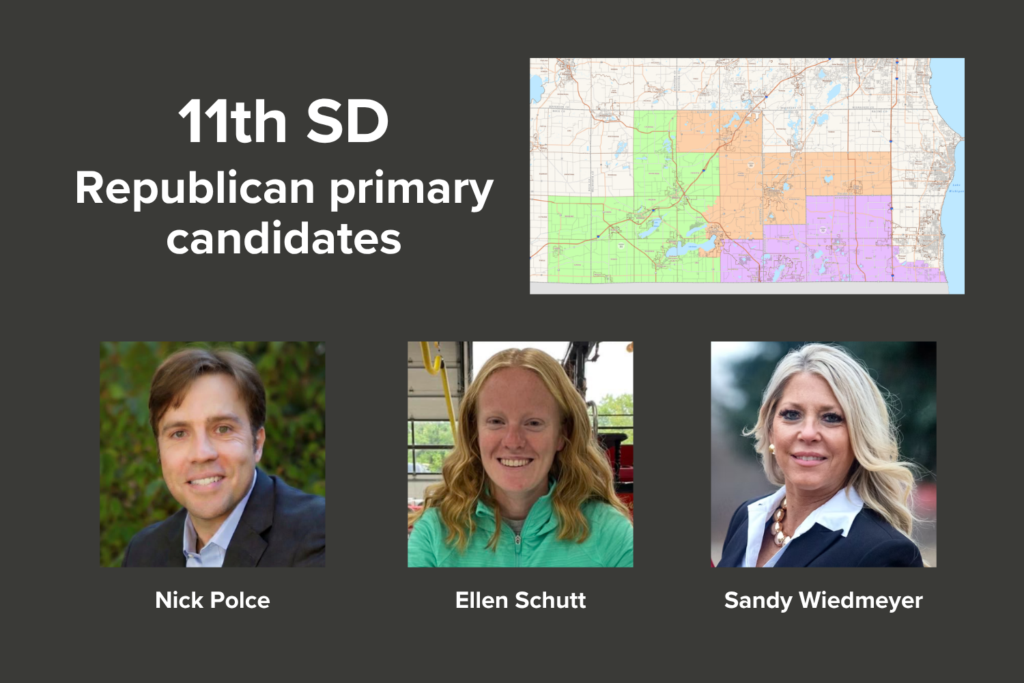
Three GOP primary candidates for the 11th SD are vying to follow in the footsteps of Sen. Steve Nass, R-Whitewater, after he decided not to seek reelection. Nass, who has been in the Legislature since 2014, has been known as one of the most conservative members of the Republican caucus.
The 11th SD makes up most of Walworth and Kenosha counties, and parts of Racine and Rock counties.
The three GOP candidates differ in political experience and on some policy priorities but have all emphasized the need for fiscal responsibility at the state level.
Ellen Schutt of Clinton represented the 31st AD in 2023 and didn’t see reelection after redistricting in 2024. She is the current executive director of the Wisconsin FFA Foundation.
Nick Polce of Walworth County is a U.S. Army Special Forces veteran and owns a car dealership. He suspended a lieutenant governor campaign to run for the 11th SD. He previously ran for Congress in the 2017-2018 cycle for District 1.
Sandy Wiedmeyer of Pleasant Prairie is a former teacher and currently an executive at RecPlex, a municipal recreation facility. This is her first campaign for office after serving as the chair for Kenosha County Republicans and starting the Wisconsin chapter of Moms for Liberty.
Schutt is the only GOP primary candidate supporting a moratorium on new data center development.
“For any new data centers, we should put a pause so that we can protect different local communities across the state,” Schutt said in an interview with WisPolitics.
Polce wouldn’t support a moratorium on data center developments and highlighted the importance of a community-first policy in an interview with WisPolitics.
“I would support a focus on the communities and making sure that they have the decision-making, one,” Polce said. “And the second part of that is, we have a lot of concerns from citizens across the 11th Senate district.”
Wiedmeyer doesn’t support a statewide moratorium and instead thinks “communities should be able to decide how their land is used.”
“I don’t believe in banning data centers altogether,” Wiedmeyer said. “But as far as at the state level, I’d like to see some legislation passed as far as things that protect local government when they’re making those decisions.”
The GOP primary candidates also disagree on if they would have voted for the failed $1.8 billion surplus package, which would have provided one-time tax rebates and funding for special education.
Polce and Schutt said they wouldn’t have voted for the surplus bill. Polce cited a spending problem in Madison as part of the reasoning behind his opposition to the bill.
“One reason is we don’t know if that money is going to be there in a couple years,” Polce said. “Second reason is that if as a legislature we are collecting more money that we spend, all of that money should go back to the taxpayers, and we should also focus on our spending, because we have a spending problem in Madison, not a revenue problem.”
Schutt said “there were some issues with that package,” and she would’ve “really advocated to make some changes to not use one-time funds for long-term ongoing expenses.”
However, Wiedmeyer would have supported the package, even though “it wasn’t everything that I would have wanted, but in a divided government you don’t always get everything you want.”
“I understand some of the points that were made by those that were not supportive because I would have preferred that the relief be permanent rather than one time,” Wiedmeyer said. “But I think that you sometimes take the relief that’s on the table and you come back for more when you can.”
The candidates all agree that conversations about renewal of the Knowles-Nelson Stewardship Program should return next session.
“I think that we should look at the program and make sure it works, and that we’re not adding too much debt to our state, but it’s definitely a useful program that has value and that we should bring back and support conservation efforts in Wisconsin,” Schutt said.
Wiedmeyer wants the stewardship fund to “be renewed at a limited basis,” raising concerns about property taxes.
“I would be open to renewal, but looking at it on a scaled-back version, such as shorter renewal and tighter limits on buying land,” Wiedmeyer said.
Polce said the program was worth “taking a look at” to see if there could be a path to continue it.
All of the candidates agree that federal immigration enforcement efforts should be supported by local and state law enforcement.