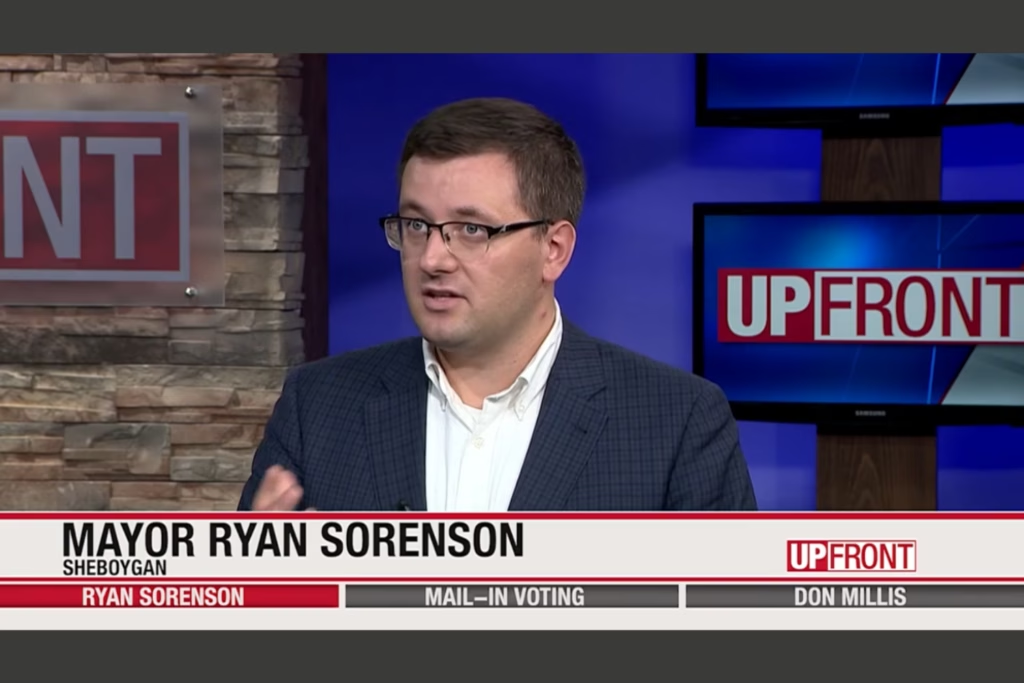
Sheboygan Mayor Ryan Sorenson says the city is pushing to end its contract with Flock, the latest move by municipalities against the company that has assembled a vast network of cameras nationwide that read license plates.
“There’s a lot of concerns when it comes to data management and sharing that data as well,” Sorenson said on WISN 12’s “UpFront,” which is produced in partnership with WisPolitics. “In the world of emerging AI and technologies, we want to make sure that we can work with a vendor and a partner that ensures that we have trust and is not violating our contracts.”
In recent days, the city has covered all 15 of its cameras. The city council is expected to vote after Labor Day to end its contract, a move backed by Sorenson and the city’s police chief.
Sorensen accused the company of violating its contract with the city.
>> WisPolitics is now on the State Affairs network. Get custom keyword notifications, bill tracking and all WisPolitics content. Get the app or access via desktop.
“I can’t get into specifics at this time,” Sorenson said when asked about the specific nature of the alleged violations. “We were making sure that we’re doing our due diligence and reviewing our partnership in the contract terms and conditions that we have, and through that vetting process, we did sadly uncover that there was a violation of the contract on a few ends, so that’s why our city administration and city police department are making the recommendation to terminate that partnership.”
But Sorenson credited Flock cameras and the technology with helping solve crimes in the city.
“I don’t think it was a mistake,” he said. “I think we’re always willing to try new technologies and try to see if things work. Pilot programs are usually great ways to figure out what works and what doesn’t. We’ve had this for a few years. Sadly, they violated our trust and we’re moving on, and we’re going to make sure that we continue to do the good work that our police officers do to keep our community safe.”
In a another segment, Wisconsin Elections Commission Chair Don Millis says commission members will seek “a greater understanding of what occurred” at Milwaukee’s central count, set to be a key point of discussion during today’s commission meeting.
“You can call it an investigation, you can call it an inquiry, whatever,” Millis told “UpFront.” “We have a draft letter to the commission asking them to respond to certain specific requirements or certain requests, and that’s not unusual. That’s something we did in the Green Bay situation when you had duplicate absentee ballots going out.”
Audit logs, instead of absentee ballot results, were uploaded to five flash drives the night of the August primary and Milwaukee’s central count, leading to a delay in results.
“The biggest problem here is that it creates lack of confidence,” Millis said. “And we want to avoid that going forward.”
Commissioners are also expected to discuss the latest surrounding President Trump’s executive order pushing to restrict mail-in voting. A federal judge Thursday temporarily barred the order from taking effect. It would create a state-by-state citizenship list and direct the U.S. Postal Service not to send ballots to anyone not on that list.
“The regulation requires states to upload data to a portal, and that portal doesn’t even exist,” Millis said. “And so no state can comply with this, even though the rule has been in effect for a few days now, and so I think it’s well-intentioned, ill-conceived.”
Millis added the state is back at the status quo.
“According to the judge’s order, the Post Office will deliver ballots from clerks to voters, and if voters choose to return their ballot using the mail, the Post Office will deliver those to the clerks, as they have always done,” he said.
When asked if there’s any scenario the new restrictions could take effect before November, Millis said, “It’s always possible that it could snow in July, but I think if that’s the case, then every state would have problems.”
Marquette University Law School Poll Director Charles Franklin told “UpFront” “there’s a lot left to decide” in the governor’s race after last week’s first post-primary poll.
Among likely voters, Democrat David Crowley led Republican Tom Tiffany 49% to 44%, but among all registered voters the race was tied 44% to 44%.
The poll found roughly 30% of independent voters said they were undecided ahead of the November contest.
“It’s not unusual to see that, so I don’t think that 30 is particularly high, but it certainly shows that among the one group of Wisconsin voters most likely to change their mind from one party to the other, there’s a lot left to decide in this race,” Franklin said. “I think we also see it in that David Crowley is not nearly as well known as Tom Tiffany, so there’s room for a lot of change in his image, either for the better or for the worse as the campaign develops.”
Those polled cited economic concerns as the most important issue ahead of November, specifically 42% saying inflation and the cost of living.
“Republicans are a little more optimistic than Democrats are,” Franklin said. “But even among Republicans, most Republicans think inflation will worsen over the next six months. That’s not the message you want for the number one problem.”
See more from the show.