
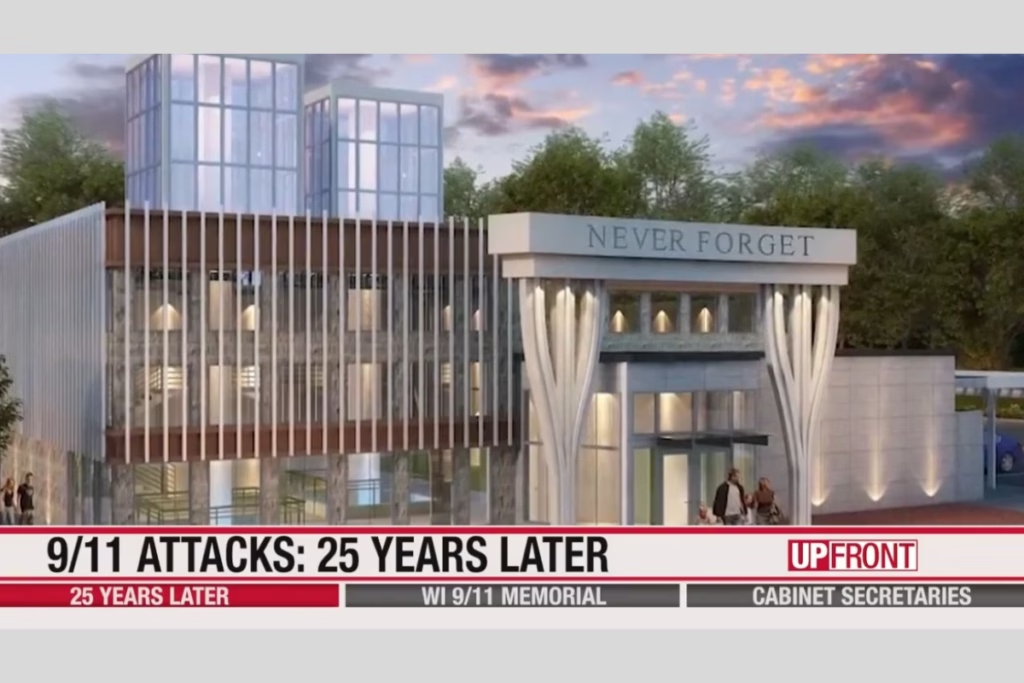
A new $4 million fundraising campaign is underway to dramatically expand the Wisconsin 9/11 Memorial in Kewaskum as the nation paused to remember the Sept. 11 terrorist attacks after 25 years.
Gordy Haberman’s daughter, Andrea, died in the north tower of the World Trade Center. He told WISN 12’s “UpFront,” which is produced in partnership with WisPolitics, that education is “paramount to what this memorial stands for.”
“You have to understand, for our family and the 2,976 other families, every day is 9/11,” he said.
The expansion would include a new 4,500-square-foot museum and community center, designed with imprints of the twin towers and be used as a space to host groups and tours year-round.
>> WisPolitics is now on the State Affairs network. Get custom keyword notifications, bill tracking and all WisPolitics content. Get the app or access via desktop.
“This isn’t about Andrea,” Haberman said. “This is about a day in history that our country was attacked and almost 3,000 people were killed. So it’s a source of education about what happened that day and what a community can do. That’s the way I want it to be after I’m gone. People are going to be coming here and getting educated.”
Organizers hope to raise the funds, through private donations and grants, by the end of 2027.
“Not only do we have something that people can come to, and they can remember what happened during 9/11 and the lessons that we learned during that time, but also a chance to inspire,” said Mark Bazata, president of the Wisconsin 9/11 Memorial. “It’s a lot of money, but I think it’s going to be such a great experience for kids, for first responders, for community members who come here.”
Former Gov. Tommy Thompson, who was Health and Human Services secretary on 9/11, was the first cabinet secretary to arrive at Ground Zero.
“I can’t tell you how surreal it was,” Thompson told “UpFront. “And then we went out to the medical examiner’s office. That was probably the most trying thing I’ve even gone through. People who had lost loved ones kept putting posters up, the pictures of their sons and daughters and husbands and wives and relatives, seeing if anybody had seen them, and they were bringing combs out and hairbrushes and false teeth, anything they thought could help identify any body parts so that they could identify it.”
Thompson also recalled the hours after the attacks when the cabinet was evacuated to an undisclosed location at the time, and Thompson crafted a plan to escape back to Washington.
“I did not want to go,” Thompson said. “I fought it because I knew I had work to do. I didn’t want to go, but they absolutely insisted that I leave because the vice president didn’t know what else might happen. What they were afraid of is the continuity of government. They were afraid that if there were people deliberately trying to harm America, they would probably try and take out the cabinet.”
Thompson said he checked in where he was told to go, but walked out the back door and came back to the office.
“Yes. Insubordination. Call it what it is,” Thompson said. “I was supposed to stay, but I knew I had to be back. I had work to do, and I did not want to shirk my responsibility to America. I was with the president that night, so they couldn’t have been too mad.”
Outagamie Co. Executive Tom Nelson is out with a new book detailing the legacy of the Green Bay Packers and the uniqueness of the team’s structure.
“The reason I wrote this is I wanted to answer a question that perhaps crossed people’s mind from time to time, which is exactly why is it that the Packers are so popular?” Nelson told “UpFront.” “What is the reason why there’s such a special bond? And it’s not simply they’re owned by the fans. They have a winning record. They’re one of the oldest teams. It’s something a little bit more to that story.”
The book is titled “The Green and Gold Standard: A People’s History of the Green Bay Packers.”
“I did about two dozen interviews,” Nelson said. “I went through all the newspaper articles from the major milestones. I layered it against news of the day, and so it wasn’t simply in 1929 they won a championship. It was 1929, which was the Great Depression, and this is how things were like in Green Bay all the way up to Curly Lambeau leaving in 1950, the same month that President Truman announced the hydrogen bomb project. So it’s important to take all of this into the context of what happened with the Packers.”
Nelson said putting team developments into context with the news of the day provides a better appreciation of the challenges the team faced.
“They went through receivership,” Nelson said. “They went through bankruptcy, they went through attempted hostile takeovers, and this little tiny team from this little tiny town kept on bouncing back up and going toe-to-toe and beating big teams from big cities.”
See more from the show.