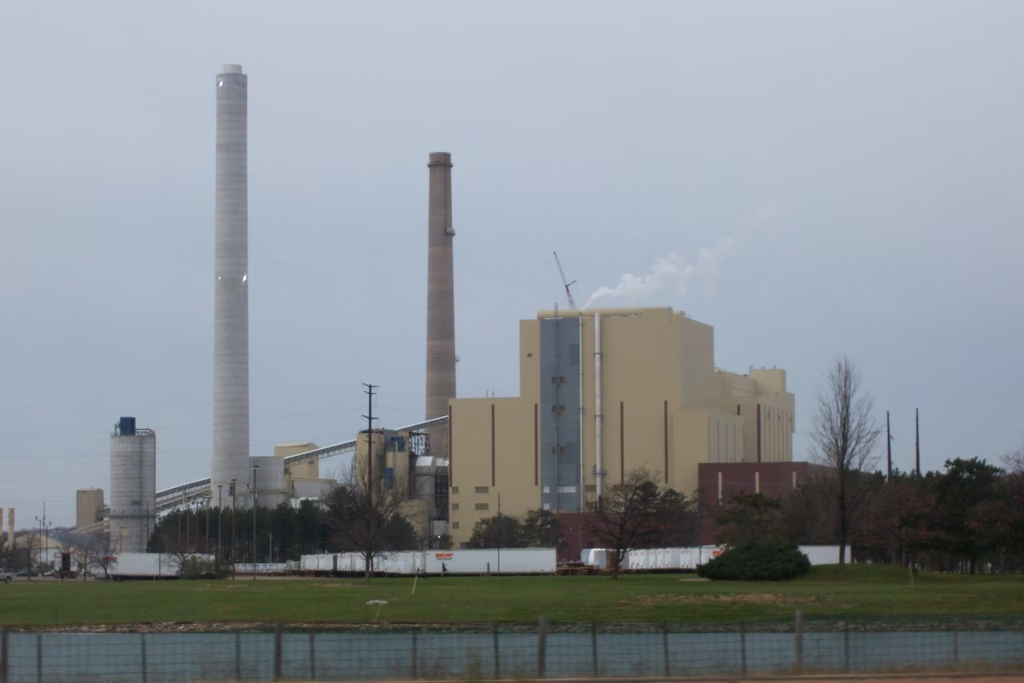
The Department of Natural Resources urged the state’s highest court to reject an environmental group’s effort to overturn a permit for several natural gas-fired turbines.
The DNR wants the Supreme Court to reverse a 2025 appeals court decision ordering the state agency to reopen an air pollution permit it granted to We Energies and Wisconsin Public Service Corporation for seven new turbines at the Wausau-area Weston Generating Station.
The Sierra Club challenged the permit in Dane County Circuit Court in 2022, arguing the permit was improperly issued; the circuit court sided with the DNR.
At the heart of its challenge and yesterday’s arguments is whether the protocol the agency uses to calculate background pollution at a site should be considered an unpromulgated rule.
>> WisPolitics is now on the State Affairs network. Get custom keyword notifications, bill tracking and all WisPolitics content. Get the app or access via desktop.
DNR did not conduct site-specific measurements of background pollution at the Weston site when it issued its permit but used a protocol to estimate whether the proposed gas turbines would exceed air quality standards.
The Sierra Club is arguing the permit should be remanded because the agency’s method for calculating pollution meets the standard to be a rule, including holding the force of law, but did not go through proper rulemaking procedures.
It’s asked for a new determination of the plant’s impacts on air quality based on site-specific air pollution measurements.
The utilities in a 2024 amicus brief argued that conducting site-specific air pollution measurements would require an extended shutdown of the Weston generators and “leave a 128 MW hole in the grid.”
DNR attorney Gabe Johnson-Karp argued yesterday that how the state agency estimated background pollution was just one part of a calculation the agency made to determine if an applicant would exceed national air quality standards.
“DNR would never hold up the memo and point to the memo and say your permit is denied because of background concentrations, your permit is denied because of these measurements,” Johnson-Karp said.
But Sierra Club attorney David Bender argued the pollution calculation still held the force of law even if it wasn’t the final decision-making factor.
He compared the pollution calculation method to rules of evidence in a court.
“It’s not just the final judgment entered by the court after a jury verdict that has the force of law. Procedures that dictate what comes in and what gets considered as part of the process also have the force of law, and that’s what the protocol is,” Bender said.