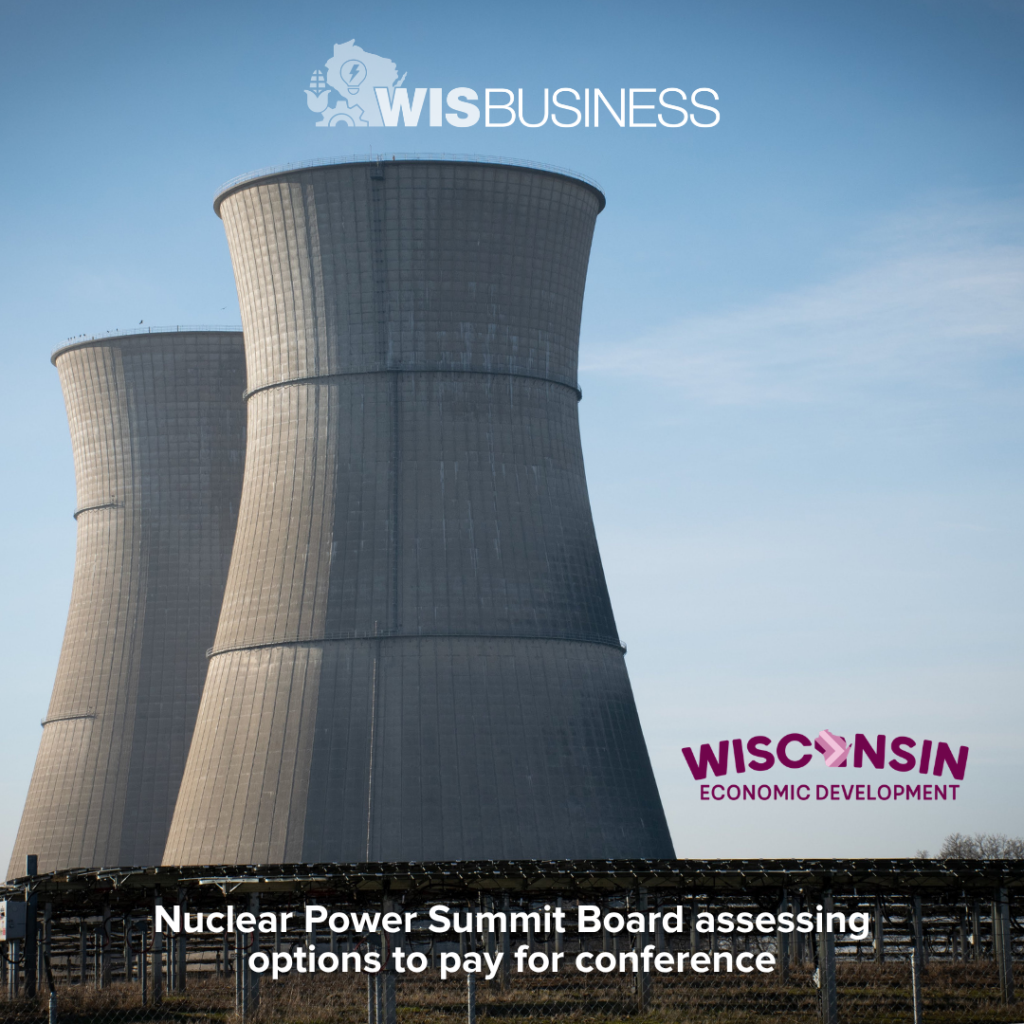
Members of the state’s Nuclear Power Summit Board are assessing options to cover the cost of a planned industry event, which could go as high as $900,000 under the most expensive estimate from agency staff.
“We don’t have anything in our budget allocated for this,” WEDC Secretary and CEO John Miller said yesterday during a meeting of the board, pointing to registration fees, sponsorships and the potential for state budget funding as possible avenues for supporting the summit.
The board was created last year through legislation signed into law by Gov. Tony Evers alongside a bill directing the state Public Service Commission to conduct a nuclear power siting study. It’s tasked with organizing, hosting and promoting a nuclear summit in Madison, aimed at educating attendees, advancing nuclear power and fusion energy technology and showcasing the state’s nuclear sector.
The two-day conference is envisioned as a 500-person summit, representing industry, government, higher education, utilities, investors and economic development groups. Along with keynotes and general sessions, staff described plans for an innovation and technology expo and manufacturing tours for visitors to the state.
Sara Beuthien, senior events director for the Wisconsin Economic Development Corp., yesterday shared an outline for three event concepts at various price points, as well as details on possible dates in 2028 for the summit.
The lowest-tier option was estimated to cost between $300,000 and $400,000, while the middle-tier option ranged from $435,000 to $570,000, including upgrades such as entertainment, a venue that’s distinctive to Madison, “high-profile” speakers and an interactive expo hall.
Meanwhile, the highest-tier went from $630,000 to $900,000, and would include nationally recognized speakers, “premium” production and an immersive, themed experience.
Beuthien noted these estimates represent gross expenses, so any associated revenues tied to the summit could help offset costs. Options include tiered pricing for registrations, sponsorship dollars and exhibitors paying to take part.
Looking ahead to next year’s budget process, Miller said: “I assume we will make an attempt for some money” and asked for input from lawmakers on the board. Rep. Angela Stroud, D-Ashland, referenced a fiscal note attached to the original legislation that had $250,000 listed for the summit.
“Could we, those of us that voted for it, make a strong case for a budget line to that effect and then fundraising make up the rest, or something like that?” she said. “That seems reasonable and in-line with the assumptions that went into voting for the bill.”
Rep. David Steffen, R-Howard, said he agreed with Stroud and called on lawmakers on the board to work together to get that amount in the state budget for the event. The other two are Sens. Julian Bradley, R-New Berlin, and Melissa Ratcliff, D-Cottage Grove.
“Having all four of us as a part of that should be helpful in that regard,” Steffen said.
Ratcliff spoke in favor of allocating state funding to the summit, arguing “this is a way to have economic development” and attract businesses to Wisconsin communities. She called for targeting the middle-tier or highest cost for the event.
“We’re looking at a really important utility, nuclear fusion, for our state to be the leader in this,” she said. “So going small for less dollars, I think is not going to really show what we’re aiming to do here.”
But Bradley took a more reserved stance, echoing Steffen’s earlier remarks that “there’s no guarantees” and stressed the financial challenges the Legislature will be facing going into the next budget process. The state’s estimated budget surplus is about $3 billion.
“I would strongly caution us against counting on state funds,” he said. “Could it happen? You know, I guess that’s possible. But I would take a very cautious approach to expecting any funding coming from the state.”
The board meets next on Dec. 2, when WEDC staff will provide a report on possible dates for the conference and potential venues, as well as conflicts or overlap with other conferences happening at the same time. From there, the board will go further on financing and content, Miller said.
“Well the good thing is, we have 18 months,” he said. “But 18 months goes quickly.”